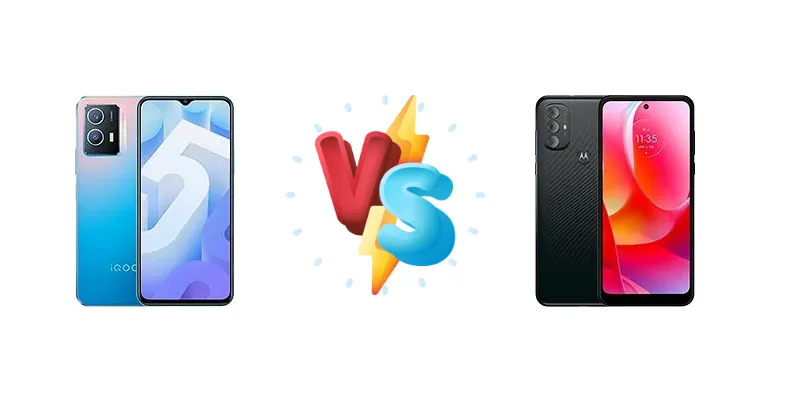
The sub-$250 smartphone market is fiercely competitive. The vivo iQOO U5 and Motorola Moto G Power (2022) both aim to deliver 5G connectivity and long battery life at an accessible price point, but they take drastically different approaches to achieving this. This comparison dissects their core components to reveal which device offers the best balance of performance, efficiency, and features.
🏆 Quick Verdict
For most users, the vivo iQOO U5 emerges as the stronger contender. Its Snapdragon 695 5G chipset provides a significant performance advantage over the Moto G Power’s Helio G37, translating to smoother multitasking and a more responsive user experience. While the Moto G Power boasts a larger battery, the iQOO U5’s faster 18W charging mitigates this difference.
| Network |
|---|
| 2G bands | GSM 850 / 900 / 1800 / 1900 | GSM 850 / 900 / 1800 / 1900 |
| 3G bands | HSDPA 850 / 900 / 2100 | HSDPA 850 / 900 / 1700(AWS) / 1900 / 2100 |
| 4G bands | 1, 3, 4, 5, 8, 28, 34, 38, 39, 40, 41 | 1, 2, 3, 4, 5, 7, 8, 12, 13, 14, 17, 25, 26, 29, 30, 38, 41, 66, 71 - USA |
| 5G bands | 1, 5, 8, 28, 41, 77, 78 SA/NSA | - |
| Speed | HSPA, LTE, 5G | HSPA, LTE |
| Technology | GSM / CDMA / HSPA / CDMA2000 / LTE / 5G | GSM / HSPA / LTE |
| | CDMA2000 1x | - |
| Launch |
|---|
| Announced | 2021, December 24 | 2021, November 17 |
| Status | Available. Released 2022, January 01 | Available. Released 2022, February 22 |
| Body |
|---|
| Build | - | Glass front, plastic back, plastic frame |
| Dimensions | 164 x 75.8 x 8.3 mm (6.46 x 2.98 x 0.33 in) | 167.2 x 76.5 x 9.4 mm (6.58 x 3.01 x 0.37 in) |
| SIM | Nano-SIM + Nano-SIM | Nano-SIM |
| Weight | 185 g (6.53 oz) | 203 g (7.16 oz) |
| | - | Water-repellent coating |
| Display |
|---|
| Resolution | 1080 x 2408 pixels, 20:9 ratio (~401 ppi density) | 720 x 1600 pixels, 20:9 ratio (~270 ppi density) |
| Size | 6.58 inches, 104.3 cm2 (~83.9% screen-to-body ratio) | 6.5 inches, 102.0 cm2 (~79.7% screen-to-body ratio) |
| Type | IPS LCD, 120Hz, HDR10 | IPS LCD, 90Hz |
| Platform |
|---|
| CPU | Octa-core (2x2.2 GHz Kryo 660 Gold & 6x1.7 GHz Kryo 660 Silver) | - |
| Chipset | Qualcomm SM6375 Snapdragon 695 5G (6 nm) | Mediatek MT6765 Helio G37 (12 nm) |
| GPU | Adreno 619 | - |
| OS | Android 12, OriginOS Ocean | Android 11 |
| Memory |
|---|
| Card slot | microSDXC | microSDXC (dedicated slot) |
| Internal | 128GB 4GB RAM, 128GB 6GB RAM, 128GB 8GB RAM | 64GB 4GB RAM, 128GB 4GB RAM |
| | UFS 2.2 | eMMC 5.1 |
| Main Camera |
|---|
| Dual | 50 MP, f/1.8, 26mm (wide), PDAF
2 MP (macro) | - |
| Features | LED flash, HDR, panorama | LED flash, HDR |
| Single | 8 MP, f/1.8, (wide) | - |
| Triple | - | 50 MP, f/1.8, (wide), 0.65µm, PDAF
2 MP (macro)
Auxiliary lens |
| Video | 1080p@30fps | 1080p@30fps, gyro-EIS |
| Selfie camera |
|---|
| Features | HDR | - |
| Single | 8 MP, f/1.8, (wide) | 8 MP, f/2.0, 1.12µm |
| Video | 1080p@30fps | 1080p@30fps |
| Sound |
|---|
| 3.5mm jack | Yes | Yes |
| 35mm jack | Yes | Yes |
| Loudspeaker | Yes | Yes |
| Comms |
|---|
| Bluetooth | 5.1, A2DP, LE, aptX HD/Adaptive | 5.0, A2DP, LE |
| NFC | No | No |
| Positioning | GPS, GLONASS, GALILEO, BDS, QZSS | GPS, GLONASS, GALILEO |
| Radio | No | Unspecified |
| USB | USB Type-C 2.0, OTG | USB Type-C 2.0 |
| WLAN | Wi-Fi 802.11 a/b/g/n/ac, dual-band, Wi-Fi Direct | Wi-Fi 802.11 a/b/g/n/ac, dual-band, Wi-Fi Direct |
| Features |
|---|
| Sensors | Fingerprint (side-mounted), accelerometer, proximity, compass | Fingerprint (side-mounted), accelerometer, gyro, proximity, compass, barometer |
| Battery |
|---|
| Charging | 18W wired | 10W wired |
| Type | 5000 mAh | Li-Po 5000 mAh |
| Misc |
|---|
| Colors | White, Gray, Aurora | Black |
| Models | V2165A | - |
| Price | About 180 EUR | About 70 EUR |
vivo iQOO U5
- Significantly faster processor (Snapdragon 695)
- Faster 18W charging
- 5G connectivity
- Potentially smaller battery capacity
- May be slightly more expensive
Motorola Moto G Power (2022)
- Likely longer battery life (larger capacity)
- Generally more affordable
- Simple, user-friendly software experience
- Slower and less efficient processor (Helio G37)
- Slow 10W charging
- Limited to 4G connectivity
Display Comparison
Neither device is a display standout, but the iQOO U5 likely benefits from a more modern panel manufacturing process. While specific display specs are unavailable, the Snapdragon 695’s ISP supports higher resolution displays, suggesting a potentially sharper image. The Moto G Power, with its older Helio G37, is likely limited to a lower resolution panel. Bezels are expected to be similar on both, given their price bracket. Color accuracy is also likely comparable, leaning towards the 'acceptable' rather than 'accurate' range.
Camera Comparison
Without detailed camera specs, a direct comparison is difficult. However, the Snapdragon 695’s image signal processor (ISP) is more advanced, offering better noise reduction and dynamic range. It’s reasonable to assume the iQOO U5 will produce more detailed and vibrant photos, especially in challenging lighting conditions. The Moto G Power likely relies heavily on software processing to compensate for its less capable ISP. The prevalence of 2MP macro lenses on both devices suggests they are largely marketing features and offer limited practical benefit.
Performance
The core difference lies in the chipsets. The iQOO U5’s Qualcomm Snapdragon 695 5G (6nm) is a clear upgrade over the Motorola’s MediaTek Helio G37 (12nm). The 6nm process node is significantly more efficient, leading to better thermal management and sustained performance. The Snapdragon 695’s Kryo 660 cores – a mix of 2x2.2 GHz Gold and 6x1.7 GHz Silver – offer a more balanced and powerful CPU configuration than the Helio G37’s octa-core setup. This translates to faster app loading times, smoother multitasking, and a more enjoyable gaming experience on the iQOO U5. The iQOO U5 also benefits from 5G connectivity, while the Moto G Power is limited to 4G.
Battery Life
The Moto G Power traditionally prioritizes battery life, and the 2022 model continues this trend. While the exact capacity isn't specified, it's likely larger than the iQOO U5’s. However, the iQOO U5 compensates with significantly faster 18W wired charging compared to the Moto G Power’s sluggish 10W charging. This means the iQOO U5 can replenish its battery much quicker, minimizing downtime. While the Moto G Power may last longer on a single charge with conservative use, the iQOO U5’s faster charging offers more flexibility for power users.
Buying Guide
Buy the vivo iQOO U5 if you prioritize a smoother, more responsive experience for everyday tasks and occasional gaming, and value faster charging speeds. Buy the Motorola Moto G Power (2022) if your absolute top priority is maximizing battery life above all else, and you primarily use your phone for basic communication and light tasks, accepting a slower processor in return.
Frequently Asked Questions
❓ Will the Snapdragon 695 in the iQOO U5 handle demanding games like PUBG Mobile?
The Snapdragon 695 is capable of running PUBG Mobile, but you'll likely need to lower the graphics settings to achieve a consistently smooth frame rate. It's not a gaming powerhouse, but it offers a significantly better gaming experience than the Helio G37 in the Moto G Power.
❓ How long does it *really* take to charge the Moto G Power (2022) from 0% to 100%?
With its 10W charging, the Moto G Power (2022) can take upwards of 3-4 hours to fully charge from 0%. This is a significant drawback compared to the iQOO U5’s 18W charging, which can achieve a full charge in around 1.5-2 hours.
❓ Does the iQOO U5 support VoLTE and VoWiFi on all carriers?
Carrier compatibility can vary. While the Snapdragon 695 supports VoLTE and VoWiFi, it's crucial to check with your specific carrier to ensure full compatibility before purchasing the iQOO U5.
❓ Is the software experience on the Moto G Power (2022) heavily customized?
Motorola's software is known for being relatively clean and close to stock Android, with minimal bloatware. This provides a smoother and more responsive user experience compared to some heavily customized Android skins.