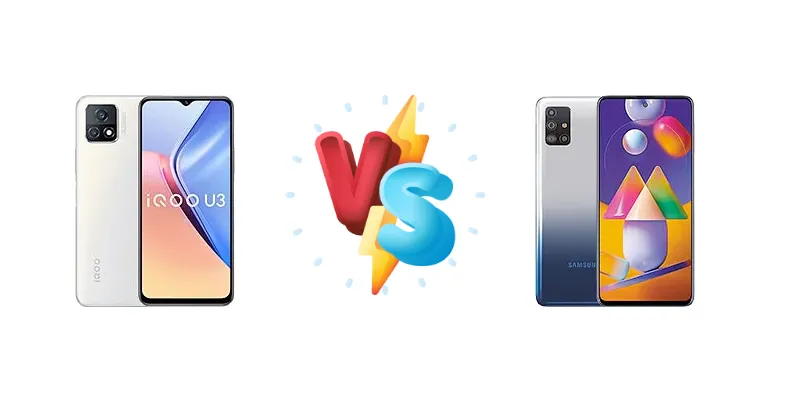
The vivo iQOO U3 and Samsung Galaxy M31s represent compelling options in the competitive mid-range smartphone market. The iQOO U3, powered by the Mediatek Dimensity 800U, aims for a balance of 5G connectivity and performance. Conversely, the Galaxy M31s leverages Samsung’s Exynos 9611, prioritizing battery life and a more established brand ecosystem. This comparison dissects their key differences to help you choose the right device.
🏆 Quick Verdict
For most users, the iQOO U3 emerges as the stronger contender. Its Dimensity 800U chipset offers a noticeable performance advantage over the Exynos 9611, particularly in demanding tasks and gaming. While the M31s boasts faster 25W charging, the U3’s superior processing power makes it the better all-around choice.
| Network |
|---|
| 2G bands | GSM 850 / 900 / 1800 / 1900 | GSM 850 / 900 / 1800 / 1900 |
| 3G bands | HSDPA 850 / 900 / 1700(AWS) / 2100 | HSDPA 850 / 900 / 1700(AWS) / 1900 / 2100 |
| 4G bands | 1, 3, 4, 5, 8, 28, 34, 38, 39, 40, 41 | 1, 2, 3, 4, 5, 7, 8, 12, 17, 20, 26, 28, 38, 40, 41, 66 |
| 5G bands | 1, 28, 41, 77, 78 SA/NSA | - |
| EDGE | No | - |
| GPRS | Class 10 | - |
| Speed | HSPA, LTE, 5G | HSPA, LTE |
| Technology | GSM / CDMA / HSPA / LTE / 5G | GSM / HSPA / LTE |
| | CDMA 800 | - |
| Launch |
|---|
| Announced | 2020, December 14. Released 2020, December 18 | 2020, July 30. Released 2020, August 06 |
| Status | Discontinued | Discontinued |
| Body |
|---|
| Dimensions | 164.2 x 75.4 x 8.4 mm (6.46 x 2.97 x 0.33 in) | 159.3 x 74.4 x 9.3 mm (6.27 x 2.93 x 0.37 in) |
| Keyboard | - | QWERTY |
| SIM | Nano-SIM + Nano-SIM | · Nano-SIM· Nano-SIM + Nano-SIM |
| Weight | 185.5 g (6.56 oz) | 203 g (7.16 oz) |
| Display |
|---|
| Protection | - | Corning Gorilla Glass 3 |
| Resolution | 1080 x 2408 pixels, 20:9 ratio (~401 ppi density) | 1080 x 2400 pixels, 20:9 ratio (~405 ppi density) |
| Size | 6.58 inches, 104.3 cm2 (~84.2% screen-to-body ratio) | 6.5 inches, 102.0 cm2 (~86.1% screen-to-body ratio) |
| Type | IPS LCD, 90Hz, HDR10, 460 nits (typ) | Super AMOLED |
| Platform |
|---|
| CPU | Octa-core (2x2.4 GHz Cortex-A76 & 6x2.0 GHz Cortex-A55) | Octa-core (4x2.3 GHz Cortex-A73 & 4x1.7 GHz Cortex-A53) |
| Chipset | Mediatek Dimensity 800U (7 nm) | Exynos 9611 (10 nm) |
| GPU | Mali-G57 MC3 | Mali-G72 MP3 |
| OS | Android 10, IQOO UI 1.5 | Android 10, upgradable to Android 12, One UI 4.1 |
| Memory |
|---|
| Call records | Yes | - |
| Card slot | No | microSDXC (dedicated slot) |
| Internal | 64GB 6GB RAM, 128GB 6GB RAM, 128GB 8GB RAM | 128GB 6GB RAM, 128GB 8GB RAM |
| Phonebook | Yes | - |
| | UFS 2.2 | - |
| Main Camera |
|---|
| Dual | 48 MP, f/1.8, 25mm (wide), 1/2.0", 0.8µm, PDAF
Auxiliary lens | - |
| Features | LED flash, HDR, panorama | LED flash, panorama, HDR |
| Single | 1.3 MP | 3.15 MP, AF |
| Triple | - | 64 MP, f/1.8, 26mm (wide), 1/1.73", 0.8µm, PDAF
12 MP, f/2.2, 123˚ (ultrawide)
5 MP (macro)
Auxiliary lens |
| Video | 4K@30fps, 1080p@30fps | 4K@30fps, 1080p@30fps, gyro-EIS |
| Selfie camera |
|---|
| Features | HDR | HDR |
| Single | 8 MP, f/2.0, (wide) | 32 MP, f/2.2, 26mm (wide), 1/2.8", 0.8µm |
| Video | 1080p@30fps | 4K@30fps, 1080p@30fps |
| | - | No |
| Sound |
|---|
| 3.5mm jack | Yes | Yes |
| 35mm jack | Yes | Yes |
| Loudspeaker | Yes | Yes |
| Comms |
|---|
| Bluetooth | 5.1, A2DP, LE, aptX HD | 5.0, A2DP, LE |
| NFC | No | Yes (market/region dependent) |
| Positioning | GPS, GLONASS, BDS, GALILEO | GPS, GLONASS, GALILEO, BDS |
| Radio | No | FM radio, RDS, recording |
| USB | USB Type-C 2.0, OTG | USB Type-C 2.0, OTG |
| WLAN | Wi-Fi 802.11 a/b/g/n/ac, dual-band, Wi-Fi Direct | Wi-Fi 802.11 a/b/g/n/ac, dual-band, Wi-Fi Direct |
| Features |
|---|
| Games | Yes | - |
| Java | No | - |
| Messaging | SMS, MMS, IM | - |
| Sensors | Fingerprint (side-mounted), accelerometer, gyro, proximity, compass | Fingerprint (side-mounted), accelerometer, gyro, compass |
| | - | MP4/H.264 player
MP3/WAV/eAAC+ player
Organizer
Voice memo
Predictive text input |
| Battery |
|---|
| Charging | 18W wired | 25W wired
4.5W reverse wired |
| Stand-by | Up to 600 h | Up to 288 h |
| Talk time | Up to 5 h | Up to 7 h |
| Type | 5000 mAh | Li-Po 6000 mAh |
| Misc |
|---|
| Colors | White, Gray, Aurora | Mirage Black, Mirage Blue |
| Models | V2061A | SM-M317F, SM-M317F/DS |
| Price | About 200 EUR | About 300 EUR |
| SAR | - | 1.38 W/kg (head) |
vivo iQOO U3
- Superior processing power with Dimensity 800U
- More efficient 7nm chipset for better battery life under load
- 5G connectivity for faster data speeds
- Slower 18W charging compared to the M31s
- Less established brand recognition than Samsung
Samsung Galaxy M31s
- Faster 25W wired charging
- 4.5W reverse wired charging for accessories
- Samsung’s One UI software experience
- Less powerful Exynos 9611 chipset
- 10nm process less efficient than the U3’s 7nm process
Display Comparison
Neither device boasts a particularly standout display. While specific panel details (like peak brightness or color gamut coverage) are absent, the focus here is on the underlying processors. The display quality is likely similar, geared towards a comfortable viewing experience rather than color accuracy for professional work. Bezels are expected to be moderate on both, typical for this price segment.
Camera Comparison
Without detailed camera specs beyond the presence of cameras, a direct comparison is difficult. However, the chipset plays a role in image processing. The Dimensity 800U’s image signal processor (ISP) is likely more advanced, potentially leading to better dynamic range and noise reduction in photos and videos. The M31s may rely more on software processing to compensate for its older chipset. The presence of a 2MP macro camera on the M31s is unlikely to significantly impact image quality, serving more as a marketing feature than a practical tool.
Performance
The core difference lies in the chipsets. The iQOO U3’s Mediatek Dimensity 800U, fabricated on a 7nm process, offers a significant architectural advantage over the Samsung Galaxy M31s’ Exynos 9611 (10nm). The Dimensity 800U’s Cortex-A76 cores, clocked at 2.4 GHz, are more efficient and powerful than the Exynos 9611’s Cortex-A73 cores at 2.3 GHz. This translates to faster app loading times, smoother multitasking, and improved gaming performance on the iQOO U3. The 7nm node also contributes to better thermal efficiency, reducing the likelihood of throttling during sustained workloads. The U3's CPU architecture is a generation newer, offering a clear advantage.
Battery Life
The Galaxy M31s’ 25W wired charging is a clear advantage over the iQOO U3’s 18W charging. This means faster top-ups, reducing downtime. However, the Dimensity 800U’s superior efficiency may offset some of the M31s’ charging advantage. While battery capacity isn't specified, the Exynos 9611 is known to be less power-efficient, potentially requiring more frequent charging despite a potentially larger battery. The M31s also includes 4.5W reverse wired charging, a niche feature for topping up accessories.
Buying Guide
Buy the vivo iQOO U3 if you prioritize smooth performance for gaming and multitasking, and require 5G connectivity. It’s ideal for users who frequently stream video, play mobile games, or need a responsive device for productivity. Buy the Samsung Galaxy M31s if you value extended battery life and prefer the Samsung One UI experience. It’s a solid choice for users who primarily browse the web, use social media, and make occasional calls, and don't need the latest in processing power.
Frequently Asked Questions
❓ Does the Exynos 9611 in the Galaxy M31s overheat during prolonged gaming sessions?
The Exynos 9611 is known to generate more heat than the Dimensity 800U, especially under sustained load. While it won't necessarily become unusable, users may experience noticeable throttling and reduced frame rates during extended gaming sessions. The iQOO U3’s 7nm process and more efficient CPU architecture mitigate this issue.
❓ Is the 2MP macro camera on the Galaxy M31s actually useful for taking detailed close-up photos?
Generally, 2MP macro cameras on budget phones offer limited detail and image quality. The small sensor size and fixed focus often result in soft, blurry images. It's more of a marketing feature than a genuinely useful tool for serious macro photography. The iQOO U3's image processing, powered by the Dimensity 800U, is likely to produce more usable close-up shots even without a dedicated macro lens.
❓ Can the iQOO U3 reliably maintain 60fps in demanding games like PUBG Mobile?
The Dimensity 800U is capable of delivering a smooth gaming experience in PUBG Mobile. While achieving a consistent 60fps depends on the game settings (graphics quality and frame rate settings), the U3 should be able to maintain playable frame rates at medium to high settings. The Exynos 9611 in the M31s will likely require lower settings to achieve similar performance.