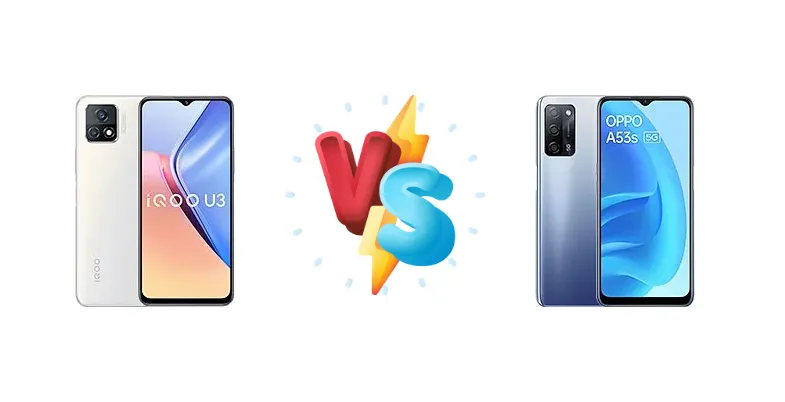
Both the vivo iQOO U3 and Oppo A53s 5G target the competitive budget 5G market, but they take slightly different approaches. The iQOO U3 prioritizes raw processing power with the Dimensity 800U, while the A53s 5G aims for a balance of features at an even more accessible price point, utilizing the Dimensity 700. This comparison dissects the key differences to help you choose the right device.
🏆 Quick Verdict
For users prioritizing performance and faster charging, the iQOO U3 is the clear winner. Its Dimensity 800U chipset offers a noticeable performance edge, and the 18W charging is significantly faster than the A53s 5G’s 10W. However, the A53s 5G remains a compelling option for those on a tighter budget.
| Network |
|---|
| 2G bands | GSM 850 / 900 / 1800 / 1900 | GSM 850 / 900 / 1800 / 1900 |
| 3G bands | HSDPA 850 / 900 / 1700(AWS) / 2100 | HSDPA 800 / 850 / 900 / 2100 |
| 4G bands | 1, 3, 4, 5, 8, 28, 34, 38, 39, 40, 41 | 1, 3, 5, 8, 34, 38, 39, 40, 41 |
| 5G bands | 1, 28, 41, 77, 78 SA/NSA | 1, 28, 41, 77, 78 SA/NSA |
| EDGE | No | - |
| GPRS | Class 10 | - |
| Speed | HSPA, LTE, 5G | HSPA, LTE, 5G |
| Technology | GSM / CDMA / HSPA / LTE / 5G | GSM / HSPA / LTE / 5G |
| | CDMA 800 | - |
| Launch |
|---|
| Announced | 2020, December 14. Released 2020, December 18 | 2021, April 27 |
| Status | Discontinued | Available. Released 2021, May 07 |
| Body |
|---|
| Dimensions | 164.2 x 75.4 x 8.4 mm (6.46 x 2.97 x 0.33 in) | 164 x 75.7 x 8.4 mm (6.46 x 2.98 x 0.33 in) |
| SIM | Nano-SIM + Nano-SIM | Nano-SIM + Nano-SIM |
| Weight | 185.5 g (6.56 oz) | 189.6 g (6.70 oz) |
| Display |
|---|
| Resolution | 1080 x 2408 pixels, 20:9 ratio (~401 ppi density) | 720 x 1600 pixels, 20:9 ratio (~269 ppi density) |
| Size | 6.58 inches, 104.3 cm2 (~84.2% screen-to-body ratio) | 6.52 inches, 102.6 cm2 (~82.7% screen-to-body ratio) |
| Type | IPS LCD, 90Hz, HDR10, 460 nits (typ) | IPS LCD, 480 nits (typ) |
| Platform |
|---|
| CPU | Octa-core (2x2.4 GHz Cortex-A76 & 6x2.0 GHz Cortex-A55) | Octa-core (2x2.2 GHz Cortex-A76 & 6x2.0 GHz Cortex-A55) |
| Chipset | Mediatek Dimensity 800U (7 nm) | Mediatek Dimensity 700 (7 nm) |
| GPU | Mali-G57 MC3 | Mali-G57 MC2 |
| OS | Android 10, IQOO UI 1.5 | Android 11, ColorOS 11.1 |
| Memory |
|---|
| Call records | Yes | - |
| Card slot | No | microSDXC (dedicated slot) |
| Internal | 64GB 6GB RAM, 128GB 6GB RAM, 128GB 8GB RAM | 128GB 6GB RAM, 128GB 8GB RAM |
| Phonebook | Yes | - |
| | UFS 2.2 | UFS 2.2 |
| Main Camera |
|---|
| Dual | 48 MP, f/1.8, 25mm (wide), 1/2.0", 0.8µm, PDAF
Auxiliary lens | - |
| Features | LED flash, HDR, panorama | LED flash, HDR, panorama |
| Single | 1.3 MP | 8 MP, f/2.0, 26mm (wide) |
| Triple | - | 13 MP, f/2.2, 25mm (wide), 1/3.06", 1.12µm, PDAF
2 MP (macro)
Auxiliary lens |
| Video | 4K@30fps, 1080p@30fps | 1080p@30fps |
| Selfie camera |
|---|
| Features | HDR | HDR |
| Single | 8 MP, f/2.0, (wide) | 8 MP, f/2.0, 26mm (wide) |
| Video | 1080p@30fps | 1080p@30fps |
| Sound |
|---|
| 3.5mm jack | Yes | Yes |
| 35mm jack | Yes | Yes |
| Loudspeaker | Yes | Yes |
| Comms |
|---|
| Bluetooth | 5.1, A2DP, LE, aptX HD | 5.0, A2DP, LE, aptX HD |
| NFC | No | No |
| Positioning | GPS, GLONASS, BDS, GALILEO | GPS, GLONASS, GALILEO, BDS, QZSS |
| Radio | No | No |
| USB | USB Type-C 2.0, OTG | USB Type-C 2.0, OTG |
| WLAN | Wi-Fi 802.11 a/b/g/n/ac, dual-band, Wi-Fi Direct | Wi-Fi 802.11 a/b/g/n/ac, dual-band, Wi-Fi Direct |
| Features |
|---|
| Games | Yes | - |
| Java | No | - |
| Messaging | SMS, MMS, IM | - |
| Sensors | Fingerprint (side-mounted), accelerometer, gyro, proximity, compass | Fingerprint (side-mounted), accelerometer, gyro, proximity, compass |
| Battery |
|---|
| Charging | 18W wired | 10W wired |
| Stand-by | Up to 600 h | - |
| Talk time | Up to 5 h | - |
| Type | 5000 mAh | Li-Po 5000 mAh |
| Misc |
|---|
| Colors | White, Gray, Aurora | Crystal Blue, Ink Black |
| Models | V2061A | CPH2321 |
| Price | About 200 EUR | About 170 EUR |
vivo iQOO U3
- Faster Dimensity 800U processor for better performance
- 18W fast charging for quicker top-ups
- Potentially better image processing due to stronger chipset
- Likely a higher price point than the Oppo A53s 5G
- Battery capacity not specified, potentially smaller than A53s
Oppo A53s 5G
- More affordable price point
- 5G connectivity for fast data speeds
- Likely a larger battery capacity (speculation)
- Slower Dimensity 700 processor
- Significantly slower 10W charging
- Potentially less refined image processing
Display Comparison
Neither device’s display specifications are provided, so a direct comparison is limited. However, given the market segment, both likely feature LCD panels. The iQOO U3’s stronger processor suggests it *might* support higher refresh rates, a feature not guaranteed on the A53s 5G. Bezels are likely comparable, and color accuracy will depend on software calibration, a known strength of vivo’s Funtouch OS.
Camera Comparison
Without detailed camera specifications, a precise comparison is difficult. Both phones likely feature a multi-camera setup, but the iQOO U3’s more powerful processor could enable more sophisticated image processing algorithms. The A53s 5G may rely more heavily on software enhancements to compensate for potentially less capable sensors. The presence of a dedicated Night Mode and HDR processing will be key differentiators, and the iQOO U3 is more likely to have these features optimized for better results. We anticipate both phones will include a standard macro lens, but its utility will be limited in both cases.
Performance
The iQOO U3’s Mediatek Dimensity 800U chipset, with its 2x2.4 GHz Cortex-A76 cores, provides a clear advantage over the Oppo A53s 5G’s Dimensity 700 (2x2.2 GHz Cortex-A76). While both utilize the same 7nm process, the higher clock speeds of the U3 translate to faster application loading and smoother multitasking. The GPU within the Dimensity 800U also offers a performance boost for gaming. Both phones share 6x2.0 GHz Cortex-A55 efficiency cores, meaning sustained performance will be similar under lighter loads. RAM configurations are not specified, but LPDDR4X is likely on both, limiting the performance gains from the chipset difference.
Battery Life
Battery capacity is not specified for either device. However, the iQOO U3’s 18W wired charging is a significant advantage over the Oppo A53s 5G’s 10W charging. This means the iQOO U3 will recharge much faster, reducing downtime. Even with a similar battery capacity, the faster charging speed makes the iQOO U3 more convenient for users who frequently need to top up their battery. The Dimensity 800U’s slightly more efficient architecture *could* offset some of the charging advantage, but the wattage difference is substantial.
Buying Guide
Buy the vivo iQOO U3 if you need a phone capable of handling demanding games and applications with greater ease, and if faster charging is a priority. Buy the Oppo A53s 5G if you prefer a more affordable 5G experience and are willing to trade some processing power for a lower price tag. The A53s 5G is ideal for everyday tasks and light gaming.
Frequently Asked Questions
❓ Will the iQOO U3 handle graphically demanding games like PUBG Mobile at high settings?
The Dimensity 800U in the iQOO U3 is capable of running PUBG Mobile at high settings, but sustained performance will depend on thermal management. Expect playable frame rates, but potential for some throttling during extended gaming sessions. The A53s 5G’s Dimensity 700 will likely require lower settings for a smooth experience.
❓ How long will it take to fully charge the Oppo A53s 5G with its 10W charging?
With 10W charging, a full charge from 0% on the Oppo A53s 5G will likely take over 2.5 to 3 hours, depending on the battery capacity. This is considerably slower than the iQOO U3’s 18W charging, which could potentially achieve a full charge in around 1.5 to 2 hours.
❓ Is the difference in processor speed between the Dimensity 800U and 700 noticeable in everyday tasks?
For basic tasks like browsing, social media, and messaging, the difference between the two processors will be minimal. However, when multitasking, opening demanding apps, or editing photos/videos, the iQOO U3’s Dimensity 800U will provide a noticeably smoother and more responsive experience.