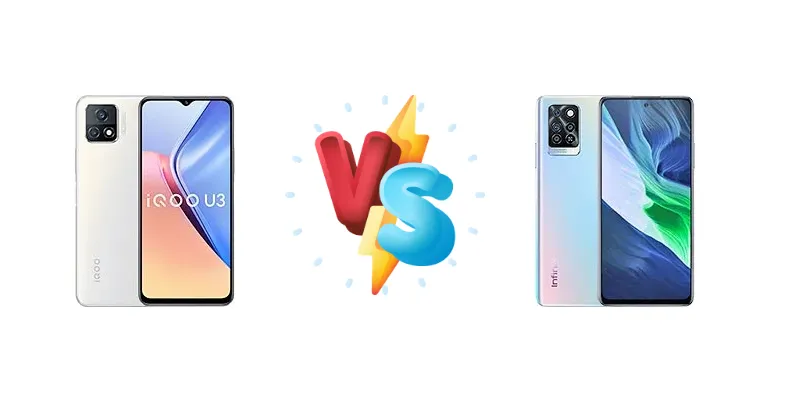
The iQOO U3 and Infinix Note 10 Pro NFC represent compelling options in the increasingly competitive sub-$250 smartphone market. While both aim to deliver a solid experience without breaking the bank, they take different approaches to achieving this goal, primarily through chipset choice and charging capabilities. This comparison dissects those differences to determine which device offers the best value.
🏆 Quick Verdict
For the average user prioritizing sustained performance and future-proofing, the iQOO U3 emerges as the stronger contender. Its Dimensity 800U, built on a more efficient 7nm process, provides a noticeable edge in CPU and GPU performance, despite the Infinix Note 10 Pro NFC’s faster charging.
| Network |
|---|
| 2G bands | GSM 850 / 900 / 1800 / 1900 | GSM 850 / 900 / 1800 / 1900 |
| 3G bands | HSDPA 850 / 900 / 1700(AWS) / 2100 | HSDPA 850 / 900 / 1700(AWS) / 1900 / 2100 |
| 4G bands | 1, 3, 4, 5, 8, 28, 34, 38, 39, 40, 41 | 1, 2, 3, 4, 5, 7, 8, 20, 28, 38, 41, 40, 66 |
| 5G bands | 1, 28, 41, 77, 78 SA/NSA | - |
| EDGE | No | - |
| GPRS | Class 10 | - |
| Speed | HSPA, LTE, 5G | HSPA, LTE |
| Technology | GSM / CDMA / HSPA / LTE / 5G | GSM / HSPA / LTE |
| | CDMA 800 | 1, 3, 7, 8, 20, 28 |
| Launch |
|---|
| Announced | 2020, December 14. Released 2020, December 18 | 2021, May 12 |
| Status | Discontinued | Available. Released 2021, June 07 |
| Body |
|---|
| Dimensions | 164.2 x 75.4 x 8.4 mm (6.46 x 2.97 x 0.33 in) | 172.8 x 78.3 x 7.8 mm (6.80 x 3.08 x 0.31 in) |
| SIM | Nano-SIM + Nano-SIM | Nano-SIM + Nano-SIM |
| Weight | 185.5 g (6.56 oz) | - |
| Display |
|---|
| Resolution | 1080 x 2408 pixels, 20:9 ratio (~401 ppi density) | 1080 x 2460 pixels (~387 ppi density) |
| Size | 6.58 inches, 104.3 cm2 (~84.2% screen-to-body ratio) | 6.95 inches, 114.7 cm2 (~84.8% screen-to-body ratio) |
| Type | IPS LCD, 90Hz, HDR10, 460 nits (typ) | IPS LCD, 90Hz |
| Platform |
|---|
| CPU | Octa-core (2x2.4 GHz Cortex-A76 & 6x2.0 GHz Cortex-A55) | Octa-core (2x2.05 GHz Cortex-A76 & 6x2.0 GHz Cortex-A55) |
| Chipset | Mediatek Dimensity 800U (7 nm) | Mediatek MT6785V/CD Helio G95 (12 nm) |
| GPU | Mali-G57 MC3 | Mali-G76 MC4 |
| OS | Android 10, IQOO UI 1.5 | Android 11, XOS 7.6 |
| Memory |
|---|
| Call records | Yes | - |
| Card slot | No | microSDXC (dedicated slot) |
| Internal | 64GB 6GB RAM, 128GB 6GB RAM, 128GB 8GB RAM | 128GB 6GB RAM, 256GB 8GB RAM |
| Phonebook | Yes | - |
| | UFS 2.2 | UFS 2.2 |
| Main Camera |
|---|
| Dual | 48 MP, f/1.8, 25mm (wide), 1/2.0", 0.8µm, PDAF
Auxiliary lens | - |
| Features | LED flash, HDR, panorama | Quad-LED flash, HDR, panorama |
| Quad | - | 64 MP, f/1.9, (wide), 1/1.72", 0.8µm, PDAF
8 MP, f/2.3, 120˚ (ultrawide)
2 MP, f/2.4, (monochrome)
Auxiliary lens |
| Single | 1.3 MP | 16 MP, (wide) |
| Video | 4K@30fps, 1080p@30fps | 4K@30fps, 1080p@30fps |
| Selfie camera |
|---|
| Features | HDR | - |
| Single | 8 MP, f/2.0, (wide) | 16 MP, f/2.0, (wide), 1/3.09" |
| Video | 1080p@30fps | 1080p@30fps |
| Sound |
|---|
| 3.5mm jack | Yes | Yes |
| 35mm jack | Yes | Yes |
| Loudspeaker | Yes | Yes, with dual speakers |
| Comms |
|---|
| Bluetooth | 5.1, A2DP, LE, aptX HD | 5.0, A2DP, LE |
| NFC | No | Yes |
| Positioning | GPS, GLONASS, BDS, GALILEO | GPS |
| Radio | No | FM radio |
| USB | USB Type-C 2.0, OTG | USB Type-C 2.0, OTG |
| WLAN | Wi-Fi 802.11 a/b/g/n/ac, dual-band, Wi-Fi Direct | Wi-Fi 802.11 a/b/g/n/ac, dual-band, Wi-Fi Direct |
| Features |
|---|
| Games | Yes | - |
| Java | No | - |
| Messaging | SMS, MMS, IM | - |
| Sensors | Fingerprint (side-mounted), accelerometer, gyro, proximity, compass | Fingerprint (side-mounted), accelerometer, gyro, proximity, compass |
| Battery |
|---|
| Charging | 18W wired | 33W wired |
| Stand-by | Up to 600 h | - |
| Talk time | Up to 5 h | - |
| Type | 5000 mAh | 5000 mAh |
| Misc |
|---|
| Colors | White, Gray, Aurora | Black, Purple, Nordic Secret |
| Models | V2061A | X695C |
| Price | About 200 EUR | - |
vivo iQOO U3
- More efficient Dimensity 800U chipset
- Better sustained performance for gaming
- Potential for 5G connectivity
- Slower 18W charging
- Likely lacks advanced display features
Infinix Note 10 Pro NFC
- Significantly faster 33W charging
- Potentially higher megapixel camera
- Competitive price point
- Less efficient Helio G95 chipset
- Potential for thermal throttling under sustained load
Display Comparison
Neither device boasts a standout display. While specific panel details (like peak brightness or color gamut coverage) are absent, the focus here is on the underlying performance. Both likely utilize IPS LCD panels, common in this price bracket. The absence of high refresh rates on either device suggests a focus on efficiency rather than visual fluidity. Bezels are likely comparable, given the similar target price points.
Camera Comparison
Without detailed sensor information, a direct camera comparison is difficult. However, the market positioning suggests the iQOO U3 likely prioritizes image processing optimization, leveraging the Dimensity 800U’s ISP capabilities. The Infinix Note 10 Pro NFC may rely more on hardware, potentially featuring a higher megapixel count, but image quality is often more dependent on software processing than raw sensor resolution. The prevalence of 2MP macro lenses on both devices suggests they offer limited practical value.
Performance
The core difference lies in the chipsets. The iQOO U3’s Mediatek Dimensity 800U (7nm) offers a significant architectural advantage over the Infinix Note 10 Pro NFC’s Helio G95 (12nm). The 7nm process inherently provides better power efficiency and thermal headroom. While the G95’s Cortex-A76 cores are clocked slightly higher (2.05 GHz vs 2.4 GHz on the U3), the Dimensity 800U’s superior architecture and process node translate to better sustained performance in CPU-intensive tasks and gaming. The Dimensity 800U also benefits from integrated 5G modem, a feature potentially absent in the Note 10 Pro NFC depending on regional variants.
Battery Life
The Infinix Note 10 Pro NFC’s 33W charging is a clear advantage over the iQOO U3’s 18W charging. This translates to significantly faster top-up times, potentially reducing charging from 0-100% by over 30 minutes. However, the Dimensity 800U’s superior efficiency may partially offset the battery capacity difference (assuming similar battery sizes, which is not confirmed), resulting in comparable real-world battery life for moderate usage. The faster charging of the Note 10 Pro NFC is most beneficial for users who frequently run out of battery and need a quick boost.
Buying Guide
Buy the vivo iQOO U3 if you need a phone capable of handling demanding applications and moderate gaming with better long-term performance. It’s ideal for users who value a smoother overall experience and anticipate keeping their device for more than two years. Buy the Infinix Note 10 Pro NFC if you prioritize extremely fast charging and are less concerned with pushing the phone to its absolute performance limits. This phone suits users who frequently need to top up their battery quickly and primarily use their phone for everyday tasks.
Frequently Asked Questions
❓ Will the Helio G95 in the Infinix Note 10 Pro NFC overheat during prolonged gaming sessions?
The Helio G95, being built on a 12nm process, is more prone to thermal throttling than the iQOO U3’s Dimensity 800U (7nm). While it can handle moderate gaming, extended sessions with graphically demanding titles may lead to noticeable performance drops as the phone attempts to manage heat.
❓ Does the iQOO U3 support carrier aggregation for faster 5G speeds?
The Dimensity 800U chipset supports carrier aggregation, which allows the phone to combine multiple frequency bands for faster and more stable 5G connections. However, actual 5G performance will depend on your carrier’s network and support for specific bands.
❓ Is the 33W charging on the Infinix Note 10 Pro NFC compatible with Power Delivery (PD) chargers?
The Infinix Note 10 Pro NFC utilizes its own proprietary charging protocol for 33W charging. While it may charge at a slower rate with a standard USB-PD charger, it won't achieve the full 33W speed unless you use the included charger.
❓ How does the Dimensity 800U handle multitasking compared to the Helio G95?
The Dimensity 800U generally offers smoother multitasking due to its more efficient CPU architecture and better memory management capabilities. It can handle more apps running in the background without significant performance slowdown.