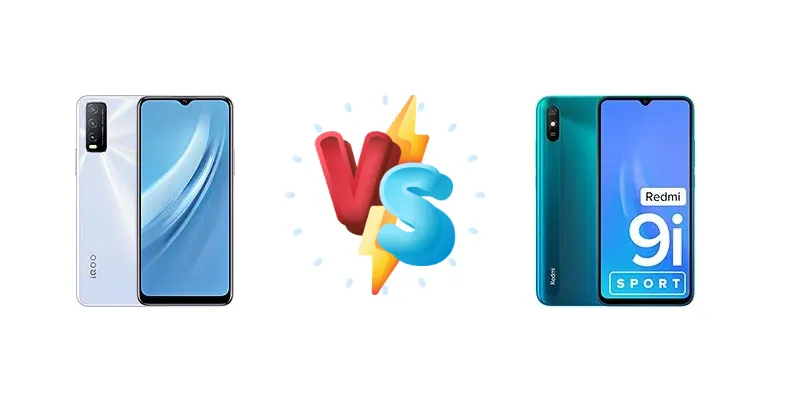
The sub-$150 smartphone market is fiercely competitive. Both the vivo iQOO U1x and Xiaomi Redmi 9i Sport aim to deliver essential smartphone functionality at an accessible price. However, they take different approaches, primarily in their chipset choices, impacting performance and charging capabilities. This comparison dissects those differences to determine which phone offers the best value.
🏆 Quick Verdict
For most users, the vivo iQOO U1x emerges as the stronger choice. Its Snapdragon 662 chipset, built on an 11nm process, provides a noticeable performance advantage over the Redmi 9i Sport’s Helio G25, and the 18W charging significantly reduces downtime. While the Redmi 9i Sport is cheaper, the iQOO U1x offers a more refined user experience.
| Network |
|---|
| 2G bands | GSM 850 / 900 / 1800 / 1900 | GSM 850 / 900 / 1800 / 1900 |
| 3G bands | HSDPA 850 / 900 / 2100 | HSDPA 850 / 900 / 2100 |
| 4G bands | 1, 3, 5, 8, 34, 38, 39, 40, 41 | 1, 3, 5, 8, 40, 41 |
| Speed | HSPA, LTE | HSPA, LTE |
| Technology | GSM / CDMA / HSPA / LTE | GSM / HSPA / LTE |
| | CDMA 800 & TD-SCDMA | - |
| Launch |
|---|
| Announced | 2020, October 21. Released 2020, October 31 | 2021, September 28 |
| Status | Discontinued | Available. Released 2021, September 28 |
| Body |
|---|
| Build | Glass front, plastic back, plastic frame | - |
| Dimensions | 164.4 x 76.3 x 8.4 mm (6.47 x 3.00 x 0.33 in) | 164.9 x 77.1 x 9 mm (6.49 x 3.04 x 0.35 in) |
| SIM | Nano-SIM + Nano-SIM | Nano-SIM + Nano-SIM |
| Weight | 192.3 g (6.77 oz) | 194 g (6.84 oz) |
| | - | Water-repellent coating |
| Display |
|---|
| Resolution | 720 x 1600 pixels, 20:9 ratio (~270 ppi density) | 720 x 1600 pixels, 20:9 ratio (~269 ppi density) |
| Size | 6.51 inches, 102.3 cm2 (~81.6% screen-to-body ratio) | 6.53 inches, 102.9 cm2 (~81.0% screen-to-body ratio) |
| Type | IPS LCD | IPS LCD, 400 nits (typ) |
| Platform |
|---|
| CPU | Octa-core (4x2.0 GHz Kryo 260 Gold & 4x1.8 GHz Kryo 260 Silver) | Octa-core (4x2.0 GHz Cortex-A53 & 4x1.5 GHz Cortex-A53) |
| Chipset | Qualcomm SM6115 Snapdragon 662 (11 nm) | Mediatek MT6762G Helio G25 (12 nm) |
| GPU | Adreno 610 | PowerVR GE8320 |
| OS | Android 10, IQOO UI 1.0 | Android 10, MIUI 12 |
| Memory |
|---|
| Card slot | No | microSDXC (dedicated slot) |
| Internal | 64GB 4GB RAM, 64GB 6GB RAM, 128GB 6GB RAM | 64GB 4GB RAM, 128GB 4GB RAM |
| | UFS 2.1 | eMMC 5.1 |
| Main Camera |
|---|
| Features | LED flash, HDR | LED flash, HDR |
| Single | - | 13 MP, f/2.2, 28mm (wide), 1.0µm, PDAF |
| Triple | 13 MP, f/2.2, (wide), PDAF
2 MP (macro)
Auxiliary lens | - |
| Video | 1080p@30fps | 1080p@30fps |
| Selfie camera |
|---|
| Features | - | HDR |
| Single | 8 MP, f/1.8, (wide) | 5 MP, f/2.2, (wide), 1.12µm |
| Video | 1080p@30fps | 1080p@30fps |
| Sound |
|---|
| 3.5mm jack | Yes | Yes |
| 35mm jack | Yes | Yes |
| Loudspeaker | Yes | Yes |
| Comms |
|---|
| Bluetooth | 5.0, A2DP, LE, aptX HD | 5.0, A2DP, LE |
| NFC | No | No |
| Positioning | GPS, BDS | GPS, GLONASS, BDS |
| Radio | Unspecified | FM radio |
| USB | microUSB 2.0, OTG | microUSB 2.0, OTG |
| WLAN | Wi-Fi 802.11 a/b/g/n/ac, dual-band, Wi-Fi Direct | Wi-Fi 802.11 а/b/g/n, Wi-Fi Direct |
| Features |
|---|
| Sensors | Fingerprint (side-mounted), accelerometer, proximity, compass | Accelerometer, proximity, compass |
| Battery |
|---|
| Charging | 18W wired | 10W wired |
| Type | 5000 mAh | Li-Po 5000 mAh |
| Misc |
|---|
| Colors | Black, Blue | Carbon Black, Coral Green, Metallic Blue |
| Models | V2065A | - |
| Price | About 110 EUR | About 100 EUR |
vivo iQOO U1x
- Faster Snapdragon 662 processor
- 18W fast charging
- Potentially better thermal management
- May be slightly more expensive
- Camera specs are unknown
Xiaomi Redmi 9i Sport
- Lower price point
- Large 5000mAh battery (likely)
- Functional for basic tasks
- Slower Helio G25 processor
- Slow 10W charging
- Less responsive user experience
Display Comparison
Neither device boasts a standout display. Both likely utilize LCD panels, common in this price bracket. However, detailed specs like resolution and peak brightness are missing. The focus here is on internal performance, not visual fidelity. Bezels are expected to be substantial on both, and color accuracy will likely be standard for the segment.
Camera Comparison
Camera performance is likely to be similar, with both phones featuring basic camera setups. Without detailed sensor information, it’s difficult to make a definitive judgment. However, the Redmi 9i Sport often includes a 13MP main sensor, while the iQOO U1x's main sensor resolution is unknown. Image processing will likely be heavily reliant on software algorithms to enhance image quality. The presence of 2MP macro/depth sensors on both devices is largely marketing fluff and shouldn’t be a deciding factor.
Performance
The core difference lies in the chipsets. The iQOO U1x’s Qualcomm Snapdragon 662 (11nm) is architecturally superior to the Redmi 9i Sport’s MediaTek Helio G25 (12nm). The Snapdragon 662 features Kryo 260 Gold and Silver cores, offering a more balanced and efficient performance profile than the Helio G25’s all Cortex-A53 setup. The 11nm process node of the Snapdragon 662 also contributes to better thermal efficiency, potentially reducing throttling during sustained tasks. While both CPUs have four cores clocked at 2.0 GHz, the architectural differences mean the Snapdragon 662 will deliver superior single-core and multi-core performance. This translates to snappier app launches and smoother multitasking on the iQOO U1x.
Battery Life
Both phones likely feature around 5000mAh batteries, standard for this price point. However, the iQOO U1x’s 18W wired charging is a significant advantage over the Redmi 9i Sport’s 10W charging. This means the iQOO U1x can replenish its battery much faster, reducing downtime. While a larger battery capacity *can* offset slower charging, the 8W difference in charging speed is substantial enough to make the iQOO U1x the more convenient option for users who frequently need to top up their battery.
Buying Guide
Buy the vivo iQOO U1x if you prioritize smoother multitasking, occasional gaming, and faster charging. It’s ideal for users who want a phone that feels responsive and doesn’t leave them tethered to a charger for hours. Buy the Xiaomi Redmi 9i Sport if your primary needs are basic communication – calls, texts, and light social media – and you’re on a very tight budget. It’s a functional device for those who prioritize affordability above all else.
Frequently Asked Questions
❓ Will the Helio G25 in the Redmi 9i Sport struggle with popular apps like WhatsApp and Facebook?
While the Helio G25 can handle basic apps like WhatsApp and Facebook, you may experience occasional lag or slowdowns when multitasking or using more demanding features within those apps. The Snapdragon 662 in the iQOO U1x offers a smoother experience for these everyday tasks.
❓ How long will it take to fully charge the iQOO U1x with the 18W charger?
While a precise 0-100% charge time is unavailable, the iQOO U1x’s 18W charging should take approximately 2-2.5 hours to fully charge a 5000mAh battery. This is significantly faster than the Redmi 9i Sport’s 10W charging, which could take upwards of 4 hours.
❓ Is the iQOO U1x a good option for playing mobile games like PUBG Mobile or Call of Duty?
The Snapdragon 662 in the iQOO U1x can handle PUBG Mobile and Call of Duty Mobile at medium settings with reasonable frame rates. However, don't expect a high-end gaming experience. The Helio G25 in the Redmi 9i Sport will struggle with these games, requiring significantly lower settings and potentially experiencing noticeable lag.
❓ Does either phone support VoLTE or VoWiFi for improved call quality?
Support for VoLTE and VoWiFi varies by region and carrier. You'll need to check with your specific mobile carrier to confirm compatibility with either the iQOO U1x or the Redmi 9i Sport.