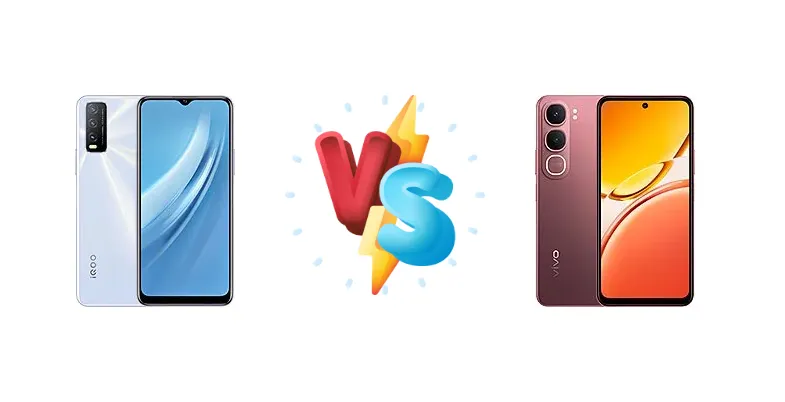
Choosing a new smartphone can be overwhelming, especially with so many options available. Today, we're pitting two popular vivo devices against each other: the iQOO U1x and the vivo Y31. Let's dive into a detailed comparison to help you decide which one is right for you.
🏆 Quick Verdict
The vivo Y31 emerges as the clear winner thanks to its significantly faster Snapdragon 4 Gen 2 chipset, faster charging (44W), and more modern 4nm process. While the iQOO U1x offers decent value, the Y31's performance and charging capabilities justify its likely higher price.
| Network |
|---|
| 2G bands | GSM 850 / 900 / 1800 / 1900 | GSM 850 / 900 / 1800 / 1900 |
| 3G bands | HSDPA 850 / 900 / 2100 | HSDPA 850 / 900 / 2100 |
| 4G bands | 1, 3, 5, 8, 34, 38, 39, 40, 41 | 1, 3, 5, 8, 28, 38, 40, 41 |
| 5G bands | - | 1, 3, 5, 8, 28, 40, 77, 78 SA/NSA |
| Speed | HSPA, LTE | HSPA, LTE, 5G |
| Technology | GSM / CDMA / HSPA / LTE | GSM / HSPA / LTE / 5G |
| | CDMA 800 & TD-SCDMA | - |
| Launch |
|---|
| Announced | 2020, October 21. Released 2020, October 31 | 2025, September 15 |
| Status | Discontinued | Available. Released 2025, September 15 |
| Body |
|---|
| Build | Glass front, plastic back, plastic frame | - |
| Dimensions | 164.4 x 76.3 x 8.4 mm (6.47 x 3.00 x 0.33 in) | 166.1 x 77 x 8.4 mm (6.54 x 3.03 x 0.33 in) |
| SIM | Nano-SIM + Nano-SIM | Nano-SIM + Nano-SIM |
| Weight | 192.3 g (6.77 oz) | 209 g (7.37 oz) |
| Display |
|---|
| Protection | - | Guardian Glass (ion-strengthened) |
| Resolution | 720 x 1600 pixels, 20:9 ratio (~270 ppi density) | 720 x 1608 pixels, 20:9 ratio (~264 ppi density) |
| Size | 6.51 inches, 102.3 cm2 (~81.6% screen-to-body ratio) | 6.68 inches, 107.4 cm2 (~84.0% screen-to-body ratio) |
| Type | IPS LCD | IPS LCD, 120Hz, 1000 nits (HBM) |
| Platform |
|---|
| CPU | Octa-core (4x2.0 GHz Kryo 260 Gold & 4x1.8 GHz Kryo 260 Silver) | Octa-core (2x2.2 GHz Cortex-A78 & 6x1.95 GHz Cortex-A55) |
| Chipset | Qualcomm SM6115 Snapdragon 662 (11 nm) | Qualcomm SM4450 Snapdragon 4 Gen 2 (4 nm) |
| GPU | Adreno 610 | Adreno 613 |
| OS | Android 10, IQOO UI 1.0 | Android 15, Funtouch 15 |
| Memory |
|---|
| Card slot | No | microSDXC (uses shared SIM slot) |
| Internal | 64GB 4GB RAM, 64GB 6GB RAM, 128GB 6GB RAM | 128GB 4GB RAM, 128GB 6GB RAM |
| | UFS 2.1 | - |
| Main Camera |
|---|
| Features | LED flash, HDR | Ring-LED flash, panorama |
| Single | - | 50 MP, f/1.8, (wide), PDAF
Auxiliary lens |
| Triple | 13 MP, f/2.2, (wide), PDAF
2 MP (macro)
Auxiliary lens | 48 MP, f/1.8, (wide), 1/2.0", 0.8µm, PDAF
2 MP, f/2.4, (macro)
2 MP, f/2.4, (depth) |
| Video | 1080p@30fps | 1080p@30fps |
| Selfie camera |
|---|
| Features | - | HDR |
| Single | 8 MP, f/1.8, (wide) | 8 MP, f/2.0, (wide) |
| Video | 1080p@30fps | 1080p@30fps |
| Sound |
|---|
| 3.5mm jack | Yes | Yes |
| 35mm jack | Yes | No |
| Loudspeaker | Yes | Yes, with stereo speakers |
| Comms |
|---|
| Bluetooth | 5.0, A2DP, LE, aptX HD | 4.2, A2DP, LE |
| NFC | No | No |
| Positioning | GPS, BDS | GPS, GLONASS, GALILEO, BDS, QZSS |
| Radio | Unspecified | No |
| USB | microUSB 2.0, OTG | USB Type-C 2.0, OTG |
| WLAN | Wi-Fi 802.11 a/b/g/n/ac, dual-band, Wi-Fi Direct | Wi-Fi 802.11 a/b/g/n/ac, dual-band |
| Features |
|---|
| Sensors | Fingerprint (side-mounted), accelerometer, proximity, compass | Fingerprint (side-mounted), accelerometer, proximity, compass |
| Battery |
|---|
| Charging | 18W wired | 44W wired, 50% in 38 min
Reverse wired |
| Type | 5000 mAh | Li-Ion 6500 mAh |
| Misc |
|---|
| Colors | Black, Blue | Rose Red, Diamond Green |
| Models | V2065A | V2036, V2036_21 |
| Price | About 110 EUR | About 150 EUR |
| SAR | - | 1.13 W/kg (head) 0.99 W/kg (body) |
vivo iQOO U1x
- Affordable
- Reliable performance for everyday tasks
- Decent battery life
- Slower performance compared to Y31
- Slow charging (18W)
- Older chipset
vivo Y31
- Faster performance (Snapdragon 4 Gen 2)
- Fast charging (44W)
- More modern chipset (4nm)
- Likely better future-proofing
- Potentially higher price
- Camera performance likely similar to iQOO U1x
Display Comparison
Both phones likely feature similar display technology (likely an IPS LCD) with comparable resolutions (likely FHD+). The Y31 might have slightly better color accuracy due to its newer chipset, but the difference will be minimal for most users. Screen size is likely around 6.5 inches for both.
Camera Comparison
Both phones likely feature a multi-lens camera system, probably including a primary sensor, ultrawide, and macro lens. The Y31's newer chipset *could* offer slightly better image processing, but both will likely produce decent photos in good lighting conditions. Low-light performance will likely be similar.
Performance
This is where the Y31 shines. The Snapdragon 4 Gen 2 is a substantial upgrade over the Snapdragon 662. Expect noticeably faster app loading times, smoother multitasking, and better gaming performance on the Y31. The 4nm process also contributes to improved efficiency.
Battery Life
The Y31's 44W fast charging is a major advantage. It can charge 50% in just 38 minutes, significantly faster than the iQOO U1x's 18W charging. Battery capacity is likely similar (around 5000mAh) so the Y31 will likely charge much faster.
Buying Guide
The vivo iQOO U1x is a good choice for budget-conscious users who prioritize a reliable, everyday phone and don't need blazing-fast performance. The vivo Y31 is ideal for users who want a smoother experience, faster charging, and a more future-proof chipset, even if it means spending a bit more.
Frequently Asked Questions
❓ Is the Snapdragon 4 Gen 2 significantly better than the Snapdragon 662?
Yes, the Snapdragon 4 Gen 2 offers a noticeable performance boost, especially in terms of speed and efficiency. It's a more modern chipset built on a smaller process node (4nm vs 11nm).
❓ Which phone is better for gaming?
The vivo Y31 is the better choice for gaming due to its more powerful chipset. You'll experience smoother gameplay and fewer stutters.