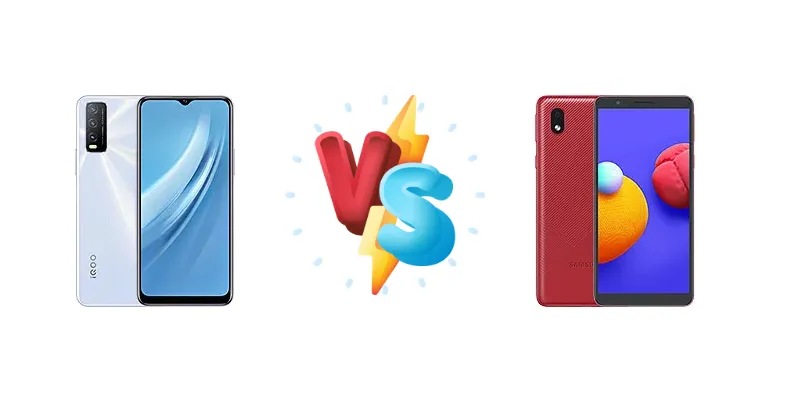
The iQOO U1x and Samsung Galaxy M01 Core represent opposite ends of the ultra-budget smartphone spectrum. The iQOO U1x aims for a balance of features and performance, while the Galaxy M01 Core prioritizes absolute affordability. This comparison dissects their key differences, focusing on how their core hardware impacts real-world usability.
🏆 Quick Verdict
For most users, the vivo iQOO U1x is the clear winner. Its Qualcomm Snapdragon 662 chipset provides a substantially smoother and more responsive experience than the Samsung Galaxy M01 Core’s Mediatek MT6739. While the M01 Core is cheaper, the performance deficit is too significant for comfortable daily use.
| Network |
|---|
| 2G bands | GSM 850 / 900 / 1800 / 1900 | GSM 850 / 900 / 1800 / 1900 |
| 3G bands | HSDPA 850 / 900 / 2100 | HSDPA 850 / 900 / 2100 |
| 4G bands | 1, 3, 5, 8, 34, 38, 39, 40, 41 | 1, 3, 5, 7, 8, 20, 38, 40, 41 |
| Speed | HSPA, LTE | HSPA 21.1/5.76 Mbps, LTE |
| Technology | GSM / CDMA / HSPA / LTE | GSM / HSPA / LTE |
| | CDMA 800 & TD-SCDMA | - |
| Launch |
|---|
| Announced | 2020, October 21. Released 2020, October 31 | 2020, July 27. Released 2020, July 29 |
| Status | Discontinued | Discontinued |
| Body |
|---|
| Build | Glass front, plastic back, plastic frame | Plastic back, plastic frame |
| Dimensions | 164.4 x 76.3 x 8.4 mm (6.47 x 3.00 x 0.33 in) | 141.7 x 67.5 x 8.6 mm (5.58 x 2.66 x 0.34 in) |
| SIM | Nano-SIM + Nano-SIM | · Nano-SIM· Nano-SIM + Nano-SIM |
| Weight | 192.3 g (6.77 oz) | 150 g (5.29 oz) |
| Display |
|---|
| Resolution | 720 x 1600 pixels, 20:9 ratio (~270 ppi density) | 720 x 1480 pixels, 18.5:9 ratio (~311 ppi density) |
| Size | 6.51 inches, 102.3 cm2 (~81.6% screen-to-body ratio) | 5.3 inches, 71.3 cm2 (~74.5% screen-to-body ratio) |
| Type | IPS LCD | PLS LCD |
| Platform |
|---|
| CPU | Octa-core (4x2.0 GHz Kryo 260 Gold & 4x1.8 GHz Kryo 260 Silver) | Quad-core 1.5 GHz Cortex-A53 |
| Chipset | Qualcomm SM6115 Snapdragon 662 (11 nm) | Mediatek MT6739 (28 nm) |
| GPU | Adreno 610 | PowerVR GE8100 |
| OS | Android 10, IQOO UI 1.0 | Android 10 (Go edition) |
| Memory |
|---|
| Card slot | No | microSDXC (dedicated slot) |
| Internal | 64GB 4GB RAM, 64GB 6GB RAM, 128GB 6GB RAM | 16GB 1GB RAM, 32GB 2GB RAM |
| | UFS 2.1 | eMMC 5.1 |
| Main Camera |
|---|
| Features | LED flash, HDR | LED flash |
| Single | - | 8 MP, f/2.2, AF |
| Triple | 13 MP, f/2.2, (wide), PDAF
2 MP (macro)
Auxiliary lens | - |
| Video | 1080p@30fps | 1080p@30fps |
| Selfie camera |
|---|
| Single | 8 MP, f/1.8, (wide) | 5 MP, f/2.4 |
| Video | 1080p@30fps | - |
| Sound |
|---|
| 3.5mm jack | Yes | Yes |
| 35mm jack | Yes | Yes |
| Loudspeaker | Yes | Yes |
| Comms |
|---|
| Bluetooth | 5.0, A2DP, LE, aptX HD | 5.0, A2DP, LE |
| NFC | No | No |
| Positioning | GPS, BDS | GPS, GLONASS |
| Radio | Unspecified | FM radio |
| USB | microUSB 2.0, OTG | microUSB 2.0 |
| WLAN | Wi-Fi 802.11 a/b/g/n/ac, dual-band, Wi-Fi Direct | Wi-Fi 802.11 b/g/n, Wi-Fi Direct |
| Features |
|---|
| Sensors | Fingerprint (side-mounted), accelerometer, proximity, compass | Accelerometer |
| Battery |
|---|
| Charging | 18W wired | - |
| Type | 5000 mAh | Li-Ion 3000 mAh |
| Misc |
|---|
| Colors | Black, Blue | Black, Blue, Red |
| Models | V2065A | SM-M013F, SM-M013F/DS |
| Price | About 110 EUR | About 60 EUR |
| SAR | - | 0.86 W/kg (head) |
vivo iQOO U1x
- Significantly faster processor (Snapdragon 662)
- More efficient 11nm process
- Faster 18W charging
- Better multitasking capabilities
- Likely a higher price point
- May lack some features found on more expensive phones
Samsung Galaxy M01 Core
- Lower price point
- Simple and easy-to-use interface
- Acceptable for basic tasks
- Potentially longer battery life with a larger capacity (unconfirmed)
- Very slow processor (MT6739)
- Poor multitasking performance
- Limited app compatibility
- Slower charging speeds
Display Comparison
Neither device boasts a standout display. Both likely utilize LCD panels, a common trait in this price bracket. However, the iQOO U1x benefits from the more powerful chipset enabling potentially better image processing. The M01 Core’s display is likely limited by the MT6739’s processing capabilities. Details like resolution and brightness are not provided, but the M01 Core’s older chipset suggests a less vibrant and responsive visual experience.
Camera Comparison
Without detailed camera specifications, a direct comparison is difficult. However, given the price points, both phones likely feature basic camera setups. The iQOO U1x’s more powerful ISP (Image Signal Processor) within the Snapdragon 662 will likely result in better image quality, particularly in challenging lighting conditions. The M01 Core’s MT6739 lacks the processing power for advanced image processing algorithms, resulting in potentially softer images with less dynamic range. The presence of a 2MP macro lens on either device is largely a marketing gimmick, offering minimal practical benefit.
Performance
The performance gap is the defining characteristic of this comparison. The iQOO U1x’s Qualcomm Snapdragon 662, built on an 11nm process, is a significant leap ahead of the Samsung Galaxy M01 Core’s Mediatek MT6739, fabricated on a much older 28nm node. The Snapdragon 662’s octa-core configuration (4x2.0 GHz Kryo 260 Gold & 4x1.8 GHz Kryo 260 Silver) provides substantially more processing power than the M01 Core’s quad-core 1.5 GHz Cortex-A53. This translates to faster app loading times, smoother multitasking, and a more enjoyable overall user experience. The 28nm process of the MT6739 also implies higher power consumption and potentially more heat generation, further impacting sustained performance.
Battery Life
Battery capacity isn’t specified for either device, but the iQOO U1x’s 18W wired charging is a clear advantage. The M01 Core likely supports slower charging speeds. While a larger battery capacity on the M01 Core could offset the slower charging, the Snapdragon 662’s more efficient 11nm process likely contributes to better overall battery life, even with a similarly sized battery. The faster charging on the iQOO U1x means less downtime and quicker top-ups.
Buying Guide
Buy the vivo iQOO U1x if you need a phone capable of handling modern apps, light gaming, and multitasking without frustrating lag. It’s ideal for students, or anyone who relies on their phone for more than just basic communication. Buy the Samsung Galaxy M01 Core if your primary needs are limited to calls, texts, and very light app usage, and your budget is extremely constrained. It’s a viable option for first-time smartphone users or as a temporary device.
Frequently Asked Questions
❓ Will the Mediatek MT6739 in the Galaxy M01 Core struggle with popular apps like WhatsApp and Facebook?
Yes, the MT6739 is a very basic processor. While it can run these apps, you may experience noticeable lag, slow loading times, and occasional crashes, especially when multitasking or using the apps for extended periods.
❓ Is the 18W charging on the iQOO U1x a significant improvement over what the Galaxy M01 Core likely offers?
Absolutely. The Galaxy M01 Core likely supports 5W or 10W charging, meaning the iQOO U1x will charge considerably faster. Expect a 0-100% charge to take significantly less time on the iQOO U1x, reducing downtime.
❓ Can the iQOO U1x handle light gaming, while the Galaxy M01 Core likely cannot?
The iQOO U1x’s Snapdragon 662 is capable of handling less demanding games at lower settings. The Galaxy M01 Core’s MT6739 will struggle even with basic games, resulting in a poor gaming experience with low frame rates and frequent stuttering.
❓ Does the iQOO U1x support software updates for longer than the Galaxy M01 Core?
Generally, devices with newer chipsets receive longer software support. The iQOO U1x, with its Snapdragon 662, is more likely to receive Android version updates and security patches for a longer period compared to the Galaxy M01 Core’s older MT6739.