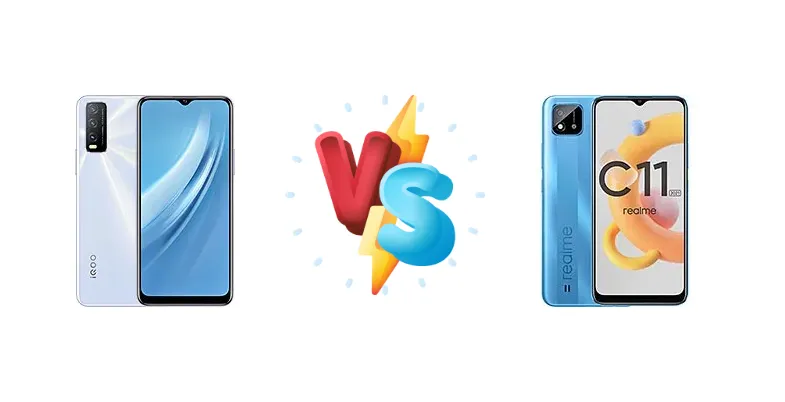
The sub-$150 smartphone market is fiercely competitive. The vivo iQOO U1x and Realme C11 (2021) both aim to deliver essential smartphone functionality at an accessible price point, but they take drastically different approaches to achieving this. The iQOO U1x leverages Qualcomm's Snapdragon 662, while the Realme C11 relies on Unisoc's SC9863A. This comparison dissects these key differences to determine which device offers the best value.
🏆 Quick Verdict
For the average user prioritizing responsiveness and future-proofing, the vivo iQOO U1x is the clear winner. Its Snapdragon 662 chipset provides significantly better performance than the Unisoc SC9863A in the Realme C11, justifying the slight price premium. However, the Realme C11's reverse wired charging is a unique feature for those needing emergency power bank functionality.
| Network |
|---|
| 2G bands | GSM 850 / 900 / 1800 / 1900 | GSM 850 / 900 / 1800 / 1900 |
| 3G bands | HSDPA 850 / 900 / 2100 | HSDPA 850 / 900 / 1900 / 2100 |
| 4G bands | 1, 3, 5, 8, 34, 38, 39, 40, 41 | 1, 3, 5, 8, 38, 40, 41 |
| Speed | HSPA, LTE | HSPA, LTE |
| Technology | GSM / CDMA / HSPA / LTE | GSM / HSPA / LTE |
| | CDMA 800 & TD-SCDMA | - |
| Launch |
|---|
| Announced | 2020, October 21. Released 2020, October 31 | 2021, June 28 |
| Status | Discontinued | Available. Released 2021, June 28 |
| Body |
|---|
| Build | Glass front, plastic back, plastic frame | Glass front, plastic frame, plastic back |
| Dimensions | 164.4 x 76.3 x 8.4 mm (6.47 x 3.00 x 0.33 in) | 165.2 x 76.4 x 8.9 mm (6.50 x 3.01 x 0.35 in) |
| SIM | Nano-SIM + Nano-SIM | Nano-SIM + Nano-SIM |
| Weight | 192.3 g (6.77 oz) | 190 g (6.70 oz) |
| | - | Splash resistant design |
| Display |
|---|
| Resolution | 720 x 1600 pixels, 20:9 ratio (~270 ppi density) | 720 x 1600 pixels, 20:9 ratio (~269 ppi density) |
| Size | 6.51 inches, 102.3 cm2 (~81.6% screen-to-body ratio) | 6.52 inches, 102.6 cm2 (~81.3% screen-to-body ratio) |
| Type | IPS LCD | IPS LCD, 400 nits (typ) |
| Platform |
|---|
| CPU | Octa-core (4x2.0 GHz Kryo 260 Gold & 4x1.8 GHz Kryo 260 Silver) | Octa-core (4x1.6 GHz Cortex-A55 & 4x1.2 GHz Cortex-A55) |
| Chipset | Qualcomm SM6115 Snapdragon 662 (11 nm) | Unisoc SC9863A (28 nm) |
| GPU | Adreno 610 | IMG8322 |
| OS | Android 10, IQOO UI 1.0 | Android 11, Realme Go UI |
| Memory |
|---|
| Card slot | No | microSDXC (dedicated slot) |
| Internal | 64GB 4GB RAM, 64GB 6GB RAM, 128GB 6GB RAM | 32GB 2GB RAM, 64GB 4GB RAM |
| | UFS 2.1 | eMMC 5.1 |
| Main Camera |
|---|
| Features | LED flash, HDR | LED flash, HDR, panorama |
| Single | - | 8 MP, f/2.0, (wide), AF |
| Triple | 13 MP, f/2.2, (wide), PDAF
2 MP (macro)
Auxiliary lens | - |
| Video | 1080p@30fps | 1080p@30fps |
| Selfie camera |
|---|
| Features | - | HDR, panorama |
| Single | 8 MP, f/1.8, (wide) | 5 MP, f/2.2, (wide) |
| Video | 1080p@30fps | 1080p@30fps |
| Sound |
|---|
| 3.5mm jack | Yes | Yes |
| 35mm jack | Yes | Yes |
| Loudspeaker | Yes | Yes |
| Comms |
|---|
| Bluetooth | 5.0, A2DP, LE, aptX HD | 4.2, A2DP |
| NFC | No | No |
| Positioning | GPS, BDS | GPS, GLONASS, GALILEO, BDS |
| Radio | Unspecified | Unspecified |
| USB | microUSB 2.0, OTG | microUSB 2.0, OTG |
| WLAN | Wi-Fi 802.11 a/b/g/n/ac, dual-band, Wi-Fi Direct | Wi-Fi 802.11 b/g/n |
| Features |
|---|
| Sensors | Fingerprint (side-mounted), accelerometer, proximity, compass | Accelerometer, gyro, proximity, compass |
| Battery |
|---|
| Charging | 18W wired | 10W wired
Reverse wired |
| Type | 5000 mAh | 5000 mAh |
| Misc |
|---|
| Colors | Black, Blue | Cool Blue, Cool Grey |
| Models | V2065A | RMX3231 |
| Price | About 110 EUR | About 80 EUR |
vivo iQOO U1x
- Significantly faster processor (Snapdragon 662)
- Faster 18W charging
- Potentially better image processing
- Likely slightly more expensive
- No reverse wired charging
Realme C11 (2021)
- More affordable price point
- Reverse wired charging capability
- Acceptable for basic smartphone tasks
- Significantly slower processor (Unisoc SC9863A)
- Slower 10W charging
- Limited performance for gaming or multitasking
Display Comparison
Neither device boasts a standout display. Both likely feature LCD panels, typical for this price bracket. However, detailed specs are missing. The Realme C11's focus on affordability likely means a lower-quality panel. The iQOO U1x, benefiting from a slightly higher price point, *may* offer marginally better color accuracy and viewing angles. The absence of high refresh rates on either device is expected, but the panel quality will be a key differentiator.
Camera Comparison
Camera performance is likely to be similar in real-world usage, given the focus on cost reduction in both devices. Detailed sensor information is missing, but both will likely feature a primary sensor paired with basic depth or macro lenses. The iQOO U1x’s more powerful processor *could* enable slightly better image processing, resulting in marginally improved dynamic range and noise reduction. However, don't expect flagship-level image quality from either device. The 2MP macro lenses found on many phones in this segment are generally of limited utility.
Performance
The performance gap is the most significant difference. The iQOO U1x’s Qualcomm Snapdragon 662, built on an 11nm process, is a substantial upgrade over the Realme C11’s Unisoc SC9863A (28nm). The Snapdragon 662’s Kryo 260 cores (4x2.0 GHz & 4x1.8 GHz) offer significantly higher clock speeds and a more efficient architecture compared to the Cortex-A55 cores in the Unisoc chip (4x1.6 GHz & 4x1.2 GHz). This translates to faster app loading times, smoother multitasking, and a more enjoyable gaming experience on the iQOO U1x. The larger process node of the Unisoc chip also implies higher power consumption for similar tasks.
Battery Life
The Realme C11 (2021) offers 10W wired charging, while the iQOO U1x steps up to 18W. While battery capacity isn't specified, the faster charging on the iQOO U1x will significantly reduce charging times. The Realme C11’s inclusion of reverse wired charging is a unique advantage, allowing it to act as a power bank for other devices. However, this comes at the cost of slower overall charging speeds. The iQOO U1x’s more efficient processor may also contribute to slightly better battery life during typical usage.
Buying Guide
Buy the vivo iQOO U1x if you need a phone capable of handling everyday tasks smoothly, enjoy occasional gaming, and appreciate a more responsive user experience. Buy the Realme C11 (2021) if you prioritize absolute affordability, require reverse wired charging to power other devices, and primarily use your phone for basic communication and light social media.
Frequently Asked Questions
❓ Will the Unisoc SC9863A in the Realme C11 struggle with popular apps like WhatsApp and Facebook?
While the Unisoc SC9863A can handle basic apps like WhatsApp and Facebook, you may experience noticeable lag and slowdowns when multitasking or using more demanding features within these apps. The Snapdragon 662 in the iQOO U1x provides a much smoother experience for these everyday tasks.
❓ Is the 18W charging on the iQOO U1x a significant improvement over the 10W charging on the Realme C11?
Yes, the 18W charging on the iQOO U1x is a substantial improvement. Expect a significantly faster 0-100% charge time compared to the Realme C11. While exact times depend on battery capacity, the iQOO U1x will likely charge in under 2 hours, while the Realme C11 could take 3+ hours.
❓ How useful is the reverse wired charging feature on the Realme C11?
The reverse wired charging feature is useful in emergency situations where you need to charge another device, like a wireless earbud case or another phone, and have no other power source available. However, it's a slow charging method and will drain the Realme C11's battery quickly.