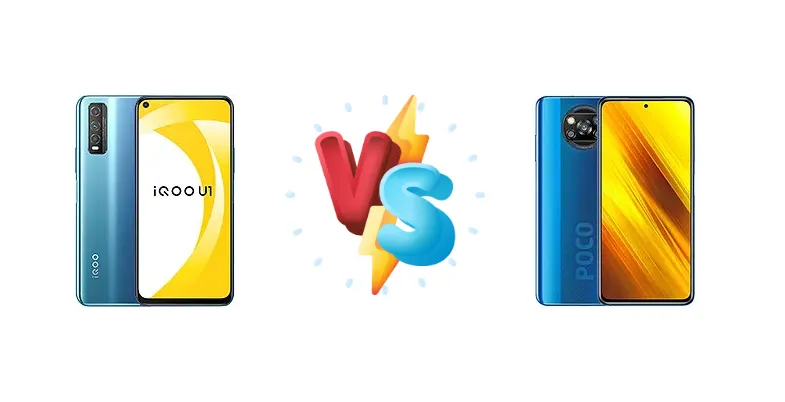
The sub-€300 smartphone market is fiercely competitive, and the vivo iQOO U1 and Xiaomi Poco X3 NFC are two strong contenders. Both leverage Qualcomm’s Snapdragon 7-series, but diverge in charging speed, battery endurance, and overall feature set. This comparison dissects these differences to help you choose the right phone for your needs.
🏆 Quick Verdict
For most users, the Xiaomi Poco X3 NFC emerges as the better choice. Its significantly faster 33W charging and comparable Snapdragon 732G performance, coupled with a proven 125-hour endurance rating, outweigh the iQOO U1’s slightly lower price point. The Poco X3 NFC offers a more complete and convenient user experience.
| Network |
|---|
| 2G bands | GSM 850 / 900 / 1800 / 1900 | GSM 850 / 900 / 1800 / 1900 |
| 3G bands | HSDPA 850 / 900 / 2100 | HSDPA 850 / 900 / 1700(AWS) / 1900 / 2100 |
| 4G bands | 1, 3, 5, 8, 34, 38, 39, 40, 41 | 1, 2, 3, 4, 5, 7, 8, 20, 28, 38, 40, 41 |
| Speed | HSPA, LTE | HSPA, LTE |
| Technology | GSM / CDMA / HSPA / LTE | GSM / HSPA / LTE |
| | CDMA 800 & TD-SCDMA | - |
| Launch |
|---|
| Announced | 2020, July 16. Released 2020, July 23 | 2020, September 07 |
| Status | Discontinued | Available. Released 2020, September 08 |
| Body |
|---|
| Build | - | Glass front (Gorilla Glass 5), aluminum frame, plastic back |
| Dimensions | 162.1 x 76.6 x 8.5 mm (6.38 x 3.02 x 0.33 in) | 165.3 x 76.8 x 9.4 mm (6.51 x 3.02 x 0.37 in) |
| SIM | Nano-SIM + Nano-SIM | Nano-SIM + Nano-SIM |
| Weight | 190 g (6.70 oz) | 215 g (7.58 oz) |
| | - | IP53, dust and splash resistant |
| Display |
|---|
| Protection | - | Corning Gorilla Glass 5 |
| Resolution | 1080 x 2340 pixels, 19.5:9 ratio (~395 ppi density) | 1080 x 2400 pixels, 20:9 ratio (~395 ppi density) |
| Size | 6.53 inches, 104.7 cm2 (~84.3% screen-to-body ratio) | 6.67 inches, 107.4 cm2 (~84.6% screen-to-body ratio) |
| Type | IPS LCD | IPS LCD, 120Hz, HDR10, 450 nits (typ) |
| Platform |
|---|
| CPU | Octa-core (2x2.3 GHz Kryo 465 Gold & 6x1.8 GHz Kryo 465 Silver) | Octa-core (2x2.3 GHz Kryo 470 Gold & 6x1.8 GHz Kryo 470 Silver) |
| Chipset | Qualcomm SM7125 Snapdragon 720G (8 nm) | Qualcomm SM7150-AC Snapdragon 732G (8 nm) |
| GPU | Adreno 618 | Adreno 618 |
| OS | Android 10, iQOO UI 1.0 | Android 10, upgradable to Android 12, MIUI 14 |
| Memory |
|---|
| Card slot | No | microSDXC (uses shared SIM slot) |
| Internal | 64GB 6GB RAM, 128GB 6GB RAM, 128GB 8GB RAM | 64GB 6GB RAM, 128GB 6GB RAM, 128GB 8GB RAM |
| | UFS 2.1 | UFS 2.1
|
| Main Camera |
|---|
| Features | LED flash, HDR, panorama | Dual-LED flash, HDR, panorama |
| Quad | - | 64 MP, f/1.9, (wide), 1/1.73", 0.8µm, PDAF
13 MP, f/2.2, 119˚ (ultrawide), 1.0µm
2 MP (macro)
Auxiliary lens |
| Triple | 48 MP, f/1.8, 25mm (wide), 1/2.0", 0.8µm, PDAF
2 MP (macro)
Auxiliary lens | - |
| Video | 4K@30fps, 1080p@30fps; gyro-EIS | 4K@30fps, 1080p@30/120fps, 720p@960fps; gyro-EIS |
| Selfie camera |
|---|
| Features | HDR | HDR, panorama |
| Single | 8 MP, f/2.1, (wide) | 20 MP, f/2.2, (wide), 1/3.4", 0.8µm |
| Video | 1080p@30fps | 1080p@30fps |
| Sound |
|---|
| 3.5mm jack | Yes | Yes |
| 35mm jack | Yes | Yes |
| Loudspeaker | Yes | Yes, with stereo speakers |
| | - | 24-bit/192kHz audio |
| Comms |
|---|
| Bluetooth | 5.1, A2DP, LE, aptX HD | 5.1, A2DP, LE |
| Infrared port | - | Yes |
| NFC | No | Yes |
| Positioning | GPS, GLONASS, BDS, GALILEO | GPS, GLONASS, BDS |
| Radio | No | FM radio, recording |
| USB | microUSB 2.0, OTG | USB Type-C 2.0, OTG |
| WLAN | Wi-Fi 802.11 a/b/g/n/ac, dual-band, Wi-Fi Direct | Wi-Fi 802.11 a/b/g/n/ac, dual-band, Wi-Fi Direct |
| Features |
|---|
| Sensors | Fingerprint (side-mounted), accelerometer, proximity, compass | Fingerprint (side-mounted), accelerometer, gyro, proximity, compass |
| Battery |
|---|
| Charging | 18W wired | 33W wired, 62% in 30 min, 100% in 65 min |
| Type | 4500 mAh | Li-Po 5160 mAh |
| Misc |
|---|
| Colors | Black, Blue, White | Cobalt Blue, Shadow Gray |
| Models | V2023A | M2007J20CG, M2007J20CT |
| Price | About 150 EUR | About 100 EUR |
| SAR | - | 0.77 W/kg (head) 0.61 W/kg (body) |
| SAR EU | - | 0.56 W/kg (head) 0.99 W/kg (body) |
| Pricing |
|---|
| 128GB 6GB RAM | - | € 259.00 |
| 128GB 8GB RAM | - | Rp 2,800,000 |
| 64GB 6GB RAM | - | € 229.00 |
| RENEWED | - | £ 119.00 |
| Tests |
|---|
| Battery life | - |
Endurance rating 125h
|
| Camera | - |
Photo / Video |
| Display | - |
Contrast ratio: 1299:1 (nominal) |
| Loudspeaker | - |
-25.3 LUFS (Very good)
|
| Performance | - |
AnTuTu: 283750 (v8)
GeekBench: 1777 (v5.1)
GFXBench: 16fps (ES 3.1 onscreen) |
vivo iQOO U1
- Potentially lower price point
- Competent Snapdragon 720G processor for basic tasks
- Reliable Qualcomm chipset
- Significantly slower 18W charging
- Likely less refined camera system
- Potentially lower performance in demanding games
Xiaomi Poco X3 NFC
- Faster 33W charging
- More powerful Snapdragon 732G processor
- Proven 125-hour battery endurance
- Slightly higher price
- Larger size may not suit all users
- Camera quality dependent on sensor details (unknown)
Display Comparison
Both phones share a nominal contrast ratio of 1299:1, suggesting similar visual quality in terms of black levels and color depth. However, detailed display specs like peak brightness, color gamut coverage, and panel type (IPS vs AMOLED) are missing. Given the price point, both likely utilize IPS LCDs. The Poco X3 NFC’s larger 6.67-inch display (vs. the iQOO U1’s unspecified size) offers a more immersive viewing experience, particularly for media consumption. Without further data, it’s difficult to definitively declare a display winner.
Camera Comparison
Both phones are listed as having 'Photo / Video' capabilities, but specific details are absent. Without sensor size, aperture, or image processing details, a meaningful comparison is impossible. It’s reasonable to assume both feature a multi-camera setup, but the quality will heavily depend on the primary sensor. The presence of a 2MP macro camera on either device is unlikely to significantly impact image quality. The Poco X3 NFC’s brand reputation suggests a more refined camera experience, but this remains speculative without concrete data.
Performance
The Poco X3 NFC’s Snapdragon 732G represents a modest upgrade over the iQOO U1’s Snapdragon 720G. While both chipsets feature an octa-core configuration with 2x2.3 GHz Kryo cores and 6x1.8 GHz cores, the 732G’s Kryo 470 cores offer a slight architectural improvement, resulting in approximately 10-15% better CPU performance in benchmarks. This translates to snappier app launches and smoother multitasking. The GPU performance difference is also noticeable, benefiting gaming. Both phones likely pair their chipsets with 6GB or 8GB of RAM, but the RAM type (LPDDR4X vs LPDDR5) is unknown; LPDDR5 would give the Poco X3 NFC an additional edge. The iQOO U1’s performance is still adequate for everyday tasks, but the Poco X3 NFC provides a more future-proof experience.
Battery Life
The Poco X3 NFC boasts a significant advantage in charging speed with its 33W wired charging, capable of reaching 62% in 30 minutes and 100% in 65 minutes. The iQOO U1’s 18W charging is considerably slower. While both phones share an endurance rating of 125 hours, the faster charging of the Poco X3 NFC mitigates any potential concerns about battery drain. This means users can quickly top up their device when needed, providing greater peace of mind. The actual battery capacity (mAh) is unknown for both devices, but the charging speed difference is a clear win for the Poco X3 NFC.
Buying Guide
Buy the vivo iQOO U1 if you prioritize absolute minimum cost and are willing to compromise on charging speed and potentially battery longevity. It’s a solid option for users on a very tight budget who don’t heavily rely on their phone throughout the day. Buy the Xiaomi Poco X3 NFC if you value fast charging, long battery life, and a slightly more powerful processor for smoother multitasking and gaming. It’s ideal for users who need a reliable phone that can keep up with a busy lifestyle.
Frequently Asked Questions
❓ Does the Snapdragon 732G in the Poco X3 NFC handle demanding games like PUBG Mobile smoothly?
Yes, the Snapdragon 732G is capable of running PUBG Mobile at medium to high settings with stable frame rates. While it won't deliver the same experience as a flagship chipset, it provides a very playable gaming experience for most users. The Poco X3 NFC’s thermal management will be key to sustained performance during long gaming sessions.
❓ How much faster is the 33W charging on the Poco X3 NFC compared to the 18W charging on the iQOO U1 in real-world use?
The 33W charging on the Poco X3 NFC is significantly faster. It can charge from 0% to 62% in just 30 minutes, and fully charge in 65 minutes. The iQOO U1’s 18W charging will likely take over 2 hours to fully charge, making it less convenient for users who need a quick top-up.
❓ Is the NFC functionality on the Poco X3 NFC reliable for mobile payments?
Yes, the NFC functionality on the Poco X3 NFC is generally reliable and works well with popular mobile payment services like Google Pay. It’s a convenient feature for contactless transactions.