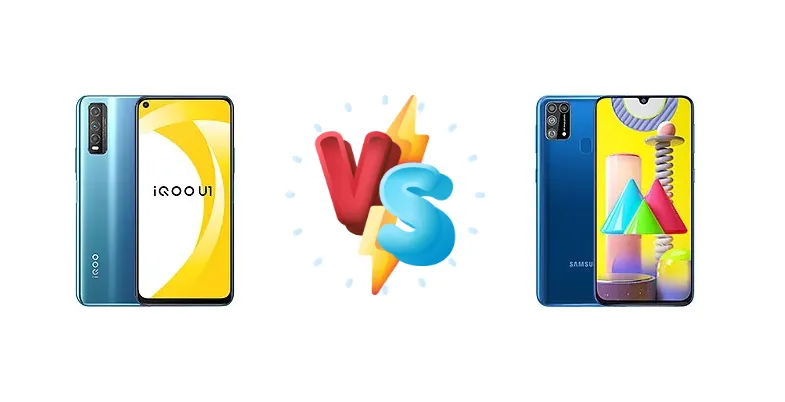
The vivo iQOO U1 and Samsung Galaxy M31 Prime represent compelling options in the crowded budget smartphone market. While both aim to deliver a feature-rich experience without breaking the bank, they take distinctly different approaches to achieving this goal, primarily through their chipset choices. This comparison dissects the core differences between the Qualcomm Snapdragon 720G-powered iQOO U1 and the Samsung Exynos 9611-equipped M31 Prime, helping you determine which device best suits your needs.
🏆 Quick Verdict
For the average user prioritizing consistent performance and efficient power management, the vivo iQOO U1 emerges as the stronger contender. Its Snapdragon 720G, built on a more modern 8nm process, offers a noticeable advantage in both CPU and GPU performance, translating to smoother multitasking and gaming experiences compared to the older 10nm Exynos 9611 in the Galaxy M31 Prime.
| Network |
|---|
| 2G bands | GSM 850 / 900 / 1800 / 1900 | GSM 850 / 900 / 1800 / 1900 |
| 3G bands | HSDPA 850 / 900 / 2100 | HSDPA 850 / 900 / 1700(AWS) / 1900 / 2100 |
| 4G bands | 1, 3, 5, 8, 34, 38, 39, 40, 41 | 1, 2, 3, 4, 5, 7, 8, 12, 13, 17, 20, 26, 28, 38, 40, 41, 66 |
| EDGE | - | Yes |
| GPRS | - | Class 10 |
| Speed | HSPA, LTE | HSPA, LTE |
| Technology | GSM / CDMA / HSPA / LTE | GSM / HSPA / LTE |
| | CDMA 800 & TD-SCDMA | - |
| Launch |
|---|
| Announced | 2020, July 16. Released 2020, July 23 | 2020, October 14. Released 2020, October 17 |
| Status | Discontinued | Discontinued |
| Body |
|---|
| Build | - | Glass front (Gorilla Glass 3), plastic back, plastic frame |
| Dimensions | 162.1 x 76.6 x 8.5 mm (6.38 x 3.02 x 0.33 in) | 159.2 x 75.1 x 8.9 mm (6.27 x 2.96 x 0.35 in) |
| SIM | Nano-SIM + Nano-SIM | Nano-SIM + Nano-SIM |
| Weight | 190 g (6.70 oz) | 191 g (6.74 oz) |
| Display |
|---|
| Protection | - | Corning Gorilla Glass 3 |
| Resolution | 1080 x 2340 pixels, 19.5:9 ratio (~395 ppi density) | 1080 x 2340 pixels, 19.5:9 ratio (~403 ppi density) |
| Size | 6.53 inches, 104.7 cm2 (~84.3% screen-to-body ratio) | 6.4 inches, 100.5 cm2 (~84.1% screen-to-body ratio) |
| Type | IPS LCD | Super AMOLED, 420 nits (peak) |
| Platform |
|---|
| CPU | Octa-core (2x2.3 GHz Kryo 465 Gold & 6x1.8 GHz Kryo 465 Silver) | Octa-core (4x2.3 GHz Cortex-A73 & 4x1.7 GHz Cortex-A53) |
| Chipset | Qualcomm SM7125 Snapdragon 720G (8 nm) | Exynos 9611 (10 nm) |
| GPU | Adreno 618 | Mali-G72 MP3 |
| OS | Android 10, iQOO UI 1.0 | Android 10, One UI 2.0 |
| Memory |
|---|
| Call records | - | Yes |
| Card slot | No | microSDXC (dedicated slot) |
| Internal | 64GB 6GB RAM, 128GB 6GB RAM, 128GB 8GB RAM | 64GB 6GB RAM, 128GB 6GB RAM |
| Phonebook | - | Yes |
| | UFS 2.1 | UFS 2.1 |
| Main Camera |
|---|
| Features | LED flash, HDR, panorama | LED flash, panorama, HDR |
| Quad | - | 64 MP, f/1.8, 26mm (wide), 1/1.72", 0.8µm, PDAF
8 MP, f/2.2, 123˚ (ultrawide), 1/4.0", 1.12µm
5 MP (macro)
Auxiliary lens |
| Single | - | 3.15 MP |
| Triple | 48 MP, f/1.8, 25mm (wide), 1/2.0", 0.8µm, PDAF
2 MP (macro)
Auxiliary lens | - |
| Video | 4K@30fps, 1080p@30fps; gyro-EIS | 4K@30fps, 1080p@30fps, gyro-EIS |
| Selfie camera |
|---|
| Features | HDR | HDR |
| Single | 8 MP, f/2.1, (wide) | 32 MP, f/2.0, 26mm (wide), 1/2.8", 0.8µm |
| Video | 1080p@30fps | 4K@30fps, 1080p@30fps |
| Sound |
|---|
| 3.5mm jack | Yes | Yes |
| 35mm jack | Yes | Yes |
| Loudspeaker | Yes | Yes |
| Comms |
|---|
| Bluetooth | 5.1, A2DP, LE, aptX HD | 5.0, A2DP, LE |
| NFC | No | No |
| Positioning | GPS, GLONASS, BDS, GALILEO | GPS, GLONASS, GALILEO, BDS |
| Radio | No | FM radio, RDS, recording |
| USB | microUSB 2.0, OTG | USB Type-C 2.0 |
| WLAN | Wi-Fi 802.11 a/b/g/n/ac, dual-band, Wi-Fi Direct | Wi-Fi 802.11 a/b/g/n/ac, dual-band, Wi-Fi Direct |
| Features |
|---|
| Games | - | Downloadable |
| Java | - | Yes |
| Messaging | - | SMS, MMS, Email, Push Email, IM |
| Sensors | Fingerprint (side-mounted), accelerometer, proximity, compass | Fingerprint (rear-mounted), accelerometer, gyro, compass |
| | - | Virtual proximity sensing |
| Battery |
|---|
| Charging | 18W wired | 15W wired |
| Stand-by | - | Up to 150 h |
| Talk time | - | Up to 1 h 30 min |
| Type | 4500 mAh | Li-Po 6000 mAh |
| Misc |
|---|
| Colors | Black, Blue, White | Ocean Blue, Space Black, Iceberg Blue |
| Models | V2023A | SM-M315F/DS |
| Price | About 150 EUR | About 190 EUR |
| SAR | - | 0.38 W/kg (head) |
vivo iQOO U1
- More efficient Snapdragon 720G processor
- Faster 18W charging
- Better sustained performance due to 8nm process
- Potentially smaller battery capacity (spec not provided)
- Brand recognition may be lower than Samsung
Samsung Galaxy M31 Prime
- Potentially larger display
- Samsung’s established brand reputation
- Likely larger battery capacity
- Less efficient Exynos 9611 processor
- Slower 15W charging
- Potential for thermal throttling under load
Display Comparison
Neither device boasts a particularly standout display. While specific panel details (like peak brightness in nits) are unavailable, the focus here is on the underlying processors. The M31 Prime likely utilizes a larger display, typical of Samsung's M-series, but the iQOO U1's display quality will be more consistently driven by the Snapdragon 720G's image signal processor (ISP) for better color reproduction. Bezels are expected to be comparable, reflecting the budget nature of both devices.
Camera Comparison
Without detailed sensor information, a direct camera comparison is challenging. However, the Snapdragon 720G’s ISP in the iQOO U1 provides a computational photography advantage. The Exynos 9611’s ISP is older and less capable. While both phones likely feature multi-camera setups, the iQOO U1 will likely deliver more consistent image quality, particularly in challenging lighting conditions, due to the superior image processing capabilities of the Snapdragon chipset. The prevalence of 2MP macro lenses on both devices suggests limited utility; focusing on the main sensor performance is key.
Performance
The core differentiator lies in the chipsets. The iQOO U1’s Qualcomm Snapdragon 720G (8nm) features a more modern CPU architecture – Kryo 465 Gold & Silver – compared to the Samsung Galaxy M31 Prime’s Exynos 9611 (10nm). The Snapdragon 720G’s octa-core configuration (2x2.3 GHz + 6x1.8 GHz) is optimized for efficiency and sustained performance. The Exynos 9611, with its 4x2.3 GHz Cortex-A73 and 4x1.7 GHz Cortex-A53 cores, is older and less efficient. This translates to the iQOO U1 handling demanding apps and games with less thermal throttling. The 8nm process node of the Snapdragon 720G inherently generates less heat than the 10nm Exynos 9611, benefiting users who engage in extended gaming sessions.
Battery Life
The Galaxy M31 Prime typically features a larger battery capacity, but the iQOO U1’s more efficient Snapdragon 720G offsets this advantage. The M31 Prime’s 15W charging is slower than the iQOO U1’s 18W charging. While the M31 Prime might offer slightly longer screen-on time in light usage, the iQOO U1 will likely provide more consistent performance throughout the day, especially with moderate to heavy use, due to its superior power efficiency. The faster charging on the iQOO U1 also minimizes downtime.
Buying Guide
Buy the vivo iQOO U1 if you need a phone that handles everyday tasks and moderate gaming with ease, and you value a more efficient processor for longer battery life. Buy the Samsung Galaxy M31 Prime if you prioritize a larger display and potentially a slightly more refined software experience, and are willing to accept some performance trade-offs in exchange for a potentially lower price point.
Frequently Asked Questions
❓ Does the Exynos 9611 in the Galaxy M31 Prime tend to overheat during prolonged gaming sessions?
Yes, the Exynos 9611, built on a 10nm process, is known to generate more heat under sustained load compared to the Snapdragon 720G. This can lead to noticeable thermal throttling, reducing performance during extended gaming sessions. The iQOO U1's 8nm Snapdragon 720G is significantly better at managing heat, providing a smoother gaming experience.
❓ Is the 18W charging on the iQOO U1 a significant improvement over the 15W charging on the Galaxy M31 Prime?
Yes, while the difference may not seem substantial, the 18W charging on the iQOO U1 translates to noticeably faster charging times. This reduces downtime and allows you to get back to using your phone more quickly. The M31 Prime's 15W charging is comparatively slower, requiring a longer time to reach a full charge.
❓ How does the Snapdragon 720G's image processing compare to the Exynos 9611's in low-light conditions?
The Snapdragon 720G features a more advanced Image Signal Processor (ISP) than the Exynos 9611. This results in superior low-light performance, with better noise reduction, improved detail retention, and more accurate colors. The iQOO U1 will likely capture more usable and aesthetically pleasing photos in challenging lighting scenarios.