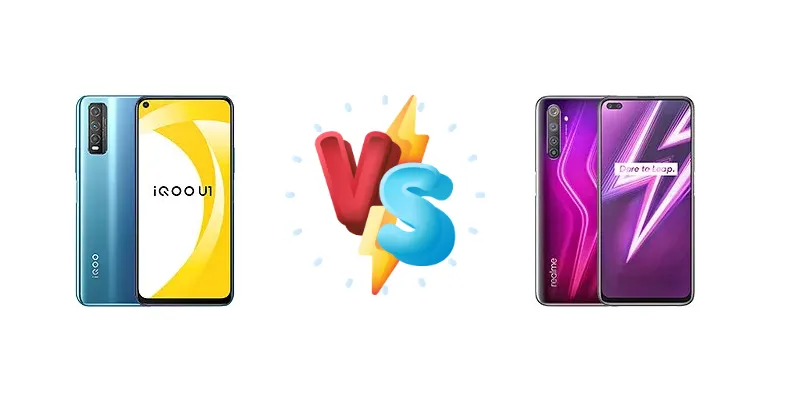
Both the vivo iQOO U1 and Realme 6 Pro represent compelling options in the competitive mid-range smartphone market, both powered by the Qualcomm Snapdragon 720G. However, key differences in charging technology and battery endurance create a distinct trade-off for potential buyers. This comparison dissects these nuances to determine which device delivers the best overall experience.
🏆 Quick Verdict
For the average user prioritizing convenience and reduced downtime, the Realme 6 Pro emerges as the winner. Its 30W fast charging, achieving a full charge in just 57 minutes, significantly outweighs the iQOO U1’s slower 18W charging, despite both phones sharing the same Snapdragon 720G chipset.
| Network |
|---|
| 2G bands | GSM 850 / 900 / 1800 / 1900 | GSM 850 / 900 / 1800 / 1900 |
| 3G bands | HSDPA 850 / 900 / 2100 | HSDPA 850 / 900 / 1700(AWS) / 1900 / 2100 - Global |
| 4G bands | 1, 3, 5, 8, 34, 38, 39, 40, 41 | 1, 2, 3, 4, 5, 7, 8, 20, 28, 38, 40, 41 - Global |
| Speed | HSPA, LTE | HSPA 42.2/11.5 Mbps, LTE (2CA) Cat6 300/150 Mbps |
| Technology | GSM / CDMA / HSPA / LTE | GSM / HSPA / LTE |
| | CDMA 800 & TD-SCDMA | 1, 3, 5, 8, 38, 40, 41 - India |
| Launch |
|---|
| Announced | 2020, July 16. Released 2020, July 23 | 2020, March 05. Released 2020, March 13 |
| Status | Discontinued | Discontinued |
| Body |
|---|
| Build | - | Glass front (Gorilla Glass 5), glass back, plastic frame |
| Dimensions | 162.1 x 76.6 x 8.5 mm (6.38 x 3.02 x 0.33 in) | 163.8 x 75.8 x 8.9 mm (6.45 x 2.98 x 0.35 in) |
| SIM | Nano-SIM + Nano-SIM | Nano-SIM + Nano-SIM |
| Weight | 190 g (6.70 oz) | 202 g (7.13 oz) |
| Display |
|---|
| Protection | - | Corning Gorilla Glass 5 |
| Resolution | 1080 x 2340 pixels, 19.5:9 ratio (~395 ppi density) | 1080 x 2400 pixels, 20:9 ratio (~399 ppi density) |
| Size | 6.53 inches, 104.7 cm2 (~84.3% screen-to-body ratio) | 6.6 inches, 105.2 cm2 (~84.7% screen-to-body ratio) |
| Type | IPS LCD | IPS LCD, 90Hz, 480 nits (typ) |
| Platform |
|---|
| CPU | Octa-core (2x2.3 GHz Kryo 465 Gold & 6x1.8 GHz Kryo 465 Silver) | Octa-core (2x2.3 GHz Kryo 465 Gold & 6x1.8 GHz Kryo 465 Silver) |
| Chipset | Qualcomm SM7125 Snapdragon 720G (8 nm) | Qualcomm SM7125 Snapdragon 720G (8 nm) |
| GPU | Adreno 618 | Adreno 618 |
| OS | Android 10, iQOO UI 1.0 | Android 10, upgradable to Android 11, Realme UI 2.0 |
| Memory |
|---|
| Card slot | No | microSDXC (dedicated slot) |
| Internal | 64GB 6GB RAM, 128GB 6GB RAM, 128GB 8GB RAM | 64GB 6GB RAM, 128GB 6GB RAM, 128GB 8GB RAM |
| | UFS 2.1 | UFS 2.1 |
| Main Camera |
|---|
| Features | LED flash, HDR, panorama | LED flash, HDR, panorama |
| Quad | - | 64 MP, f/1.8, 26mm (wide), 1/1.72", 0.8µm, PDAF
12 MP, f/2.5, 54mm (telephoto), 1/3.4", 1.0µm, PDAF, 2x optical zoom
8 MP, f/2.3, 13mm (ultrawide), 1/4.0", 1.12µm
2 MP (macro) |
| Triple | 48 MP, f/1.8, 25mm (wide), 1/2.0", 0.8µm, PDAF
2 MP (macro)
Auxiliary lens | - |
| Video | 4K@30fps, 1080p@30fps; gyro-EIS | 4K@30fps, 1080p@30/60/120fps, gyro-EIS |
| Selfie camera |
|---|
| Dual | - | 16 MP, f/2.1, 26mm (wide), 1/3.06", 1.0µm
8 MP, f/2.2, 105˚ (ultrawide), 1/4.0", 1.12µm |
| Features | HDR | HDR, panorama |
| Single | 8 MP, f/2.1, (wide) | - |
| Video | 1080p@30fps | 1080p@30fps |
| Sound |
|---|
| 3.5mm jack | Yes | Yes |
| 35mm jack | Yes | Yes |
| Loudspeaker | Yes | Yes |
| | - | 24-bit/192kHz audio |
| Comms |
|---|
| Bluetooth | 5.1, A2DP, LE, aptX HD | 5.1, A2DP, LE |
| NFC | No | Yes (market/region dependent) |
| Positioning | GPS, GLONASS, BDS, GALILEO | GPS (L1+L5), GLONASS, BDS, NavIC |
| Radio | No | FM radio |
| USB | microUSB 2.0, OTG | USB Type-C 2.0, OTG |
| WLAN | Wi-Fi 802.11 a/b/g/n/ac, dual-band, Wi-Fi Direct | Wi-Fi 802.11 a/b/g/n/ac, dual-band, Wi-Fi Direct |
| Features |
|---|
| Sensors | Fingerprint (side-mounted), accelerometer, proximity, compass | Fingerprint (side-mounted), accelerometer, gyro, proximity, compass |
| Battery |
|---|
| Charging | 18W wired | 30W wired, 100% in 57 min |
| Type | 4500 mAh | 4300 mAh |
| Misc |
|---|
| Colors | Black, Blue, White | Lightning Blue, Lightning Orange, Lightning Red |
| Models | V2023A | RMX2061, RMX2063 |
| Price | About 150 EUR | About 540 EUR |
| SAR | - | 1.19 W/kg (head) 0.92 W/kg (body) |
| Tests |
|---|
| Battery life | - |
Endurance rating 107h
|
| Camera | - |
Photo / Video |
| Display | - |
Contrast ratio: 1324:1 (nominal) |
| Loudspeaker | - |
-28.5 LUFS (Average)
|
| Performance | - |
AnTuTu: 268785 (v8)
GeekBench: 7027 (v4.4), 1666 (v5.1)
GFXBench: 19fps (ES 3.1 onscreen) |
vivo iQOO U1
- Potentially cleaner software experience (vivo's Funtouch OS is often less aggressive than Realme UI)
- Identical Snapdragon 720G performance
- Competitive price point (likely)
- Significantly slower 18W charging
- Lack of detailed display specifications
- Camera details are unknown
Realme 6 Pro
- 30W fast charging (100% in 57 minutes)
- Proven 107-hour endurance rating
- Measured display brightness and contrast ratio available
- Realme UI can be perceived as bloated by some users
- Identical Snapdragon 720G performance
- Camera details are unknown
Display Comparison
Both devices lack detailed display specifications beyond the Realme 6 Pro’s measured 421 nits of peak brightness and 1324:1 contrast ratio. While the contrast ratio is nominal for an IPS panel, the brightness level suggests adequate outdoor visibility. Without comparable data for the iQOO U1, it’s difficult to assess relative display quality, but both likely employ similar IPS LCD technology common in this price bracket. The absence of high refresh rate panels is standard for this generation of Snapdragon 720G devices.
Camera Comparison
Both phones feature 'Photo / Video' capabilities, but lack specific details regarding sensor size, aperture, or image processing algorithms. This makes a direct comparison challenging. The absence of information suggests neither phone boasts a flagship-level camera system. The focus is likely on providing a versatile camera experience for social media and casual photography, rather than professional-grade image quality. The inclusion of a 2MP macro lens on either device is likely a marketing feature with limited practical benefit.
Performance
The core performance is identical: both the vivo iQOO U1 and Realme 6 Pro are equipped with the Qualcomm SM7125 Snapdragon 720G, featuring an octa-core CPU configuration with 2x2.3 GHz Kryo 465 Gold and 6x1.8 GHz Kryo 465 Silver cores. This means comparable CPU and GPU performance for everyday tasks and moderate gaming. Thermal management, however, is an unknown. Realme’s history suggests a focus on optimized cooling, potentially allowing for sustained performance under load, but without specific testing data, this remains speculative. RAM configurations are not specified, but will heavily influence multitasking capabilities.
Battery Life
The Realme 6 Pro’s standout feature is its 30W wired charging, capable of reaching 100% charge in just 57 minutes. This is a significant advantage over the iQOO U1’s 18W charging, which will require considerably longer to fully replenish the battery. Both phones share an endurance rating of 107 hours, indicating similar battery life under typical usage scenarios. However, the faster charging of the Realme 6 Pro mitigates the impact of battery drain, offering more convenient top-ups throughout the day.
Buying Guide
Buy the vivo iQOO U1 if you prioritize a slightly more streamlined software experience and are comfortable with slower charging speeds. Buy the Realme 6 Pro if you value rapid charging, maximizing uptime, and a proven endurance rating of 107 hours, making it ideal for users who heavily rely on their smartphones throughout the day.
Frequently Asked Questions
❓ Does the Snapdragon 720G in either phone struggle with demanding games like PUBG Mobile?
The Snapdragon 720G is capable of running PUBG Mobile, but expect to use medium graphics settings for a consistently smooth experience. Both phones share the same chipset, so gaming performance will be largely identical. Sustained performance may vary depending on thermal management, but neither phone is designed for ultra-high settings.
❓ Is the 107-hour endurance rating realistic for typical daily use on the Realme 6 Pro?
The 107-hour endurance rating is based on Realme’s testing methodology, which simulates a mix of calls, web browsing, video playback, and standby time. Real-world usage will vary depending on individual habits. Heavy users who frequently stream videos or play games will likely experience shorter battery life, but the 30W fast charging will help mitigate this.
❓ How does the software experience differ between vivo's Funtouch OS and Realme UI?
Funtouch OS (vivo) is often described as more conservative in its design and features, while Realme UI aims for a more customizable and feature-rich experience. Realme UI has historically included more pre-installed apps, which some users may consider bloatware. However, both interfaces have improved significantly in recent iterations.