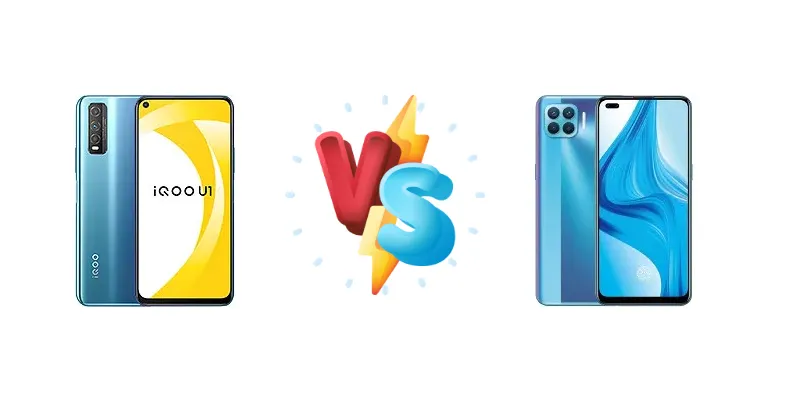
The mid-range smartphone market is fiercely competitive, and the vivo iQOO U1 and Oppo F17 Pro represent compelling options for budget-conscious buyers. While both aim to deliver a balanced experience, they take different approaches to achieving it. The iQOO U1 prioritizes a newer Qualcomm chipset, while the F17 Pro focuses on faster charging and a more polished aesthetic. This comparison dives deep into the specifics to determine which phone offers the best value.
🏆 Quick Verdict
For the average user prioritizing fast charging and a sleek design, the Oppo F17 Pro is the better choice. Its 30W charging significantly reduces downtime. However, users focused on raw processing power and potential for future software updates will find the iQOO U1's Snapdragon 720G a more appealing foundation.
| Network |
|---|
| 2G bands | GSM 850 / 900 / 1800 / 1900 | GSM 850 / 900 / 1800 / 1900 |
| 3G bands | HSDPA 850 / 900 / 2100 | HSDPA 850 / 900 / 2100 |
| 4G bands | 1, 3, 5, 8, 34, 38, 39, 40, 41 | 1, 3, 5, 8, 38, 40, 41 |
| Speed | HSPA, LTE | HSPA, LTE |
| Technology | GSM / CDMA / HSPA / LTE | GSM / HSPA / LTE |
| | CDMA 800 & TD-SCDMA | - |
| Launch |
|---|
| Announced | 2020, July 16. Released 2020, July 23 | 2020, September 02. Released 2020, September 07 |
| Status | Discontinued | Discontinued |
| Body |
|---|
| Build | - | Glass front (Gorilla Glass 3), plastic back |
| Dimensions | 162.1 x 76.6 x 8.5 mm (6.38 x 3.02 x 0.33 in) | 160.1 x 73.8 x 7.5 mm (6.30 x 2.91 x 0.30 in) |
| SIM | Nano-SIM + Nano-SIM | Nano-SIM + Nano-SIM |
| Weight | 190 g (6.70 oz) | 164 g (5.78 oz) |
| Display |
|---|
| Protection | - | Corning Gorilla Glass 3 |
| Resolution | 1080 x 2340 pixels, 19.5:9 ratio (~395 ppi density) | 1080 x 2400 pixels, 20:9 ratio (~408 ppi density) |
| Size | 6.53 inches, 104.7 cm2 (~84.3% screen-to-body ratio) | 6.43 inches, 100.3 cm2 (~84.9% screen-to-body ratio) |
| Type | IPS LCD | Super AMOLED, 430 nits (typ), 800 nits (peak) |
| Platform |
|---|
| CPU | Octa-core (2x2.3 GHz Kryo 465 Gold & 6x1.8 GHz Kryo 465 Silver) | Octa-core (2x2.2 GHz Cortex-A75 & 6x2.0 GHz Cortex-A55) |
| Chipset | Qualcomm SM7125 Snapdragon 720G (8 nm) | Mediatek MT6779V Helio P95 (12 nm) |
| GPU | Adreno 618 | PowerVR GM9446 |
| OS | Android 10, iQOO UI 1.0 | Android 10, ColorOS 7.2 |
| Memory |
|---|
| Card slot | No | microSDXC (dedicated slot) |
| Internal | 64GB 6GB RAM, 128GB 6GB RAM, 128GB 8GB RAM | 128GB 8GB RAM |
| | UFS 2.1 | UFS 2.1 |
| Main Camera |
|---|
| Features | LED flash, HDR, panorama | LED flash, HDR, panorama |
| Quad | - | 48 MP, f/1.8, 26mm (wide), 1/2.0", 0.8µm, PDAF
8 MP, f/2.2, 119˚, 16mm (ultrawide), 1/4.0", 1.12µm
Auxiliary lens |
| Triple | 48 MP, f/1.8, 25mm (wide), 1/2.0", 0.8µm, PDAF
2 MP (macro)
Auxiliary lens | - |
| Video | 4K@30fps, 1080p@30fps; gyro-EIS | 4K@30fps, 1080p@30/120fps, gyro-EIS |
| Selfie camera |
|---|
| Dual | - | 16 MP, f/2.4, (wide), 1/3.09", 1.0µm
2 MP, f/2.4, (depth) |
| Features | HDR | HDR |
| Single | 8 MP, f/2.1, (wide) | - |
| Video | 1080p@30fps | 1080p@30fps |
| Sound |
|---|
| 3.5mm jack | Yes | Yes |
| 35mm jack | Yes | Yes |
| Loudspeaker | Yes | Yes |
| Comms |
|---|
| Bluetooth | 5.1, A2DP, LE, aptX HD | 5.1, A2DP, LE, aptX HD |
| NFC | No | No |
| Positioning | GPS, GLONASS, BDS, GALILEO | GPS, GLONASS, GALILEO, BDS, QZSS |
| Radio | No | FM radio |
| USB | microUSB 2.0, OTG | USB Type-C 2.0, OTG |
| WLAN | Wi-Fi 802.11 a/b/g/n/ac, dual-band, Wi-Fi Direct | Wi-Fi 802.11 a/b/g/n/ac, dual-band, Wi-Fi Direct |
| Features |
|---|
| Sensors | Fingerprint (side-mounted), accelerometer, proximity, compass | Fingerprint (under display, optical), accelerometer, gyro, proximity, compass |
| Battery |
|---|
| Charging | 18W wired | 30W wired, 50% in 30 min, 100% in 53 min |
| Type | 4500 mAh | Li-Po 4015 mAh |
| Misc |
|---|
| Colors | Black, Blue, White | Magic Blue, Matte Black, Metallic White |
| Models | V2023A | CPH2119 |
| Price | About 150 EUR | About 270 EUR |
| SAR | - | 1.44 W/kg (head) 1.41 W/kg (body) |
| Pricing |
|---|
| 128GB 8GB RAM | - | ₹ 17,990 |
vivo iQOO U1
- More efficient Snapdragon 720G chipset
- Potentially better sustained performance
- Qualcomm's established software support
- Slower 18W charging
- Likely less refined design
- Unspecified display details
Oppo F17 Pro
- 30W fast charging (50% in 30 min)
- Sleek and stylish design (based on Oppo's marketing)
- ₹17,990 price point (with 128GB/8GB configuration)
- Less powerful Helio P95 chipset
- Older CPU architecture
- Potentially less efficient power consumption
Display Comparison
Neither device's display specifications are provided, so a direct comparison is limited. However, given the price point, both likely utilize LCD panels. The Oppo F17 Pro's marketing often emphasizes its design, suggesting a potentially more refined display with slimmer bezels. The iQOO sub-brand typically focuses on gaming, which *could* translate to a higher refresh rate display, though this is not confirmed. Color accuracy and peak brightness will likely be similar, falling within the typical range for mid-range phones.
Camera Comparison
Without detailed camera specs, a precise comparison is difficult. However, the focus should be on the main sensor. The absence of information suggests both phones likely feature multi-camera setups with a primary sensor, an ultrawide, and potentially a depth or macro lens. The iQOO U1's Snapdragon ISP (Image Signal Processor) generally offers better image processing capabilities than the Helio P95's, potentially resulting in more detailed and dynamic photos, especially in challenging lighting conditions. The usefulness of any 2MP macro lenses on either device is questionable; they often lack the detail and clarity to be truly impactful.
Performance
The core difference lies in the chipsets. The iQOO U1's Qualcomm Snapdragon 720G (8nm) boasts a more modern architecture than the Oppo F17 Pro's MediaTek Helio P95 (12nm). The 8nm process node of the Snapdragon 720G translates to improved power efficiency and potentially better thermal management, allowing for sustained performance during demanding tasks. The Snapdragon 720G's CPU configuration (2x2.3 GHz Kryo 465 Gold & 6x1.8 GHz Kryo 465 Silver) is optimized for a balance of performance and efficiency, while the Helio P95 (2x2.2 GHz Cortex-A75 & 6x2.0 GHz Cortex-A55) relies on older Cortex designs. This means the iQOO U1 will likely exhibit superior performance in CPU-intensive applications and gaming.
Battery Life
The Oppo F17 Pro's 30W wired charging is a significant advantage. The advertised 50% charge in 30 minutes and 100% in 53 minutes drastically reduces downtime compared to the iQOO U1's 18W charging. While the iQOO U1 may have a slightly larger battery capacity (unspecified), the F17 Pro's faster charging effectively mitigates any potential battery life differences. Users who frequently find themselves needing to top up their phone will greatly benefit from the F17 Pro's charging speed.
Buying Guide
Buy the vivo iQOO U1 if you need a phone that prioritizes sustained performance for gaming and multitasking, and you value Qualcomm's chipset ecosystem. Buy the Oppo F17 Pro if you prefer a phone with a faster charging experience, a more refined design, and are less concerned with pushing the absolute limits of processing power. The F17 Pro is geared towards users who value convenience and aesthetics.
Frequently Asked Questions
❓ Will the Helio P95 in the Oppo F17 Pro struggle with demanding games like PUBG or Call of Duty?
The Helio P95 can handle PUBG and Call of Duty, but you'll likely need to lower graphics settings for a smooth experience. The Snapdragon 720G in the iQOO U1 will provide a more consistent and higher-fidelity gaming experience without requiring as many compromises.
❓ How much of a difference will the 30W charging make in real-world usage on the Oppo F17 Pro?
The 30W charging is a game-changer for convenience. Being able to get a 50% charge in just 30 minutes means you can quickly top up your phone during a short break, minimizing downtime and ensuring you're always ready to go.
❓ Is the Snapdragon 720G in the iQOO U1 likely to receive more software updates than the Helio P95 in the Oppo F17 Pro?
Generally, Qualcomm chipsets receive longer and more consistent software support from manufacturers. While both phones will likely receive security updates, the iQOO U1 has a higher probability of receiving major Android version updates for a longer period.
❓ Does the Oppo F17 Pro's design justify the performance trade-off compared to the iQOO U1?
That depends on your priorities. If you value aesthetics and a sleek design, the F17 Pro's more polished appearance might be worth the performance compromise. However, if performance is paramount, the iQOO U1 is the better choice.