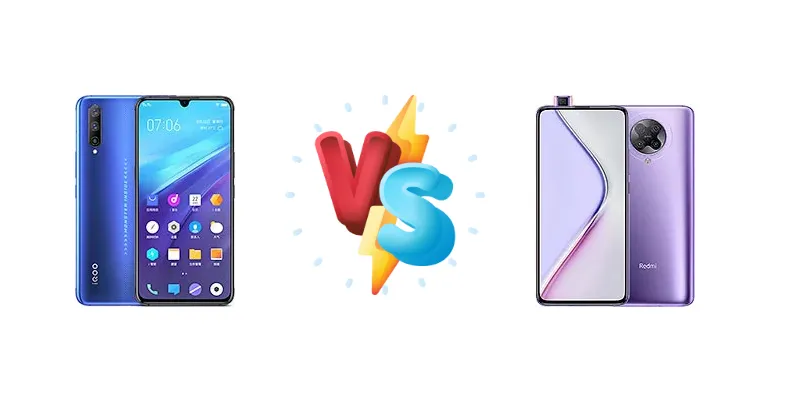
The vivo iQOO Pro and Xiaomi Redmi K30 Pro Zoom represent a fascinating inflection point in the smartphone market. The iQOO Pro, leveraging the refined Snapdragon 855+, aimed for peak performance within a competitive price bracket. The K30 Pro Zoom, however, arrived with the newer Snapdragon 865, promising future-proofing with 5G connectivity and architectural improvements. This comparison dissects the differences to determine which device delivers the best experience.
🏆 Quick Verdict
For the average user prioritizing future-proofing and 5G connectivity, the Xiaomi Redmi K30 Pro Zoom is the better choice. While the iQOO Pro offers a solid experience, the Snapdragon 865’s architectural advantages and faster charging outweigh the iQOO Pro’s slightly more mature software optimization.
| Network |
|---|
| 2G bands | GSM 850 / 900 / 1800 / 1900 | GSM 850 / 900 / 1800 / 1900 |
| 3G bands | HSDPA 850 / 900 / 1700(AWS) / 2100 | HSDPA 850 / 900 / 1900 / 2100 |
| 4G bands | 1, 2, 3, 4, 5, 7, 8, 12, 17, 18, 19, 20, 25, 26, 38, 39, 40, 41 | 1, 3, 5, 7, 8, 34, 38, 39, 40, 41 |
| 5G bands | - | 1, 3, 41, 78, 79 SA/NSA |
| Speed | HSPA 42.2/5.76 Mbps, LTE (7CA) Cat20 2000/150 Mbps | HSPA, LTE, 5G |
| Technology | GSM / CDMA / HSPA / LTE | GSM / CDMA / HSPA / EVDO / LTE / 5G |
| | CDMA 800 & TD-SCDMA | CDMA2000 1xEV-DO |
| Launch |
|---|
| Announced | 2019, August. Released 2019, August | 2020, March 24. Released 2020, April 04 |
| Status | Discontinued | Discontinued |
| Body |
|---|
| Build | - | Glass front (Gorilla Glass 5), glass back (Gorilla Glass 5), aluminum frame |
| Dimensions | 158.8 x 75.7 x 9.3 mm (6.25 x 2.98 x 0.37 in) | 163.3 x 75.4 x 8.9 mm (6.43 x 2.97 x 0.35 in) |
| SIM | Nano-SIM + Nano-SIM | Nano-SIM + Nano-SIM |
| Weight | 215 g (7.58 oz) | 218 g (7.69 oz) |
| Display |
|---|
| Protection | - | Corning Gorilla Glass 5 |
| Resolution | 1080 x 2340 pixels, 19.5:9 ratio (~402 ppi density) | 1080 x 2400 pixels, 20:9 ratio (~395 ppi density) |
| Size | 6.41 inches, 100.9 cm2 (~83.9% screen-to-body ratio) | 6.67 inches, 107.4 cm2 (~87.2% screen-to-body ratio) |
| Type | Super AMOLED | Super AMOLED, HDR10+, 500 nits (typ) |
| Platform |
|---|
| CPU | Octa-core (1x2.84 GHz Kryo 485 & 3x2.42 GHz Kryo 485 & 4x1.78 GHz Kryo 485) | Octa-core (1x2.84 GHz Cortex-A77 & 3x2.42 GHz Cortex-A77 & 4x1.80 GHz Cortex-A55) |
| Chipset | Qualcomm SM8150 Snapdragon 855+ (7 nm) | Qualcomm SM8250 Snapdragon 865 5G (7 nm+) |
| GPU | Adreno 640 (700 MHz) | Adreno 650 |
| OS | Android 9.0 (Pie), Funtouch 9.1 | Android 10, MIUI 11 |
| Memory |
|---|
| Card slot | No | No |
| Internal | 128GB 8GB RAM, 128GB 12GB RAM | 128GB 8GB RAM, 256GB 8GB RAM, 512GB 12GB RAM |
| | UFS 3.0 | UFS 3.1 |
| Main Camera |
|---|
| Features | LED flash, HDR, panorama | Dual-LED dual-tone flash, HDR, panorama |
| Quad | - | 64 MP, 26mm (wide), 1/1.72", 0.8µm, PDAF, OIS
8 MP, (telephoto), PDAF, OIS, 3x optical zoom
13 MP, 13mm (ultrawide)
Auxiliary lens |
| Triple | 48 MP, f/1.8, (wide), 1/2.0", 0.8µm, PDAF
13 MP, f/2.2, (ultrawide)
Auxiliary lens | - |
| Video | 4K@30/60fps, 1080p@30/60fps, 720p@1920fps | 8K@24/30fps, 4K@30/60fps, 1080p@30/60/120/240fps, 1080p@960fps; gyro-EIS |
| Selfie camera |
|---|
| Features | HDR | HDR |
| Single | 12 MP, f/2.0, (wide), 1/2.8", 1.28µm | Motorized pop-up 20 MP, (wide), 1/3.4", 0.8µm |
| Video | 1080p@30fps | 1080p@30fps |
| Sound |
|---|
| 3.5mm jack | Yes | Yes |
| 35mm jack | Yes | Yes |
| Loudspeaker | Yes | Yes |
| | 32-bit/192kHz audio
| 24-bit/192kHz audio
|
| Comms |
|---|
| Bluetooth | 5.0, A2DP, LE, aptX | 5.1, A2DP, LE, aptX HD, aptX Adaptive |
| Infrared port | - | Yes |
| NFC | Yes | Yes |
| Positioning | GPS, GLONASS, BDS, GALILEO | GPS (L1+L5), GLONASS (G1), BDS (B1I+B2a), GALILEO (E1+E5a), QZSS (L1+L5) |
| Radio | No | No |
| USB | USB Type-C 2.0, OTG | USB Type-C 2.0, OTG |
| WLAN | Wi-Fi 802.11 a/b/g/n/ac, dual-band, Wi-Fi Direct | Wi-Fi 802.11 a/b/g/n/ac/6, dual-band, Wi-Fi Direct |
| Features |
|---|
| Sensors | Fingerprint (under display, optical), accelerometer, gyro, proximity, compass | Fingerprint (under display, optical), accelerometer, gyro, proximity, compass, barometer |
| Battery |
|---|
| Charging | 44W wired | 33W wired, PD, QC4, 100% in 63 min |
| Type | 4500 mAh, non-removable | Li-Po 4700 mAh |
| Misc |
|---|
| Colors | Black, Blue | Grey, Purple, White, Blue |
| Models | V1922A, V1922A | - |
| Price | About 410 EUR | About 500 EUR |
vivo iQOO Pro
- Proven Snapdragon 855+ performance
- Potentially more mature software optimization
- Competitive price point (likely)
- Older Snapdragon 855+ chipset
- Lacks 5G connectivity
- Slower charging compared to K30 Pro Zoom
Xiaomi Redmi K30 Pro Zoom
- Future-proof Snapdragon 865 chipset
- 5G connectivity
- Faster and more versatile charging (33W, PD, QC4)
- Potentially less refined initial software
- May be slightly more expensive
- Thermal management could be a concern under sustained load
Display Comparison
Neither device’s display specifications are provided, but given their market positioning, both likely feature high refresh rate AMOLED panels. However, the K30 Pro Zoom’s Snapdragon 865 includes a more advanced ISP capable of handling higher resolution displays and faster refresh rates more efficiently. The iQOO Pro, while capable, will be limited by the 855+'s processing power when pushing display boundaries. Bezels are likely comparable, but color accuracy and peak brightness would require direct testing to determine a clear winner.
Camera Comparison
Without detailed camera specs, a direct comparison is difficult. However, the Snapdragon 865’s ISP (Image Signal Processor) in the K30 Pro Zoom offers advantages in image processing, particularly in low-light conditions and video recording. The 865 supports higher resolution sensors and faster capture rates. The iQOO Pro’s 855+ ISP is still capable, but will be limited in its ability to fully utilize cutting-edge camera hardware. The presence of OIS (Optical Image Stabilization) on the primary sensor of either device would be a significant advantage, but is unknown without further information.
Performance
The core difference lies in the chipsets. The Xiaomi Redmi K30 Pro Zoom’s Snapdragon 865 (7nm+) represents a significant architectural leap over the iQOO Pro’s Snapdragon 855+ (7nm). The 865 utilizes ARM’s Cortex-A77 cores, offering improved IPC (Instructions Per Clock) compared to the Kryo 485 cores in the 855+. This translates to faster application loading, smoother multitasking, and better sustained performance under load. While both share the same peak CPU clock speed (2.84 GHz), the 865’s architecture is more efficient. The 865 also boasts a significantly more powerful Adreno 650 GPU, providing a substantial advantage in gaming. The K30 Pro Zoom’s 5G modem is another key differentiator, offering future-proof connectivity.
Battery Life
The Redmi K30 Pro Zoom’s 33W charging with support for PD and QC4 is a clear advantage over the iQOO Pro’s 44W wired charging. While 44W sounds faster, the K30 Pro Zoom’s charging implementation, combined with its power management, achieves a full charge in 63 minutes. The iQOO Pro’s charging time is not specified, but is likely longer. The actual battery life will depend on the mAh capacity of each device (not provided), but the K30 Pro Zoom’s more efficient chipset and optimized charging will likely result in comparable or better real-world battery performance.
Buying Guide
Buy the vivo iQOO Pro if you need a proven performer with a focus on maximizing the Snapdragon 855+'s capabilities, and are less concerned with 5G or the latest chipset architecture. Buy the Xiaomi Redmi K30 Pro Zoom if you prefer a device built for the future, benefiting from the Snapdragon 865’s 5G modem, improved CPU/GPU architecture, and faster charging, even if it means potentially navigating slightly less refined initial software.
Frequently Asked Questions
❓ Will the Redmi K30 Pro Zoom’s Snapdragon 865 overheat during extended gaming sessions?
The Snapdragon 865 is known to generate more heat than the 855+. However, Xiaomi typically employs effective thermal management solutions, including vapor chambers and graphite sheets. While some throttling is possible during prolonged, demanding gaming, the K30 Pro Zoom should maintain acceptable performance levels. Real-world testing is needed to confirm the extent of throttling.
❓ Does the iQOO Pro’s 44W charging significantly outperform the K30 Pro Zoom’s 33W charging in real-world usage?
While 44W appears higher, the K30 Pro Zoom’s 33W charging, combined with Power Delivery (PD) and Quick Charge 4 (QC4) support, achieves a full charge in 63 minutes. The iQOO Pro’s charging time is not specified, but is likely longer. The K30 Pro Zoom’s charging efficiency and protocol support provide a more versatile and potentially faster overall charging experience.
❓ Is the 5G connectivity on the Redmi K30 Pro Zoom useful if 5G infrastructure isn't widely available in my area?
Even without widespread 5G coverage, the Snapdragon 865’s 5G modem offers benefits beyond just speed. It includes improved modem efficiency and connectivity features that can enhance 4G performance. Furthermore, purchasing a 5G-enabled device future-proofs your investment as 5G networks expand.