
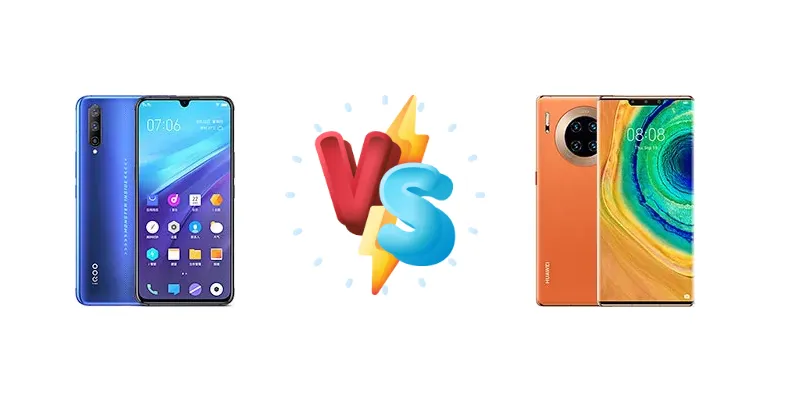
vivo iQOO Pro vs Huawei Mate 30 Pro 5G: A Head-to-Head Flagship Battle
| Phones Images | |||||
|---|---|---|---|---|---|
|
🏆 Quick Verdict
For the average user prioritizing gaming and fast charging, the vivo iQOO Pro emerges as the winner. Its Snapdragon 855+ offers consistently strong performance, and the 44W charging is faster than the Mate 30 Pro 5G’s 40W wired solution. However, the Mate 30 Pro 5G’s camera system and wireless charging capabilities are significant advantages for photography enthusiasts.
| PHONES | ||
|---|---|---|
| Phone Names | vivo iQOO Pro | Huawei Mate 30 Pro 5G |
| Network | ||
|---|---|---|
| 2G bands | GSM 850 / 900 / 1800 / 1900 | GSM 850 / 900 / 1800 / 1900 |
| 3G bands | HSDPA 850 / 900 / 1700(AWS) / 2100 | HSDPA 800 / 850 / 900 / 1700(AWS) / 1900 / 2100 |
| 4G bands | 1, 2, 3, 4, 5, 7, 8, 12, 17, 18, 19, 20, 25, 26, 38, 39, 40, 41 | 1, 2, 3, 4, 5, 6, 7, 8, 9, 12, 17, 18, 19, 20, 26, 28, 32, 34, 38, 39, 40, 41 - Global |
| 5G bands | - | 1, 3, 28, 38, 41, 77, 78, 79 NSA/Sub6 |
| Speed | HSPA 42.2/5.76 Mbps, LTE (7CA) Cat20 2000/150 Mbps | HSPA, LTE, 5G (2+ Gbps DL) |
| Technology | GSM / CDMA / HSPA / LTE | GSM / HSPA / LTE / 5G |
| CDMA 800 & TD-SCDMA | 1, 2, 3, 4, 5, 6, 7, 8, 9, 12, 17, 18, 19, 20, 26, 34, 38, 39, 40, 41 - China | |
| Launch | ||
|---|---|---|
| Announced | 2019, August. Released 2019, August | 2019, September 19. Released 2019, October 23 |
| Status | Discontinued | Discontinued |
| Body | ||
|---|---|---|
| Build | - | Glass front (Gorilla Glass 6), glass back (Gorilla Glass 6), aluminum frame |
| Dimensions | 158.8 x 75.7 x 9.3 mm (6.25 x 2.98 x 0.37 in) | 158.1 x 73.1 x 8.8 mm (6.22 x 2.88 x 0.35 in) |
| SIM | Nano-SIM + Nano-SIM | Nano-SIM + Nano-SIM |
| Weight | 215 g (7.58 oz) | 198 g (6.98 oz) |
| - | IP68 dust/water resistant (up to 2m for 30 mins) | |
| Display | ||
|---|---|---|
| Protection | - | Corning Gorilla Glass 6 |
| Resolution | 1080 x 2340 pixels, 19.5:9 ratio (~402 ppi density) | 1176 x 2400 pixels, 18.5:9 ratio (~409 ppi density) |
| Size | 6.41 inches, 100.9 cm2 (~83.9% screen-to-body ratio) | 6.53 inches, 108.7 cm2 (~94.1% screen-to-body ratio) |
| Type | Super AMOLED | OLED, HDR10 |
| Platform | ||
|---|---|---|
| CPU | Octa-core (1x2.84 GHz Kryo 485 & 3x2.42 GHz Kryo 485 & 4x1.78 GHz Kryo 485) | Octa-core (2x2.86 GHz Cortex-A76 & 2x2.36 GHz Cortex-A76 & 4x1.95 GHz Cortex-A55) |
| Chipset | Qualcomm SM8150 Snapdragon 855+ (7 nm) | Kirin 990 5G (7 nm+) |
| GPU | Adreno 640 (700 MHz) | Mali-G76 MP16 |
| OS | Android 9.0 (Pie), Funtouch 9.1 | Android 10, EMUI 10, no Google Play Services |
| Memory | ||
|---|---|---|
| Card slot | No | Nano Memory (uses shared SIM slot) |
| Internal | 128GB 8GB RAM, 128GB 12GB RAM | 128GB 8GB RAM, 256GB 8GB RAM, 512GB 8GB RAM |
| UFS 3.0 | UFS 3.0 | |
| Main Camera | ||
|---|---|---|
| Features | LED flash, HDR, panorama | Leica optics, color spectrum sensor, dual-LED dual-tone flash, panorama, HDR |
| Triple | 48 MP, f/1.8, (wide), 1/2.0", 0.8µm, PDAF 13 MP, f/2.2, (ultrawide) Auxiliary lens | 40 MP, f/1.6, 27mm (wide), 1/1.7", PDAF, OIS 8 MP, f/2.4, 80mm (telephoto), 1/4.0", PDAF, OIS, 3x optical zoom 40 MP, f/1.8, 18mm (ultrawide), 1/1.54", PDAF TOF 3D, (depth) |
| Video | 4K@30/60fps, 1080p@30/60fps, 720p@1920fps | 4K@30/60fps, 1080p@30/60/120fps, 1080p@960fps, 720p@7680fps, gyro-EIS |
| Selfie camera | ||
|---|---|---|
| Features | HDR | HDR, panorama |
| Single | 12 MP, f/2.0, (wide), 1/2.8", 1.28µm | 32 MP, f/2.0, 26mm (wide), 1/2.8", 0.8µm TOF 3D, (depth/biometrics sensor) |
| Video | 1080p@30fps | 1080p@30fps |
| Sound | ||
|---|---|---|
| 3.5mm jack | Yes | No |
| 35mm jack | Yes | No |
| Loudspeaker | Yes | Yes |
| 32-bit/192kHz audio | 32-bit/384kHz audio | |
| Comms | ||
|---|---|---|
| Bluetooth | 5.0, A2DP, LE, aptX | 5.1, A2DP, aptX HD, LE |
| Infrared port | - | Yes |
| NFC | Yes | Yes |
| Positioning | GPS, GLONASS, BDS, GALILEO | GPS (L1+L5), GLONASS (L1), BDS (B1), GALILEO (E1+E5a), QZSS (L1+L5) |
| Radio | No | No |
| USB | USB Type-C 2.0, OTG | USB Type-C 3.1, OTG |
| WLAN | Wi-Fi 802.11 a/b/g/n/ac, dual-band, Wi-Fi Direct | Wi-Fi 802.11 a/b/g/n/ac, dual-band, DLNA, Wi-Fi Direct |
| Features | ||
|---|---|---|
| Sensors | Fingerprint (under display, optical), accelerometer, gyro, proximity, compass | Face ID, fingerprint (under display, optical), accelerometer, gyro, proximity, barometer, compass |
| Battery | ||
|---|---|---|
| Charging | 44W wired | 40W wired 27W wireless Reverse wireless |
| Type | 4500 mAh, non-removable | Li-Po 4500 mAh, non-removable |
| Misc | ||
|---|---|---|
| Colors | Black, Blue | Black, Space Silver, Cosmic Purple, Emerald Green, Orange, Forest Green |
| Models | V1922A, V1922A | LIO-N29, LIO-AL10, LIO-TL10 |
| Price | About 410 EUR | About 1440 EUR |
vivo iQOO Pro
- Faster 44W wired charging
- Stronger sustained performance due to Snapdragon 855+
- Likely higher refresh rate display for smoother gaming
- Lacks wireless charging
- Potentially less versatile camera system
Huawei Mate 30 Pro 5G
- Exceptional camera system with RYYB sensor
- Wireless and reverse wireless charging
- Potentially longer battery life
- Kirin 990 prone to thermal throttling
- Slower wired charging compared to iQOO Pro
Display Comparison
While both phones feature excellent displays, specific details are limited in the provided data. However, given the iQOO Pro’s gaming focus, it likely prioritized a high refresh rate (a common feature for iQOO devices) which the Mate 30 Pro 5G likely lacked. Both would have utilized OLED panels for vibrant colors and deep blacks. The Mate 30 Pro 5G’s curved display design, a signature Huawei aesthetic, would offer a more immersive viewing experience, but potentially increased accidental touch inputs. Without nit brightness data, it’s difficult to definitively say which display is superior, but Huawei typically excels in display calibration.
Camera Comparison
The provided data doesn’t detail camera specs beyond the presence of a camera system on each device. However, the Mate 30 Pro 5G was renowned for its exceptional camera capabilities, particularly its innovative RYYB sensor which captured more light than traditional RGGB sensors. This resulted in superior low-light performance. The iQOO Pro, while likely possessing a capable camera, would have prioritized speed and efficiency over outright image quality. The Mate 30 Pro 5G’s multi-camera setup, including ultra-wide and telephoto lenses, offered greater versatility. The iQOO Pro likely focused on a more streamlined camera experience.
Performance
The core of the difference lies in the chipsets. The iQOO Pro’s Qualcomm Snapdragon 855+ (7nm) is a proven performer, featuring an octa-core configuration with a peak clock speed of 2.84 GHz. This is geared towards sustained performance. The Huawei Mate 30 Pro 5G utilizes the Kirin 990 5G (7nm+), also octa-core, but with a slightly higher peak clock speed of 2.86 GHz on its Cortex-A76 cores. However, the Kirin 990’s architecture, while powerful, was known to be more susceptible to thermal throttling under prolonged heavy loads compared to the Snapdragon 855+. The iQOO Pro, designed for gaming, likely incorporated more robust cooling solutions to mitigate throttling, giving it an edge in sustained performance scenarios. The Snapdragon’s Adreno 640 GPU also provides a strong advantage in graphics-intensive tasks.
Battery Life
The iQOO Pro’s 44W wired charging is a clear advantage over the Mate 30 Pro 5G’s 40W wired charging. This translates to faster top-up times, crucial for gamers and power users. The Mate 30 Pro 5G compensates with 27W wireless charging and reverse wireless charging, features absent on the iQOO Pro. While battery capacity isn’t specified, the Mate 30 Pro 5G typically featured a larger battery, offering potentially longer battery life in typical usage. However, the Snapdragon 855+’s efficiency could partially offset this difference, especially during gaming.
Buying Guide
Buy the vivo iQOO Pro if you need a phone primarily for gaming, demand the fastest possible wired charging, and value a clean, performance-focused Android experience. Buy the Huawei Mate 30 Pro 5G if you prioritize camera versatility, appreciate the convenience of wireless and reverse wireless charging, and are comfortable with Huawei’s EMUI software.