
iQOO Pro vs Asus ROG Phone II: Which Snapdragon 855+ Gaming Phone Wins?
| Phones Images | |||||
|---|---|---|---|---|---|
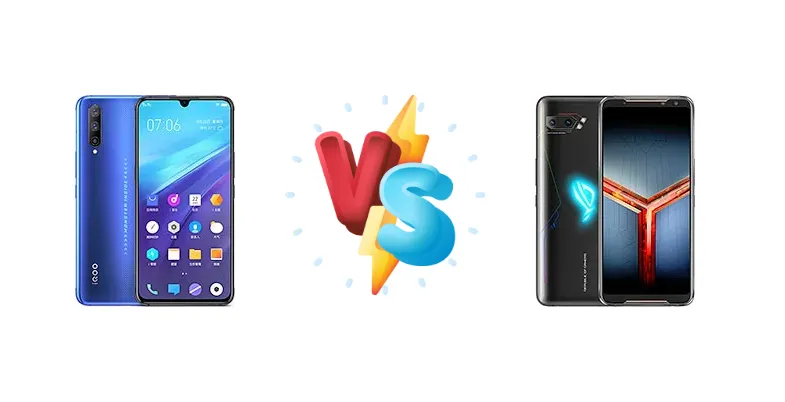
|
🏆 Quick Verdict
For the average user prioritizing a blend of performance and rapid replenishment, the iQOO Pro emerges as the winner. Its 44W charging significantly outperforms the ROG Phone II’s 30W, offering quicker top-ups, despite the ROG Phone II’s slightly better battery endurance rating.
| PHONES | ||
|---|---|---|
| Phone Names | vivo iQOO Pro | Asus ROG Phone II ZS660KL |
| Network | ||
|---|---|---|
| 2G bands | GSM 850 / 900 / 1800 / 1900 | GSM 850 / 900 / 1800 / 1900 |
| 3G bands | HSDPA 850 / 900 / 1700(AWS) / 2100 | HSDPA 850 / 900 / 1900 / 2100 |
| 4G bands | 1, 2, 3, 4, 5, 7, 8, 12, 17, 18, 19, 20, 25, 26, 38, 39, 40, 41 | 1, 2, 3, 4, 5, 7, 8, 12, 13, 17, 18, 19, 20, 28, 29, 32, 34, 38, 39, 40, 41, 46 |
| Speed | HSPA 42.2/5.76 Mbps, LTE (7CA) Cat20 2000/150 Mbps | HSPA 42.2/5.76 Mbps, LTE (5CA) Cat18 (Cat20 Ultimate edition) 1200/150 Mbps |
| Technology | GSM / CDMA / HSPA / LTE | GSM / HSPA / LTE |
| CDMA 800 & TD-SCDMA | - | |
| Launch | ||
|---|---|---|
| Announced | 2019, August. Released 2019, August | 2019, July 22. Released 2019, September |
| Status | Discontinued | Discontinued |
| Body | ||
|---|---|---|
| Build | - | Glass front (Gorilla Glass 6), glass back (Gorilla Glass 3), aluminum frame |
| Dimensions | 158.8 x 75.7 x 9.3 mm (6.25 x 2.98 x 0.37 in) | 171 x 77.6 x 9.5 mm (6.73 x 3.06 x 0.37 in) |
| SIM | Nano-SIM + Nano-SIM | Nano-SIM + Nano-SIM |
| Weight | 215 g (7.58 oz) | 240 g (8.47 oz) |
| - | RGB light panel (on the back) | |
| Display | ||
|---|---|---|
| Protection | - | Corning Gorilla Glass 6 |
| Resolution | 1080 x 2340 pixels, 19.5:9 ratio (~402 ppi density) | 1080 x 2340 pixels, 19.5:9 ratio (~391 ppi density) |
| Size | 6.41 inches, 100.9 cm2 (~83.9% screen-to-body ratio) | 6.59 inches, 106.6 cm2 (~80.3% screen-to-body ratio) |
| Type | Super AMOLED | AMOLED, 1B colors, 120Hz, HDR10 |
| Platform | ||
|---|---|---|
| CPU | Octa-core (1x2.84 GHz Kryo 485 & 3x2.42 GHz Kryo 485 & 4x1.78 GHz Kryo 485) | Octa-core (1x2.96 GHz Kryo 485 & 3x2.42 GHz Kryo 485 & 4x1.78 GHz Kryo 485) |
| Chipset | Qualcomm SM8150 Snapdragon 855+ (7 nm) | Qualcomm SM8150 Snapdragon 855+ (7 nm) |
| GPU | Adreno 640 (700 MHz) | Adreno 640 (700 MHz) |
| OS | Android 9.0 (Pie), Funtouch 9.1 | Android 9.0 (Pie), ROG UI |
| Memory | ||
|---|---|---|
| Card slot | No | No |
| Internal | 128GB 8GB RAM, 128GB 12GB RAM | 128GB 8GB RAM, 256GB 12GB RAM, 512GB 12GB RAM, 1TB 12GB RAM |
| UFS 3.0 | UFS 3.0 | |
| Main Camera | ||
|---|---|---|
| Dual | - | 48 MP, f/1.8, 26mm (wide), 1/2.0", 0.8µm, PDAF 13 MP, f/2.4, 11mm (ultrawide) |
| Features | LED flash, HDR, panorama | Laser AF, LED flash, HDR, panorama |
| Single | - | 5 MP |
| Triple | 48 MP, f/1.8, (wide), 1/2.0", 0.8µm, PDAF 13 MP, f/2.2, (ultrawide) Auxiliary lens | - |
| Video | 4K@30/60fps, 1080p@30/60fps, 720p@1920fps | 4K@30/60fps, 1080p@30/60/240fps, 720p@480fps; gyro-EIS (except @240/480fps) |
| Selfie camera | ||
|---|---|---|
| Features | HDR | Panorama, HDR |
| Single | 12 MP, f/2.0, (wide), 1/2.8", 1.28µm | 24MP, f/2.2, 0.9µm |
| Video | 1080p@30fps | 1080p@30fps |
| Sound | ||
|---|---|---|
| 3.5mm jack | Yes | Yes |
| 35mm jack | Yes | Yes |
| Loudspeaker | Yes | Yes, with DTS:X stereo speakers (2 dedicated amplifiers) |
| 32-bit/192kHz audio | 24-bit/192kHz audio | |
| Comms | ||
|---|---|---|
| Bluetooth | 5.0, A2DP, LE, aptX | 5.0, A2DP, LE, aptX HD |
| NFC | Yes | Yes |
| Positioning | GPS, GLONASS, BDS, GALILEO | GPS (L1+L5), GLONASS, BDS, GALILEO, QZSS |
| Radio | No | FM radio |
| USB | USB Type-C 2.0, OTG | USB Type-C 3.1, accessory connector, OTG |
| WLAN | Wi-Fi 802.11 a/b/g/n/ac, dual-band, Wi-Fi Direct | Wi-Fi 802.11 a/b/g/n/ac/ad, dual-band, Wi-Fi Direct |
| Features | ||
|---|---|---|
| Sensors | Fingerprint (under display, optical), accelerometer, gyro, proximity, compass | Fingerprint (under display, optical), accelerometer, gyro, proximity, compass |
| Battery | ||
|---|---|---|
| Charging | 44W wired | 30W wired 10W reverse wired, QC4 |
| Stand-by | - | Up to 150 h (3G) |
| Talk time | - | Up to 5 h (3G) |
| Type | 4500 mAh, non-removable | Li-Po 6000 mAh, non-removable |
| Misc | ||
|---|---|---|
| Colors | Black, Blue | Matte Black, Glossy Black |
| Models | V1922A, V1922A | ASUS_I001D, I001DA, I001DE, I001DC, I001DB, I001D, I001DD |
| Price | About 410 EUR | About 1070 EUR |
| Tests | ||
|---|---|---|
| Battery life | - | Endurance rating 114h |
| Camera | - | Photo / Video |
| Display | - | Contrast ratio: Infinite (nominal) |
| Loudspeaker | - | -19.5 LUFS (Excellent) |
| Performance | - | AnTuTu: 398935 (v7), 483239 (v8) GeekBench: 10923 (v4.4) GFXBench: 40fps (ES 3.1 onscreen) |
vivo iQOO Pro
- Significantly faster 44W charging
- Potentially more compact form factor
- Likely streamlined software experience
- Battery capacity not specified
- Camera details are unknown
Asus ROG Phone II ZS660KL
- Exceptional 114-hour battery endurance
- Higher CPU clock speed (marginal)
- 10W reverse wired charging
- Slower 30W charging
- Larger size may be less comfortable for some
Display Comparison
The Asus ROG Phone II boasts a measured peak brightness of 626 nits, providing excellent visibility in bright conditions. While the iQOO Pro’s display specs aren’t provided, the ROG Phone II’s infinite contrast ratio (nominal) suggests a superior viewing experience with deeper blacks. The ROG Phone II’s larger display size, typical of gaming phones, offers a more immersive experience, though the iQOO Pro likely aims for a more manageable form factor. Without PWM frequency data for the iQOO Pro, it’s difficult to assess potential eye strain compared to the ROG Phone II.
Camera Comparison
Both phones feature photo and video capabilities, but detailed camera specifications are lacking. Without sensor size, aperture, or image processing details, a direct comparison is difficult. The ROG Phone II’s gaming focus suggests camera performance may be secondary, while vivo generally prioritizes camera quality in its iQOO sub-brand. The absence of specific details makes it impossible to determine which phone offers superior image quality or low-light performance.
Performance
Both devices are powered by the Qualcomm SM8150 Snapdragon 855+ (7 nm) chipset, but the ROG Phone II’s CPU clocks slightly higher at 2.96 GHz versus the iQOO Pro’s 2.84 GHz. This difference, while measurable, is unlikely to translate into a significant real-world performance gap for most users. Both utilize an octa-core configuration with the same Kryo 485 core arrangement. Thermal management will be crucial; the ROG Phone II’s larger chassis may offer better heat dissipation, potentially mitigating throttling during prolonged gaming sessions. The iQOO Pro’s focus on fast charging might necessitate more aggressive thermal throttling to protect the battery during charging.
Battery Life
The Asus ROG Phone II achieves an impressive endurance rating of 114 hours, indicating exceptional battery life. The iQOO Pro’s battery capacity is not specified, but its 44W wired charging significantly surpasses the ROG Phone II’s 30W charging, including Quick Charge 4 (QC4) support. This means the iQOO Pro can replenish its battery much faster, even if its overall capacity is smaller. The ROG Phone II also offers 10W reverse wired charging, a feature absent in the iQOO Pro, allowing it to charge other devices.
Buying Guide
Buy the vivo iQOO Pro if you need consistently fast charging and a streamlined user experience without excessive gaming-specific frills. It’s ideal for users who game frequently but also demand a phone that excels in everyday tasks. Buy the Asus ROG Phone II ZS660KL if you prioritize maximum battery endurance and are willing to trade charging speed for extended gaming sessions, and appreciate the gaming-focused software and potential for accessories.