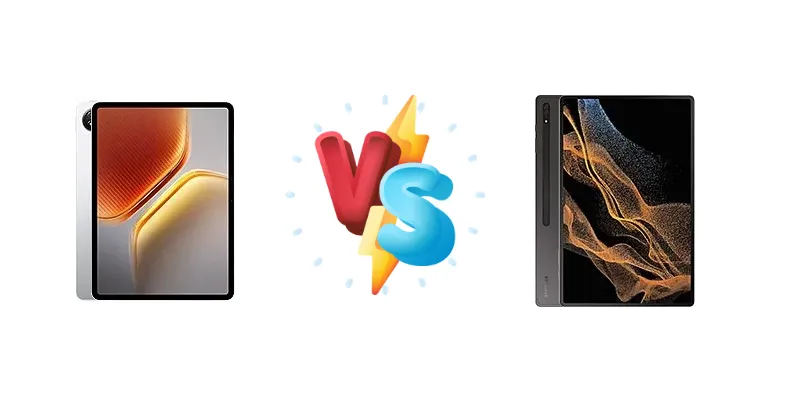
The tablet market is heating up, with the vivo IQOO Pad5 challenging Samsung’s dominance with its new Mediatek Dimensity 9300+ chipset. This comparison pits the IQOO Pad5’s focus on raw CPU performance against the Samsung Galaxy Tab S8 Ultra’s established ecosystem, larger display, and refined software experience. We’ll dissect the key differences to help you decide which tablet best suits your needs.
🏆 Quick Verdict
For users prioritizing peak CPU performance and future-proofing, the IQOO Pad5 is the winner. Its Dimensity 9300+ offers a more modern CPU architecture. However, the Samsung Galaxy Tab S8 Ultra remains a compelling choice for those deeply invested in the Samsung ecosystem and valuing a larger, more polished experience.
| Network |
|---|
| 2G bands | N/A | GSM 850 / 900 / 1800 / 1900 |
| 3G bands | N/A | HSDPA 850 / 900 / 1700(AWS) / 1900 / 2100 |
| 4G bands | N/A | LTE |
| 5G bands | - | SA/NSA |
| EDGE | No | - |
| GPRS | No | - |
| Speed | - | HSPA, LTE, 5G - cellular model only |
| Technology | No cellular connectivity | GSM / HSPA / LTE / 5G |
| Launch |
|---|
| Announced | 2025, May 20 | 2022, February 09 |
| Status | Available. Released 2025, May 20 | Available. Released 2022, April 30 |
| Body |
|---|
| Build | Glass front, aluminum back, aluminum frame | - |
| Dimensions | 266.4 x 192 x 6.6 mm (10.49 x 7.56 x 0.26 in) | 326.4 x 208.6 x 5.5 mm (12.85 x 8.21 x 0.22 in) |
| SIM | No | Nano-SIM (cellular model only) |
| Weight | 590 g (1.30 lb) | 726 g (Wi-Fi), 728 g (5G) (1.60 lb) |
| | - | Stylus, 2.8ms latency (Bluetooth integration, accelerometer, gyro) |
| Display |
|---|
| Protection | - | Corning Gorilla Glass 5 |
| Resolution | 1968 x 2800 pixels (~283 ppi density) | 1848 x 2960 pixels, 16:10 ratio (~240 ppi density) |
| Size | 12.1 inches, 444.4 cm2 (~86.9% screen-to-body ratio) | 14.6 inches, 612.6 cm2 (~90.0% screen-to-body ratio) |
| Type | IPS LCD, 1B colors, 144Hz, HDR10, 900 nits (peak) | Super AMOLED, 120Hz, HDR10+ |
| Platform |
|---|
| CPU | Octa-core (1x3.4 GHz Cortex-X4 & 3x2.85 GHz Cortex-X4 & 4x2.0 GHz Cortex-A720) | Octa-core (1x3.00 GHz Cortex-X2 & 3x2.50 GHz Cortex-A710 & 4x1.80 GHz Cortex-A510) |
| Chipset | Mediatek Dimensity 9300+ (4 nm) | Qualcomm SM8450 Snapdragon 8 Gen 1 (4 nm) |
| GPU | Immortalis-G720 MC12 | Adreno 730 |
| OS | Android 15, OriginOS 5 HD | Android 12, up to 4 major Android upgrades, One UI 6.1.1 |
| Memory |
|---|
| Card slot | No | microSDXC (dedicated slot) |
| Internal | 128GB 8GB RAM, 256GB 8GB RAM, 256GB 12GB RAM, 512GB 16GB RAM | 128GB 8GB RAM, 256GB 8GB RAM, 256GB 12GB RAM, 256GB 16GB RAM, 512GB 12GB RAM, 512GB 16GB RAM |
| | - | UFS |
| Main Camera |
|---|
| Dual | - | 13 MP, f/2.0, 26mm (wide), 1/3.4", 1.0µm, AF
6 MP, f/2.2, (ultrawide) |
| Features | LED flash | LED flash, HDR, panorama |
| Single | 8 MP | - |
| Video | 1080p@30fps | 4K@30/60fps, 1080p@30fps |
| Selfie camera |
|---|
| Dual | - | 12 MP, f/2.2, 26mm (wide)
12 MP, f/2.4, 120˚ (ultrawide) |
| Features | - | HDR |
| Single | 5 MP | - |
| Video | 1080p@30fps | 4K@30/60fps, 1080p@30fps |
| Sound |
|---|
| 3.5mm jack | - | No |
| 35mm jack | No | No |
| Loudspeaker | Yes, with stereo speakers (6 speakers) | Yes, with stereo speakers (4 speakers) |
| | - | Tuned by AKG |
| Comms |
|---|
| Bluetooth | 5.4, A2DP, LE | 5.2, A2DP, LE |
| NFC | No | No |
| Positioning | Unspecified | GPS, GLONASS, BDS, GALILEO - cellular model only |
| Radio | No | No |
| USB | USB Type-C 3.2, OTG, magnetic connector | USB Type-C 3.2, magnetic connector |
| WLAN | Wi-Fi 802.11 a/b/g/n/ac/6/7, dual-band | Wi-Fi 802.11 a/b/g/n/ac/6e, dual-band, Wi-Fi Direct |
| Features |
|---|
| Sensors | Accelerometer, proximity (accessories only), gyro | Fingerprint (under display, optical), accelerometer, gyro, proximity, compass |
| | - | Wireless Samsung DeX |
| Battery |
|---|
| Charging | 44W wired, PD
5W reverse wired | 45W wired, 100% in 82 min |
| Type | 10000 mAh | Li-Po 11200 mAh |
| Misc |
|---|
| Colors | Gray, Green, Silver | Graphite |
| Models | - | SM-X900, SM-X906, SM-X906B, SM-X906U, SM-X906N |
| Price | About 290 EUR | About 1150 EUR |
| SAR EU | - | 0.69 W/kg (body) |
vivo IQOO Pad5
- Cutting-edge Dimensity 9300+ CPU architecture
- Potentially faster charging speeds (44W vs 45W)
- Reverse wired charging capability
- Limited information on display and camera specs
- Less established ecosystem compared to Samsung
Samsung Galaxy Tab S8 Ultra
- Large, high-quality 14.6-inch Super AMOLED display
- Mature Samsung ecosystem and software experience
- S Pen support for enhanced productivity
- Older Snapdragon 8 Gen 1 chipset
- Larger size may be less portable
Display Comparison
While specific display specs beyond size are unavailable for the IQOO Pad5, the Samsung Galaxy Tab S8 Ultra boasts a massive 14.6-inch Super AMOLED display. Both devices utilize a 4nm chipset, suggesting a focus on power efficiency, which is crucial for larger displays. The Tab S8 Ultra’s AMOLED panel offers superior contrast and color accuracy compared to typical LCD panels, and its 120Hz refresh rate ensures smooth scrolling and animations. The IQOO Pad5’s display quality will be a key factor in determining its overall value, but the Tab S8 Ultra clearly leads in size and panel technology.
Camera Comparison
Detailed camera specifications for the IQOO Pad5 are currently unavailable. The Samsung Galaxy Tab S8 Ultra features a 13MP main camera and a 12MP ultrawide camera. While tablet cameras aren’t typically a primary focus, the Tab S8 Ultra’s setup is adequate for video calls and casual photography. Without specific details on the IQOO Pad5’s camera system, it’s difficult to make a direct comparison, but the Tab S8 Ultra holds an advantage based on available information.
Performance
The core of this comparison lies in the chipsets. The IQOO Pad5’s Mediatek Dimensity 9300+ features a unique CPU configuration with a 1x3.4 GHz Cortex-X4, 3x2.85 GHz Cortex-X4, and 4x2.0 GHz Cortex-A720 cores. This architecture prioritizes peak performance, particularly in single-core tasks, due to the multiple high-performance X4 cores. The Samsung Galaxy Tab S8 Ultra, powered by the Qualcomm Snapdragon 8 Gen 1, utilizes a more traditional 1x3.00 GHz Cortex-X2, 3x2.50 GHz Cortex-A710, and 4x1.80 GHz Cortex-A510 configuration. While the Snapdragon 8 Gen 1 is a powerful chip, the Dimensity 9300+’s newer architecture and higher clock speeds suggest a performance advantage, especially in CPU-bound workloads. Both utilize a 4nm process, but the Dimensity 9300+'s core design is more modern.
Battery Life
The Samsung Galaxy Tab S8 Ultra packs an 11,200 mAh battery and supports 45W wired charging, achieving a full charge in approximately 82 minutes. The IQOO Pad5 has a smaller battery capacity, but compensates with 44W wired charging and 5W reverse wired charging. The Tab S8 Ultra’s larger battery provides longer runtime, but the IQOO Pad5’s faster charging could be beneficial for users who need a quick top-up. The Dimensity 9300+'s efficiency could mitigate the smaller battery capacity, but real-world testing is needed to confirm.
Buying Guide
Buy the vivo IQOO Pad5 if you need a tablet focused on demanding tasks like video editing, content creation, or running complex applications, and you value the latest CPU technology. Buy the Samsung Galaxy Tab S8 Ultra if you prefer a larger screen for multitasking and media consumption, seamless integration with Samsung devices, and a more mature software experience with S Pen support.
Frequently Asked Questions
❓ How does the Dimensity 9300+ handle sustained workloads compared to the Snapdragon 8 Gen 1 in the Tab S8 Ultra?
The Dimensity 9300+'s newer architecture and potentially improved thermal management suggest better sustained performance under heavy loads. While the Snapdragon 8 Gen 1 is powerful, it's known to throttle under prolonged stress. The IQOO Pad5's cooling solution will be crucial, but the chipset itself offers a foundation for more consistent performance.
❓ Does the IQOO Pad5 support any stylus functionality, and how does it compare to the S Pen experience on the Tab S8 Ultra?
Currently, there is no information available regarding stylus support for the IQOO Pad5. The Samsung Galaxy Tab S8 Ultra offers a fully integrated S Pen experience with low latency and advanced features like Air Actions, making it a significant advantage for users who rely on stylus input for note-taking, drawing, or navigation.
❓ What kind of gaming performance can I expect from the IQOO Pad5 with the Dimensity 9300+?
The Dimensity 9300+ is expected to deliver excellent gaming performance, potentially exceeding the Snapdragon 8 Gen 1 in titles optimized for its architecture. The combination of a powerful CPU and GPU should allow for high frame rates and smooth gameplay in demanding mobile games. However, sustained performance will depend on the tablet's cooling system.