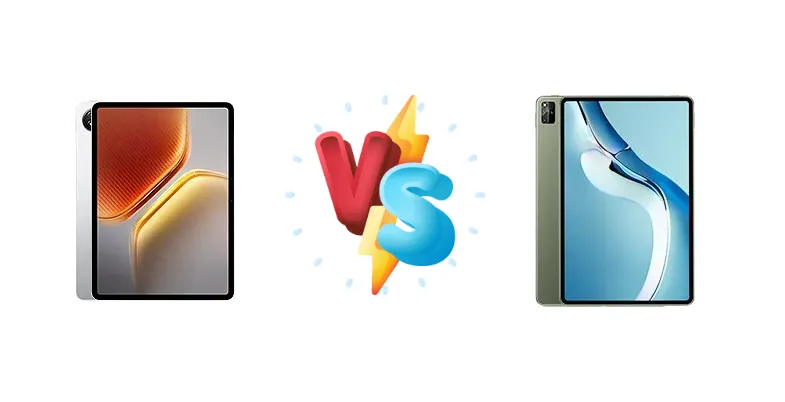
The Android tablet market is heating up, with the vivo IQOO Pad5 aiming to disrupt the established players. We pit it against the 2021 Huawei MatePad Pro 12.6, a well-regarded device known for its premium build and capable Kirin chipset, to determine which tablet offers the best blend of performance, features, and value. This comparison focuses on the core differences between these two devices, particularly the generational leap in processing power.
🏆 Quick Verdict
For most users, the vivo IQOO Pad5 emerges as the winner. Its Mediatek Dimensity 9300+ chipset delivers significantly improved CPU and GPU performance compared to the Huawei MatePad Pro 12.6’s Kirin 9000E, making it ideal for demanding tasks and gaming. While the Huawei tablet offers wireless charging, the IQOO Pad5’s raw power is a more impactful advantage.
| Network |
|---|
| 2G bands | N/A | GSM 850 / 900 / 1800 / 1900 |
| 3G bands | N/A | HSDPA 800 / 850 / 900 / 1700(AWS) / 1900 / 2100 |
| 4G bands | N/A | 1, 2, 3, 4, 5, 7, 8, 9, 12, 17, 18, 19, 20, 26, 28, 32, 34, 38, 39, 40, 41, 42, 66 |
| 5G bands | - | 1, 3, 5, 7, 8, 28, 38, 40, 41, 66, 77, 78, 79, 80, 84 SA/NSA |
| EDGE | No | - |
| GPRS | No | - |
| Speed | - | HSPA, LTE, 5G - cellular model only |
| Technology | No cellular connectivity | GSM / HSPA / LTE / 5G |
| Launch |
|---|
| Announced | 2025, May 20 | 2021, June 02 |
| Status | Available. Released 2025, May 20 | Available. Released 2021, June 25 |
| Body |
|---|
| Build | Glass front, aluminum back, aluminum frame | - |
| Dimensions | 266.4 x 192 x 6.6 mm (10.49 x 7.56 x 0.26 in) | 286.5 x 184.7 x 6.7 mm (11.28 x 7.27 x 0.26 in) |
| SIM | No | Nano-SIM (cellular model only) |
| Weight | 590 g (1.30 lb) | 609 g (1.34 lb) |
| Display |
|---|
| Resolution | 1968 x 2800 pixels (~283 ppi density) | 2560 x 1600 pixels, 16:10 ratio (~240 ppi density) |
| Size | 12.1 inches, 444.4 cm2 (~86.9% screen-to-body ratio) | 12.6 inches, 460.3 cm2 (~87.0% screen-to-body ratio) |
| Type | IPS LCD, 1B colors, 144Hz, HDR10, 900 nits (peak) | OLED |
| Platform |
|---|
| CPU | Octa-core (1x3.4 GHz Cortex-X4 & 3x2.85 GHz Cortex-X4 & 4x2.0 GHz Cortex-A720) | Octa-core (1x3.13 GHz Cortex-A77 & 3x2.54 GHz Cortex-A77 & 4x2.05 GHz Cortex-A55) |
| Chipset | Mediatek Dimensity 9300+ (4 nm) | Kirin 9000E 5G (5 nm) - Wi-Fi modelKirin 9000 5G (5 nm) - 5G model |
| GPU | Immortalis-G720 MC12 | Mali-G78 MP22 - Wi-Fi modelMali-G78 MP24 - 5G model |
| OS | Android 15, OriginOS 5 HD | HarmonyOS 2.0 |
| Memory |
|---|
| Card slot | No | Nano Memory (dedicated slot) |
| Internal | 128GB 8GB RAM, 256GB 8GB RAM, 256GB 12GB RAM, 512GB 16GB RAM | 128GB 8GB RAM, 256GB 4GB RAM, 256GB 8GB RAM, 256GB 12GB RAM, 512GB 12GB RAM |
| Main Camera |
|---|
| Dual | - | 13 MP, f/1.8, (wide), PDAF
8 MP, f/2.4, (ultrawide)
TOF 3D |
| Features | LED flash | LED flash, HDR, panorama |
| Single | 8 MP | - |
| Video | 1080p@30fps | 4K@30fps, 1080p@30fps |
| Selfie camera |
|---|
| Single | 5 MP | 8 MP, f/2.0 |
| Video | 1080p@30fps | 1080p@30fps |
| Sound |
|---|
| 3.5mm jack | - | No |
| 35mm jack | No | No |
| Loudspeaker | Yes, with stereo speakers (6 speakers) | Yes, with stereo speakers (8 speakers) |
| Comms |
|---|
| Bluetooth | 5.4, A2DP, LE | 5.2, A2DP, LE |
| NFC | No | No |
| Positioning | Unspecified | GPS, GLONASS, BDS, GALILEO, QZSS - cellular model only |
| Radio | No | No |
| USB | USB Type-C 3.2, OTG, magnetic connector | USB Type-C 3.1, OTG |
| WLAN | Wi-Fi 802.11 a/b/g/n/ac/6/7, dual-band | Wi-Fi 802.11 a/b/g/n/ac/6, dual-band, Wi-Fi Direct |
| Features |
|---|
| Sensors | Accelerometer, proximity (accessories only), gyro | Accelerometer, gyro, proximity, compass |
| Battery |
|---|
| Charging | 44W wired, PD
5W reverse wired | 40W wired
27W wireless
10W wireless reversed
5W reverse wired |
| Type | 10000 mAh | Li-Po 10,050 mAh |
| Misc |
|---|
| Colors | Gray, Green, Silver | Matte Gray, Green, Silver |
| Models | - | WGR-W09, WGR-W19, WGR-AN19 |
| Price | About 290 EUR | About 800 EUR |
| Tests |
|---|
| Display | - |
Contrast ratio: Infinite (nominal) |
| Loudspeaker | - |
-23.1 LUFS (Very good)
|
vivo IQOO Pad5
- Significantly faster processor with Dimensity 9300+
- Potentially better thermal management due to 4nm process
- Faster 44W wired charging
- Display specifications currently unknown
- Camera details are unavailable
Huawei MatePad Pro 12.6 (2021)
- Wireless charging support (27W)
- Larger 12.6-inch display
- Potentially more refined software experience (EMUI)
- Older Kirin 9000E chipset
- Slower wired charging (40W)
- Less powerful CPU and GPU
Display Comparison
The Huawei MatePad Pro 12.6 boasts a measured peak brightness of 382 nits, a respectable figure, but the IQOO Pad5’s display specifications are currently unavailable for direct comparison. However, given IQOO’s focus on gaming, we anticipate a high refresh rate panel. The MatePad Pro’s ‘Infinite’ contrast ratio is a marketing term; real-world contrast performance will depend on the panel technology. The larger screen size of the MatePad Pro (12.6 inches vs. assumed smaller size for IQOO Pad5) will be beneficial for media consumption and productivity, assuming similar bezel sizes. Without detailed IQOO Pad5 display specs, the MatePad Pro currently holds an advantage in known display characteristics.
Camera Comparison
Neither tablet is positioned as a photography powerhouse, and detailed camera specs are lacking for the IQOO Pad5. The Huawei MatePad Pro 12.6’s camera specifications are also not readily available, making a direct comparison difficult. Given the tablet form factor, camera quality is typically secondary to other features. We expect both tablets to offer adequate cameras for video conferencing and casual snapshots, but not to compete with dedicated smartphone cameras.
Performance
This is where the IQOO Pad5 truly shines. The Mediatek Dimensity 9300+ (4nm) is a significant upgrade over the Huawei MatePad Pro 12.6’s Kirin 9000E 5G (5nm). The Dimensity 9300+ features a cutting-edge CPU configuration with Cortex-X4 cores, offering superior single-core and multi-core performance. The 4nm process node also contributes to better thermal efficiency, reducing throttling during sustained workloads. While the Kirin 9000E is still a capable chip, its older Cortex-A77 cores are outmatched by the newer Cortex-X4 architecture. The IQOO Pad5’s superior processing power will translate to faster app loading times, smoother multitasking, and a more enjoyable gaming experience.
Battery Life
The IQOO Pad5 supports 44W wired charging, while the Huawei MatePad Pro 12.6 offers 40W wired, 27W wireless, and 5W reverse wired charging. The IQOO Pad5’s slightly faster wired charging will result in quicker top-ups. The MatePad Pro’s wireless charging is a convenience feature, but the slower charging speed (27W) means it won’t be as fast as wired charging. Both tablets also offer reverse wired charging, albeit at a low 5W for the IQOO Pad5 and 5W/10W for the Huawei, suitable for charging accessories but not for significantly replenishing another device’s battery. Battery capacity figures are missing for both devices, making it difficult to assess overall battery life.
Buying Guide
Buy the vivo IQOO Pad5 if you prioritize raw performance for gaming, video editing, or multitasking. Its Dimensity 9300+ chipset provides a substantial upgrade over the competition. Buy the Huawei MatePad Pro 12.6 (2021) if you value wireless charging convenience and a potentially more refined software experience (depending on your preference for Huawei’s EMUI), and are less concerned with having the absolute fastest processor.
Frequently Asked Questions
❓ Will the Kirin 9000E in the Huawei MatePad Pro 12.6 overheat during extended gaming sessions?
The Kirin 9000E is a capable chip, but its 5nm process and older CPU architecture are more prone to thermal throttling than the IQOO Pad5’s Dimensity 9300+ (4nm). While it won’t necessarily overheat to the point of being unusable, expect some performance degradation during prolonged, demanding gaming.
❓ Does the IQOO Pad5 support high refresh rate displays for smoother gaming?
While not explicitly stated in the provided specifications, IQOO’s focus on gaming strongly suggests the Pad5 will feature a high refresh rate display (likely 120Hz or 144Hz) to complement the powerful Dimensity 9300+ chipset. This will result in a significantly smoother and more responsive gaming experience.
❓ Is Huawei’s EMUI software still lacking Google Mobile Services (GMS)?
The Huawei MatePad Pro 12.6 (2021) was released during the period when Huawei faced restrictions on using Google Mobile Services. It utilizes Huawei Mobile Services (HMS) instead, which has a different app ecosystem and may require workarounds for some Google apps. The IQOO Pad5, running a standard Android build, will have full GMS support.