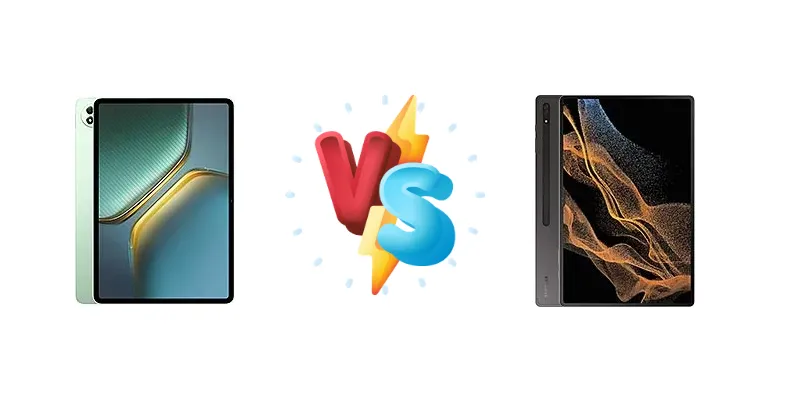
The Android tablet market is heating up, with the vivo IQOO Pad5 Pro challenging Samsung’s dominance with its new Mediatek Dimensity 9400+ chipset. We pit this newcomer against the established Samsung Galaxy Tab S8 Ultra, powered by the Snapdragon 8 Gen 1, to determine which tablet delivers the best blend of performance, features, and value for demanding users.
🏆 Quick Verdict
For users prioritizing raw processing power and future-proofing, the IQOO Pad5 Pro emerges as the winner. Its Dimensity 9400+ chipset, built on a 3nm process, offers a significant architectural advantage over the 4nm Snapdragon 8 Gen 1 in the Tab S8 Ultra, translating to potentially better sustained performance and efficiency. However, Samsung’s software ecosystem and established brand recognition remain strong contenders.
| Network |
|---|
| 2G bands | N/A | GSM 850 / 900 / 1800 / 1900 |
| 3G bands | N/A | HSDPA 850 / 900 / 1700(AWS) / 1900 / 2100 |
| 4G bands | N/A | LTE |
| 5G bands | - | SA/NSA |
| EDGE | No | - |
| GPRS | No | - |
| Speed | - | HSPA, LTE, 5G - cellular model only |
| Technology | No cellular connectivity | GSM / HSPA / LTE / 5G |
| Launch |
|---|
| Announced | 2025, May 20 | 2022, February 09 |
| Status | Available. Released 2025, May 20 | Available. Released 2022, April 30 |
| Body |
|---|
| Build | Glass front, aluminum back, aluminum frame | - |
| Dimensions | 289.6 x 198.3 x 6.1 mm (11.40 x 7.81 x 0.24 in) | 326.4 x 208.6 x 5.5 mm (12.85 x 8.21 x 0.22 in) |
| SIM | No | Nano-SIM (cellular model only) |
| Weight | 635 g (1.40 lb) | 726 g (Wi-Fi), 728 g (5G) (1.60 lb) |
| | - | Stylus, 2.8ms latency (Bluetooth integration, accelerometer, gyro) |
| Display |
|---|
| Protection | - | Corning Gorilla Glass 5 |
| Resolution | 2064 x 3096 pixels, 3:2 ratio (~286 ppi density) | 1848 x 2960 pixels, 16:10 ratio (~240 ppi density) |
| Size | 13.0 inches, 503.2 cm2 (~87.6% screen-to-body ratio) | 14.6 inches, 612.6 cm2 (~90.0% screen-to-body ratio) |
| Type | IPS LCD, 1B colors, 144Hz, HDR10, 1200 nits (peak) | Super AMOLED, 120Hz, HDR10+ |
| Platform |
|---|
| CPU | Octa-core (1x3.73 GHz Cortex-X925 & 3x3.3 GHz Cortex-X4 & 4x2.4 GHz Cortex-A720) | Octa-core (1x3.00 GHz Cortex-X2 & 3x2.50 GHz Cortex-A710 & 4x1.80 GHz Cortex-A510) |
| Chipset | Mediatek Dimensity 9400+ (3 nm) | Qualcomm SM8450 Snapdragon 8 Gen 1 (4 nm) |
| GPU | Immortalis-G925 MC12 | Adreno 730 |
| OS | Android 15, OriginOS 5 HD | Android 12, up to 4 major Android upgrades, One UI 6.1.1 |
| Memory |
|---|
| Card slot | No | microSDXC (dedicated slot) |
| Internal | 256GB 8GB RAM, 256GB 12GB RAM, 512GB 12GB RAM, 512GB 16GB RAM | 128GB 8GB RAM, 256GB 8GB RAM, 256GB 12GB RAM, 256GB 16GB RAM, 512GB 12GB RAM, 512GB 16GB RAM |
| | - | UFS |
| Main Camera |
|---|
| Dual | - | 13 MP, f/2.0, 26mm (wide), 1/3.4", 1.0µm, AF
6 MP, f/2.2, (ultrawide) |
| Features | LED flash, panorama | LED flash, HDR, panorama |
| Single | 13 MP | - |
| Video | 4K, 1080p | 4K@30/60fps, 1080p@30fps |
| Selfie camera |
|---|
| Dual | - | 12 MP, f/2.2, 26mm (wide)
12 MP, f/2.4, 120˚ (ultrawide) |
| Features | - | HDR |
| Single | 8 MP | - |
| Video | 1080p@30fps | 4K@30/60fps, 1080p@30fps |
| Sound |
|---|
| 3.5mm jack | - | No |
| 35mm jack | No | No |
| Loudspeaker | Yes, with stereo speakers (8 speakers) | Yes, with stereo speakers (4 speakers) |
| | - | Tuned by AKG |
| Comms |
|---|
| Bluetooth | 5.4, A2DP, LE | 5.2, A2DP, LE |
| NFC | No | No |
| Positioning | Unspecified | GPS, GLONASS, BDS, GALILEO - cellular model only |
| Radio | No | No |
| USB | USB Type-C 3.2, OTG, magnetic connector | USB Type-C 3.2, magnetic connector |
| WLAN | Wi-Fi 802.11 a/b/g/n/ac/6/7, dual-band | Wi-Fi 802.11 a/b/g/n/ac/6e, dual-band, Wi-Fi Direct |
| Features |
|---|
| Sensors | Accelerometer, gyro, proximity (accessories only) | Fingerprint (under display, optical), accelerometer, gyro, proximity, compass |
| | - | Wireless Samsung DeX |
| Battery |
|---|
| Charging | 66W wired, PD
5W reverse wired | 45W wired, 100% in 82 min |
| Type | 12050 mAh | Li-Po 11200 mAh |
| Misc |
|---|
| Colors | Gray, Green, Silver | Graphite |
| Models | - | SM-X900, SM-X906, SM-X906B, SM-X906U, SM-X906N |
| Price | About 390 EUR | About 1150 EUR |
| SAR EU | - | 0.69 W/kg (body) |
vivo IQOO Pad5 Pro
- Superior chipset performance with Dimensity 9400+
- Faster 66W wired charging
- Potentially better thermal management due to 3nm process
- Less established brand recognition
- Software ecosystem may not be as mature as Samsung's
Samsung Galaxy Tab S8 Ultra
- Large 14.6-inch display
- Mature software experience with One UI
- Seamless integration with Samsung ecosystem
- Slower 45W charging
- Snapdragon 8 Gen 1 is less efficient than Dimensity 9400+
Display Comparison
While both tablets likely feature high-quality displays, specific details like resolution and refresh rate are missing. However, the chipset’s ability to drive a high-resolution display smoothly is crucial. The Dimensity 9400+’s advanced GPU architecture should handle demanding visuals with ease. The Tab S8 Ultra’s large 14.6-inch display is a key selling point, but the IQOO Pad5 Pro’s display quality will be critical to compete. We anticipate both will utilize LTPO technology for variable refresh rates, optimizing battery life.
Camera Comparison
Given the tablet form factor, camera performance isn’t a primary concern for most users. However, the IQOO Pad5 Pro and Galaxy Tab S8 Ultra likely feature capable camera systems. Without specific sensor details, it’s difficult to make a direct comparison. We expect Samsung to leverage its image processing expertise, but the Dimensity 9400+'s ISP could offer competitive performance. The presence of OIS on the main sensor would be a significant advantage for both devices.
Performance
The core of this comparison lies in the chipsets. The IQOO Pad5 Pro’s Mediatek Dimensity 9400+ (3nm) boasts a Cortex-X925 prime core clocked at 3.73 GHz, alongside three Cortex-X4 cores at 3.3 GHz and four Cortex-A720 efficiency cores. This configuration is a step ahead of the Galaxy Tab S8 Ultra’s Snapdragon 8 Gen 1 (4nm) with its Cortex-X2, A710, and A510 cores. The 3nm process node of the Dimensity 9400+ offers superior transistor density and power efficiency, potentially leading to less thermal throttling during sustained workloads. The IQOO Pad5 Pro’s LPDDR5x RAM will further enhance memory bandwidth, contributing to smoother multitasking and faster application loading times.
Battery Life
The IQOO Pad5 Pro’s 66W wired charging is a clear advantage over the Galaxy Tab S8 Ultra’s 45W charging. The faster charging speed translates to significantly reduced downtime, allowing users to quickly replenish the battery. While the Tab S8 Ultra claims a full charge in 82 minutes, the IQOO Pad5 Pro should achieve a similar result in less time. The 5W reverse wired charging on the IQOO Pad5 Pro is a useful addition for topping up smaller devices. Battery capacity is not specified for either device, but the Dimensity 9400+'s efficiency could offset a potentially smaller battery size in the IQOO Pad5 Pro.
Buying Guide
Buy the vivo IQOO Pad5 Pro if you need uncompromising performance for demanding tasks like video editing, gaming, or multitasking, and value the latest chipset technology. Buy the Samsung Galaxy Tab S8 Ultra if you prioritize a mature software experience, seamless integration with the Samsung ecosystem, and a larger, more established support network, even if it means sacrificing some raw processing power.
Frequently Asked Questions
❓ Will the Dimensity 9400+ in the IQOO Pad5 Pro handle demanding games like Genshin Impact at maximum settings?
The Dimensity 9400+'s Cortex-X925 prime core and advanced GPU architecture are specifically designed for high-performance gaming. It should comfortably handle Genshin Impact at maximum settings, potentially with higher and more stable frame rates compared to the Snapdragon 8 Gen 1, thanks to the 3nm process and improved thermal efficiency.
❓ How does the software experience differ between the IQOO Pad5 Pro and the Galaxy Tab S8 Ultra?
The Galaxy Tab S8 Ultra runs Samsung’s One UI, a mature and feature-rich Android skin with excellent tablet optimization and integration with Samsung’s ecosystem. The IQOO Pad5 Pro likely runs a customized version of Android, potentially with a focus on gaming and performance. While IQOO’s software is improving, it may not offer the same level of polish and long-term software support as Samsung’s One UI.
❓ Is the 66W charging on the IQOO Pad5 Pro compatible with Power Delivery (PD) chargers from other brands?
Yes, the IQOO Pad5 Pro supports PD charging, meaning you can use compatible USB-C PD chargers from other brands to take advantage of the 66W charging speed. However, ensure the charger supports the PD protocol and delivers sufficient power for optimal charging.