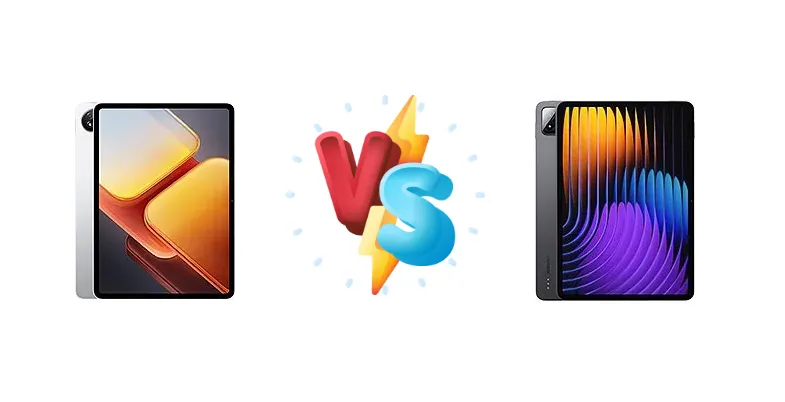
The Android tablet market is heating up, with both vivo’s iQOO Pad2 and Xiaomi’s Pad 7 Pro aiming to deliver flagship experiences without the flagship price tag. Both devices center around Qualcomm’s Snapdragon 8s Gen 3, promising strong performance. However, key differences in charging speed and battery endurance separate these contenders, making the choice less about raw power and more about how you intend to use your tablet.
🏆 Quick Verdict
For the average user prioritizing sustained performance and convenience, the Xiaomi Pad 7 Pro emerges as the better choice. Its 67W charging significantly reduces downtime, and the reported 10:12 active use battery life provides greater peace of mind. While the iQOO Pad2 offers a compelling package, Xiaomi’s charging and battery advantages are decisive.
| Network |
|---|
| 2G bands | N/A | N/A |
| 3G bands | N/A | N/A |
| 4G bands | N/A | - |
| EDGE | No | N/A |
| GPRS | No | N/A |
| Technology | No cellular connectivity | No cellular connectivity |
| Launch |
|---|
| Announced | 2024, May 31 | 2024, October 29 |
| Status | Available. Released 2024, June 04 | Available. Released 2024, October 29 |
| Body |
|---|
| Build | Glass front, aluminum back, aluminum frame | Glass front, aluminum frame, aluminum back |
| Dimensions | 266.4 x 192 x 6.6 mm (10.49 x 7.56 x 0.26 in) | 251.2 x 173.4 x 6.2 mm (9.89 x 6.83 x 0.24 in) |
| SIM | No | No |
| Weight | 589 g (1.30 lb) | 500 g (1.10 lb) |
| Display |
|---|
| Resolution | 1968 x 2800 pixels (~283 ppi density) | 2136 x 3200 pixels, 3:2 ratio (~345 ppi density) |
| Size | 12.1 inches, 444.4 cm2 (~86.9% screen-to-body ratio) | 11.2 inches, 371.5 cm2 (~85.3% screen-to-body ratio) |
| Type | IPS LCD, 1B colors, 144Hz, HDR10, 600 nits (peak) | IPS LCD, 68B colors, 144Hz, HDR10, Dolby Vision, 800 nits (peak) |
| Platform |
|---|
| CPU | Octa-core (1x3.0 GHz Cortex-X4 & 4x2.8 GHz Cortex-A720 & 3x2.0 GHz Cortex-A520) | Octa-core (1x3.0 GHz Cortex-X4 & 4x2.8 GHz Cortex-A720 & 3x2.0 GHz Cortex-A520) |
| Chipset | Qualcomm SM8635 Snapdragon 8s Gen 3 (4 nm) | Qualcomm SM8635 Snapdragon 8s Gen 3 (4 nm) |
| GPU | Adreno 735 | Adreno 735 |
| OS | Android 14, OriginOS 4 | Android 15, HyperOS 2 |
| Memory |
|---|
| Card slot | No | No |
| Internal | 128GB 8GB RAM, 256GB 8GB RAM, 256GB 12GB RAM, 512GB 12GB RAM | 128GB 8GB RAM, 256GB 8GB RAM, 256GB 12GB RAM, 512GB 12GB RAM |
| Main Camera |
|---|
| Dual | - | 50 MP, f/1.8, (wide), 1/2.76", 0.64µm, PDAF
Auxiliary lens |
| Features | LED flash | LED flash, HDR, panorama |
| Single | 8 MP | - |
| Video | 1080p@30fps | 4K@30/60fps, 1080p@30/60fps |
| Selfie camera |
|---|
| Features | - | HDR |
| Single | 5 MP | 32 MP, f/2.2, 19mm (ultrawide), 1/3.6", 0.61µm |
| Video | 1080p@30fps | 1080p@30fps |
| Sound |
|---|
| 35mm jack | No | No |
| Loudspeaker | Yes, with stereo speakers (6 speakers) | Yes, with stereo speakers (4 speakers) |
| Comms |
|---|
| Bluetooth | 5.4, A2DP, LE | 5.4, A2DP, LE, LHDC 5 |
| Infrared port | - | Yes |
| NFC | No | No |
| Positioning | Unspecified | No |
| Radio | No | No |
| USB | USB Type-C 3.2, OTG, magnetic connector | USB Type-C 3.2, accessory connector |
| WLAN | Wi-Fi 802.11 a/b/g/n/ac, dual-band | Wi-Fi 802.11 a/b/g/n/ac/6e/7, dual-band, Wi-Fi Direct |
| Features |
|---|
| Sensors | Accelerometer, gyro, proximity (accessories only) | Fingerprint (side-mounted), accelerometer, gyro, proximity, compass |
| Battery |
|---|
| Charging | 44W wired, PD
5W reverse wired | 67W wired, PD3.0, QC3+, 40% in 20 min |
| Type | 10000 mAh | 8850 mAh |
| Misc |
|---|
| Colors | Gray, Blue, Silver | Gray, Blue, Green |
| Models | - | 24091RPADG |
| Price | About 320 EUR | About 500 EUR |
| SAR EU | - | 0.99 W/kg (body) |
vivo iQOO Pad2
- Potentially lower price point
- Snapdragon 8s Gen 3 provides strong performance
- 44W fast charging is still respectable
- Slower charging compared to Xiaomi Pad 7 Pro
- Battery life likely shorter than Xiaomi Pad 7 Pro
- Missing detailed display specifications
Xiaomi Pad 7 Pro
- 67W fast charging significantly reduces downtime
- Excellent 10:12 hour active use battery life
- Likely superior display quality based on Xiaomi's track record
- May be more expensive than iQOO Pad2
- Shares the same Snapdragon 8s Gen 3, so performance gains are marginal
- Camera details are currently unknown
Display Comparison
Both tablets utilize the Qualcomm SM8635 Snapdragon 8s Gen 3 (4nm) chipset, meaning display performance will be largely similar. However, detailed display specs (resolution, panel type, peak brightness) are missing. Given Xiaomi’s history with high-quality displays, it’s reasonable to expect a slightly more refined visual experience, potentially with higher peak brightness and better color accuracy. The absence of LTPO information on both devices suggests standard refresh rate management, impacting battery life during dynamic content.
Camera Comparison
Camera details are absent for both devices. Given the tablet form factor, camera quality is less critical than on smartphones. However, Xiaomi typically invests more in camera technology. We can assume both will feature capable main sensors for casual photography and video calls, but don't expect flagship-level image quality. The absence of information prevents a meaningful comparison beyond speculation.
Performance
The core of both tablets is the Qualcomm SM8635 Snapdragon 8s Gen 3, featuring an octa-core CPU configuration (1x3.0 GHz Cortex-X4, 4x2.8 GHz Cortex-A720, 3x2.0 GHz Cortex-A520). This ensures comparable CPU performance for tasks like app launching, web browsing, and multitasking. The 4nm process node contributes to thermal efficiency, minimizing throttling during extended gaming sessions. RAM specifications are currently unknown, but LPDDR5x is expected on both, further enhancing performance. The real-world performance difference will likely be minimal, dictated more by software optimization and thermal management.
Battery Life
This is where the Xiaomi Pad 7 Pro pulls ahead. While both share the same Snapdragon 8s Gen 3, the Xiaomi Pad 7 Pro boasts 67W wired charging with PD3.0 and QC3+ support, achieving 40% charge in just 20 minutes. This is a significant advantage over the iQOO Pad2’s 44W wired charging. Furthermore, the Xiaomi Pad 7 Pro achieves an active use battery score of 10:12 hours, indicating superior battery endurance. The iQOO Pad2’s 5W reverse wired charging is a niche feature, useful for topping up accessories but not a primary selling point.
Buying Guide
Buy the vivo iQOO Pad2 if you prioritize a potentially lower price point and are comfortable with slower charging speeds. It’s a solid option for casual users who primarily consume media and engage in light productivity tasks. Buy the Xiaomi Pad 7 Pro if you demand faster charging, longer battery life, and are a power user who frequently games, edits videos, or multitasks heavily. The 67W charging is a game-changer for those constantly on the move.
Frequently Asked Questions
❓ How much faster is the 67W charging on the Xiaomi Pad 7 Pro compared to the iQOO Pad2's 44W charging in real-world use?
The 67W charging on the Xiaomi Pad 7 Pro can realistically shave off 30-45 minutes of charging time for a full charge compared to the iQOO Pad2. The Xiaomi Pad 7 Pro also reaches 40% charge in just 20 minutes, offering a quick boost when you're short on time.
❓ Will the Snapdragon 8s Gen 3 in both tablets handle demanding games like Genshin Impact and Call of Duty Mobile at high settings?
Yes, the Snapdragon 8s Gen 3 is a capable chipset and should handle demanding games at high settings with smooth frame rates. However, sustained performance will depend on the tablet's thermal management system. Both tablets should perform well, but prolonged gaming may lead to some throttling.
❓ Are there any known issues with overheating on either the iQOO Pad2 or the Xiaomi Pad 7 Pro during extended use?
Currently, there are no widespread reports of overheating issues on either device. The 4nm process node of the Snapdragon 8s Gen 3 contributes to improved thermal efficiency. However, long gaming sessions or intensive tasks may cause the tablets to warm up, which is normal.
❓ Do either of these tablets support stylus input and keyboard accessories?
While not explicitly stated in the provided specs, Xiaomi typically offers official stylus and keyboard accessories for its Pad series. The iQOO Pad2's support for these accessories is currently unknown, but it's likely to be compatible with third-party options.