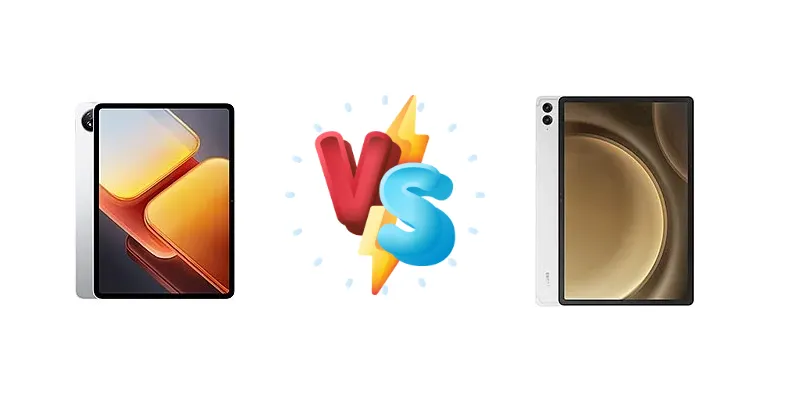
The Android tablet market is heating up, with the vivo iQOO Pad2 and Samsung Galaxy Tab S9 FE+ vying for attention. The iQOO Pad2 arrives with a focus on raw performance thanks to the Snapdragon 8s Gen 3, while the Tab S9 FE+ aims for a balance of features and affordability with the Exynos 1380. This comparison dissects their strengths and weaknesses to help you choose the right tablet for your needs.
🏆 Quick Verdict
For users prioritizing gaming and demanding tasks, the vivo iQOO Pad2 is the clear winner. Its Snapdragon 8s Gen 3 chipset delivers significantly better performance than the Exynos 1380 in the Tab S9 FE+. However, the Tab S9 FE+ remains a compelling option for everyday use and those deeply embedded in the Samsung ecosystem.
| Network |
|---|
| 2G bands | N/A | GSM 850 / 900 / 1800 / 1900 |
| 3G bands | N/A | HSDPA 850 / 900 / 1700(AWS) / 1900 / 2100 |
| 4G bands | N/A | 1, 2, 3, 4, 5, 7, 8, 12, 13, 17, 20, 26, 28, 32, 38, 40, 41, 66 |
| 5G bands | - | 1, 3, 5, 7, 8, 20, 28, 38, 40, 41, 66, 77, 78 SA/NSA/Sub6 |
| EDGE | No | - |
| GPRS | No | - |
| Speed | - | HSPA, LTE, 5G - cellular model only |
| Technology | No cellular connectivity | GSM / HSPA / LTE / 5G |
| Launch |
|---|
| Announced | 2024, May 31 | 2023, October 04 |
| Status | Available. Released 2024, June 04 | Available. Released 2023, October 16 |
| Body |
|---|
| Build | Glass front, aluminum back, aluminum frame | Glass front, aluminum back, aluminum frame |
| Dimensions | 266.4 x 192 x 6.6 mm (10.49 x 7.56 x 0.26 in) | 285.4 x 185.4 x 6.5 mm (11.24 x 7.30 x 0.26 in) |
| SIM | No | Nano-SIM + eSIM (cellular model only) |
| Weight | 589 g (1.30 lb) | 627 g or 628 g (1.38 lb) |
| Display |
|---|
| Resolution | 1968 x 2800 pixels (~283 ppi density) | 1600 x 2560 pixels, 16:10 ratio (~243 ppi density) |
| Size | 12.1 inches, 444.4 cm2 (~86.9% screen-to-body ratio) | 12.4 inches, 445.8 cm2 (~84.3% screen-to-body ratio) |
| Type | IPS LCD, 1B colors, 144Hz, HDR10, 600 nits (peak) | IPS LCD, 90Hz |
| Platform |
|---|
| CPU | Octa-core (1x3.0 GHz Cortex-X4 & 4x2.8 GHz Cortex-A720 & 3x2.0 GHz Cortex-A520) | Octa-core (4x2.4 GHz Cortex-A78 & 4x2.0 GHz Cortex-A55) |
| Chipset | Qualcomm SM8635 Snapdragon 8s Gen 3 (4 nm) | Exynos 1380 (5 nm) |
| GPU | Adreno 735 | Mali-G68 MP5 |
| OS | Android 14, OriginOS 4 | Android 13, up to 4 major Android upgrades, One UI 6 |
| Memory |
|---|
| Card slot | No | microSDXC (dedicated slot) |
| Internal | 128GB 8GB RAM, 256GB 8GB RAM, 256GB 12GB RAM, 512GB 12GB RAM | 128GB 6GB RAM, 128GB 8GB RAM, 256GB 8GB RAM, 256GB 12GB RAM |
| Main Camera |
|---|
| Dual | - | 8 MP, (wide)
8 MP, (ultrawide) |
| Features | LED flash | - |
| Single | 8 MP | - |
| Video | 1080p@30fps | 4K@30fps, 1080p@30fps |
| Selfie camera |
|---|
| Single | 5 MP | 12 MP, (ultrawide) |
| Video | 1080p@30fps | Yes |
| Sound |
|---|
| 35mm jack | No | No |
| Loudspeaker | Yes, with stereo speakers (6 speakers) | Yes, with stereo speakers |
| Comms |
|---|
| Bluetooth | 5.4, A2DP, LE | 5.3, A2DP, LE |
| NFC | No | No |
| Positioning | Unspecified | GPS, GALILEO, GLONASS, BDS, QZSS - cellular model only |
| Radio | No | No |
| USB | USB Type-C 3.2, OTG, magnetic connector | USB Type-C 2.0, magnetic connector |
| WLAN | Wi-Fi 802.11 a/b/g/n/ac, dual-band | Wi-Fi 802.11 a/b/g/n/ac/6, dual-band, Wi-Fi Direct |
| Features |
|---|
| Sensors | Accelerometer, gyro, proximity (accessories only) | Fingerprint (side-mounted), accelerometer, gyro, compass, proximity (accessories only) |
| Battery |
|---|
| Charging | 44W wired, PD
5W reverse wired | 45W wired, QC2.0 |
| Type | 10000 mAh | Li-Po 10090 mAh |
| Misc |
|---|
| Colors | Gray, Blue, Silver | Mint, Silver, Gray, Lavender |
| Models | - | SM-X610, SM-X616B |
| Price | About 320 EUR | About 770 EUR |
| SAR | - | 0.77 W/kg (body) |
| SAR EU | - | 0.50 W/kg (body) |
vivo iQOO Pad2
- Superior processing power with Snapdragon 8s Gen 3
- Potentially better thermal management
- Faster overall performance for demanding tasks
- Brand recognition may be lower than Samsung
- Ecosystem integration may not be as seamless as Samsung
Samsung Galaxy Tab S9 FE+
- Strong brand reputation and ecosystem integration
- Potentially wider availability of accessories
- Competitive price point
- Less powerful chipset compared to the iQOO Pad2
- May experience throttling under sustained load
Display Comparison
While both tablets likely feature LCD panels (data not provided), the core difference lies in the processing power driving them. The absence of LTPO technology in either device suggests standard refresh rates. The iQOO Pad2’s performance headroom could potentially allow for smoother rendering of graphically intensive content, even if the panels themselves are similar. Bezels are a key area where differentiation could occur, impacting immersion, but specific measurements are unavailable. Color accuracy will likely be good on both, given Samsung’s display expertise and vivo’s increasing focus on image quality.
Camera Comparison
Without detailed camera specifications, a direct comparison is difficult. However, given the market positioning, it’s reasonable to assume both tablets prioritize functionality over photographic excellence. The iQOO Pad2’s chipset likely offers more advanced image signal processing capabilities, potentially leading to better low-light performance and dynamic range. The absence of information regarding sensor sizes and OIS makes it impossible to definitively declare a winner. Any 2MP macro cameras on either device are likely to be of limited practical use.
Performance
The Snapdragon 8s Gen 3 (4nm) in the iQOO Pad2 represents a significant leap in performance over the Exynos 1380 (5nm) found in the Tab S9 FE+. The Snapdragon’s Cortex-X4 prime core clocked at 3.0 GHz provides a substantial advantage in single-core tasks, while its combination of Cortex-A720 and A520 cores offers superior multi-core performance. The 4nm process node of the Snapdragon also translates to better thermal efficiency, reducing the likelihood of throttling during extended gaming sessions. The Exynos 1380, while capable, relies on older Cortex-A78 and A55 cores, resulting in lower peak performance. The iQOO Pad2’s LPDDR5x RAM (assumed, based on chipset) further enhances its performance advantage.
Battery Life
Both tablets offer comparable charging speeds – 44W for the iQOO Pad2 and 45W for the Tab S9 FE+. The Tab S9 FE+ supports QC2.0, while the iQOO Pad2 utilizes PD. While the difference in wattage is minimal, the efficiency of the Snapdragon 8s Gen 3 could translate to slightly better battery life under heavy load. The actual 0-100% charging time will depend on the charger used and the tablet’s power management system. Without knowing the battery capacity of each device, it’s difficult to assess which offers superior endurance.
Buying Guide
Buy the vivo iQOO Pad2 if you need a tablet capable of handling demanding games, video editing, or multitasking without compromise. Its superior chipset and potential for sustained performance make it ideal for power users. Buy the Samsung Galaxy Tab S9 FE+ if you prefer a more balanced experience with a focus on ecosystem integration, a potentially lower price point, and a wider range of accessories within the Samsung universe.
Frequently Asked Questions
❓ Does the Exynos 1380 in the Galaxy Tab S9 FE+ overheat during prolonged gaming sessions?
The Exynos 1380 is a capable chip, but it's more prone to thermal throttling than the Snapdragon 8s Gen 3. Expect performance to decrease slightly after extended gaming, particularly with graphically demanding titles. The Tab S9 FE+ may require active cooling solutions for optimal sustained performance.
❓ How does the Snapdragon 8s Gen 3 handle multitasking and app switching on the iQOO Pad2?
The Snapdragon 8s Gen 3 excels at multitasking. Its combination of high-performance cores and ample RAM (likely LPDDR5x) ensures smooth app switching and the ability to run multiple applications simultaneously without noticeable lag. This makes the iQOO Pad2 ideal for users who frequently juggle between tasks.
❓ Is the 44W charging on the iQOO Pad2 significantly slower than the 45W charging on the Tab S9 FE+?
The difference of 1W is negligible in real-world charging times. Both tablets should achieve a full charge in approximately 1.5 to 2 hours, depending on the charger used. The charging protocol (PD vs QC2.0) may have a minor impact on efficiency, but it's unlikely to be substantial.
❓ Will the iQOO Pad2 receive regular software updates and security patches?
vivo's software update track record is improving, but it doesn't currently match Samsung's commitment to long-term support. Expect the Tab S9 FE+ to receive more frequent and longer-lasting software updates and security patches.