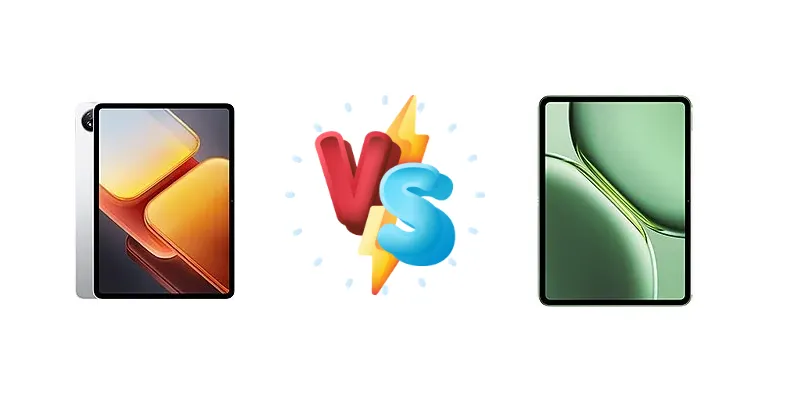
The Android tablet market is heating up, with the vivo iQOO Pad2 and OnePlus Pad Pro representing compelling options for users seeking a larger screen experience. Both leverage Qualcomm's latest silicon, but significant differences in chipset choice and charging capabilities create distinct user experiences. This comparison dissects those differences to help you choose the right tablet for your needs.
🏆 Quick Verdict
For most users, the OnePlus Pad Pro emerges as the superior choice. Its Snapdragon 8 Gen 3 chipset delivers a noticeable performance edge, and the 67W charging significantly reduces downtime. While the iQOO Pad2 offers a strong value proposition, the Pro's raw power and convenience justify the price premium.
| Network |
|---|
| 2G bands | N/A | N/A |
| 3G bands | N/A | N/A |
| 4G bands | N/A | N/A |
| EDGE | No | No |
| GPRS | No | No |
| Technology | No cellular connectivity | No cellular connectivity |
| Launch |
|---|
| Announced | 2024, May 31 | 2024, June 27 |
| Status | Available. Released 2024, June 04 | Available. Released 2024, June 29 |
| Body |
|---|
| Build | Glass front, aluminum back, aluminum frame | Glass front, aluminum back, aluminum frame |
| Dimensions | 266.4 x 192 x 6.6 mm (10.49 x 7.56 x 0.26 in) | 268.7 x 195.1 x 6.5 mm (10.58 x 7.68 x 0.26 in) |
| SIM | No | No |
| Weight | 589 g (1.30 lb) | 584 g (1.29 lb) |
| Display |
|---|
| Resolution | 1968 x 2800 pixels (~283 ppi density) | 2120 x 3000 pixels (~304 ppi density) |
| Size | 12.1 inches, 444.4 cm2 (~86.9% screen-to-body ratio) | 12.1 inches, 445.2 cm2 (~84.9% screen-to-body ratio) |
| Type | IPS LCD, 1B colors, 144Hz, HDR10, 600 nits (peak) | IPS LCD, 68B colors, Dolby Vision, HDR10+, 144Hz, 600 nits (typ), 900 nits (peak) |
| Platform |
|---|
| CPU | Octa-core (1x3.0 GHz Cortex-X4 & 4x2.8 GHz Cortex-A720 & 3x2.0 GHz Cortex-A520) | Octa-core (1x3.3 GHz Cortex-X4 & 3x3.2 GHz Cortex-A720 & 2x3.0 GHz Cortex-A720 & 2x2.3 GHz Cortex-A520) |
| Chipset | Qualcomm SM8635 Snapdragon 8s Gen 3 (4 nm) | Qualcomm SM8650-AB Snapdragon 8 Gen 3 (4 nm) |
| GPU | Adreno 735 | Adreno 750 |
| OS | Android 14, OriginOS 4 | Android 14, OxygenOS 14.1 |
| Memory |
|---|
| Card slot | No | No |
| Internal | 128GB 8GB RAM, 256GB 8GB RAM, 256GB 12GB RAM, 512GB 12GB RAM | 128GB 8GB RAM, 256GB 8GB RAM, 256GB 12GB RAM, 512GB 16GB RAM |
| Main Camera |
|---|
| Features | LED flash | LED flash |
| Single | 8 MP | 13 MP, f/2.2, 23mm (wide) |
| Video | 1080p@30fps | 4K@30fps, 1080p@30ps, gyro-EIS |
| Selfie camera |
|---|
| Single | 5 MP | 8 MP, f/2.3, (wide), 1/4.0", 1.12µm |
| Video | 1080p@30fps | 1080p@30fps |
| Sound |
|---|
| 35mm jack | No | No |
| Loudspeaker | Yes, with stereo speakers (6 speakers) | Yes, with stereo speakers (4 speakers) |
| Comms |
|---|
| Bluetooth | 5.4, A2DP, LE | 5.4, A2DP, LE, aptX HD, LHDC |
| NFC | No | NFC (data sharing only) |
| Positioning | Unspecified | No |
| Radio | No | No |
| USB | USB Type-C 3.2, OTG, magnetic connector | USB Type-C 3.2, OTG, accessory connector |
| WLAN | Wi-Fi 802.11 a/b/g/n/ac, dual-band | Wi-Fi 802.11 a/b/g/n/ac/6/7, dual-band |
| Features |
|---|
| Sensors | Accelerometer, gyro, proximity (accessories only) | Accelerometer, gyro, proximity (accessories only), compass |
| Battery |
|---|
| Charging | 44W wired, PD
5W reverse wired | 67W wired, PD, QC |
| Type | 10000 mAh | Li-Po 9510 mAh |
| Misc |
|---|
| Colors | Gray, Blue, Silver | Gray, Green |
| Models | - | OPD2404 |
| Price | About 320 EUR | About 370 EUR |
vivo iQOO Pad2
- More affordable price point
- Reverse wired charging capability
- Competent performance for everyday tasks
- Less powerful Snapdragon 8s Gen 3 chipset
- Slower 44W charging
OnePlus Pad Pro
- Superior Snapdragon 8 Gen 3 performance
- Significantly faster 67W charging
- Likely better camera image processing
- Higher price tag
- No reverse wired charging
Display Comparison
Both tablets are expected to feature high-resolution displays, though specific details like peak brightness and panel type (LTPO) are currently unavailable. However, the focus here is on performance, so display differences are less critical. Bezels will likely be similar, aiming for an immersive viewing experience. Color accuracy will be a key differentiator, and independent testing will be needed to determine which tablet offers more faithful color reproduction.
Camera Comparison
Given the tablet form factor, camera performance isn't a primary concern for most users. However, the OnePlus Pad Pro is likely to feature a more sophisticated camera system, leveraging the processing power of the Snapdragon 8 Gen 3 for improved image quality. Details on sensor sizes and apertures are currently unavailable, but the Pro model will likely benefit from better image stabilization and dynamic range. The iQOO Pad2 will likely offer a competent camera experience for casual use, but won't compete with flagship smartphone cameras.
Performance
The core difference lies in the chipsets. The OnePlus Pad Pro boasts the Qualcomm SM8650-AB Snapdragon 8 Gen 3, featuring a 1x3.3 GHz Cortex-X4 prime core, 3x3.2 GHz Cortex-A720 cores, 2x3.0 GHz Cortex-A720 cores, and 2x2.3 GHz Cortex-A520 cores. The iQOO Pad2 utilizes the Snapdragon 8s Gen 3 (SM8635) with a 1x3.0 GHz Cortex-X4, 4x2.8 GHz Cortex-A720, and 3x2.0 GHz Cortex-A520. The Gen 3’s higher clock speeds across the board, particularly the prime core, translate to faster processing in CPU-intensive tasks. While both are built on a 4nm process, the Gen 3’s architectural improvements and higher clock speeds provide a clear performance advantage. The OnePlus Pad Pro will likely exhibit less throttling under sustained load, making it better suited for extended gaming sessions. Both will likely pair with ample LPDDR5x RAM, but the chipset difference will be the primary performance bottleneck.
Battery Life
The OnePlus Pad Pro’s 67W charging is a significant advantage over the iQOO Pad2’s 44W wired charging. This faster charging speed will dramatically reduce downtime, allowing users to quickly top up their battery. While battery capacity is unknown for both devices, the faster charging of the OnePlus Pad Pro effectively mitigates any potential capacity disadvantage. The inclusion of PD and QC support on both tablets ensures compatibility with a wide range of chargers. The iQOO Pad2 also offers 5W reverse wired charging, a useful feature for topping up accessories, but the OnePlus Pad Pro lacks this functionality.
Buying Guide
Buy the vivo iQOO Pad2 if you prioritize value and are comfortable with slightly less peak performance. It’s ideal for media consumption, light gaming, and everyday productivity tasks. Buy the OnePlus Pad Pro if you demand the best possible performance for demanding applications like video editing, AAA gaming, or multitasking, and if minimizing charging time is a priority. It’s the tablet for power users who won’t compromise.
Frequently Asked Questions
❓ Will the Snapdragon 8s Gen 3 in the iQOO Pad2 struggle with graphically demanding games like Genshin Impact?
While the Snapdragon 8s Gen 3 is a capable chip, it won't deliver the same sustained performance as the Snapdragon 8 Gen 3 in the OnePlus Pad Pro. Expect to potentially need to lower graphics settings in demanding titles to maintain a smooth frame rate, especially during extended gaming sessions. The OnePlus Pad Pro will offer a more consistent and higher-fidelity gaming experience.
❓ How much faster is the 67W charging on the OnePlus Pad Pro compared to the 44W charging on the iQOO Pad2 in real-world usage?
The 67W charging on the OnePlus Pad Pro will likely reduce a full charge time by approximately 30-45 minutes compared to the iQOO Pad2’s 44W charging. This difference is substantial and makes a significant impact on convenience, especially for users who frequently need to top up their tablet throughout the day.
❓ Does either tablet support stylus input or keyboard covers?
While not explicitly stated in the provided specs, both the iQOO Pad2 and OnePlus Pad Pro are likely to support stylus input and keyboard covers, given the tablet form factor and the trend towards productivity features. However, compatibility and functionality will vary, and dedicated accessories may be required.