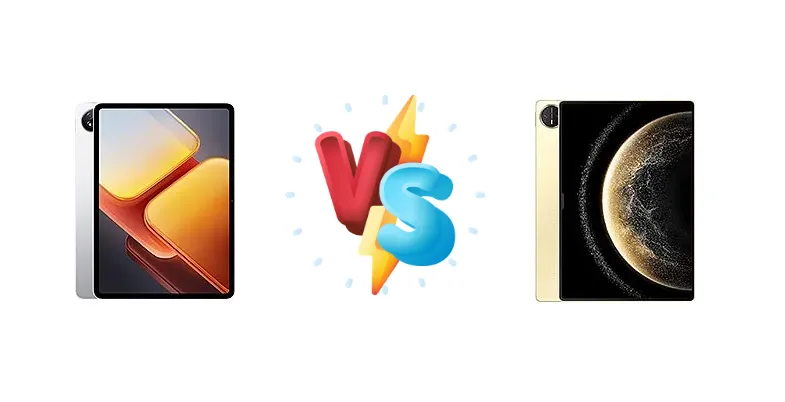
The tablet market is heating up, with the vivo iQOO Pad2 aiming for a performance-focused experience and the Huawei MatePad Pro 13.2 (2025) prioritizing rapid charging and potentially a more refined ecosystem. This comparison dissects the core differences between these two Android tablets, focusing on their chipsets, charging capabilities, and how those translate to real-world usage.
🏆 Quick Verdict
For users prioritizing raw performance and a more open Android experience, the iQOO Pad2, powered by the Snapdragon 8s Gen 3, is the better choice. However, the Huawei MatePad Pro 13.2 (2025) wins for those who value incredibly fast 100W charging and are invested in the Huawei ecosystem.
| Network |
|---|
| 2G bands | N/A | GSM 850 / 900 / 1800 / 1900 |
| 3G bands | N/A | HSDPA 850 / 900 / 1900 / 2100 |
| 4G bands | N/A | LTE |
| EDGE | No | - |
| GPRS | No | - |
| Speed | - | HSPA, LTE - cellular model only |
| Technology | No cellular connectivity | GSM / HSPA / LTE |
| Launch |
|---|
| Announced | 2024, May 31 | 2024, November 26 |
| Status | Available. Released 2024, June 04 | Available. Released 2024, December 12 |
| Body |
|---|
| Build | Glass front, aluminum back, aluminum frame | Glass front, nylon fiber back, magnesium alloy frame |
| Dimensions | 266.4 x 192 x 6.6 mm (10.49 x 7.56 x 0.26 in) | 289.1 x 196.1 x 5.5 mm (11.38 x 7.72 x 0.22 in) |
| SIM | No | Nano-SIM (cellular model only) |
| Weight | 589 g (1.30 lb) | 580 g (Wi-FI) or 590 g (LTE) (1.28 lb) |
| Display |
|---|
| Resolution | 1968 x 2800 pixels (~283 ppi density) | 2880 x 1920 pixels, 3:2 ratio (~262 ppi density) |
| Size | 12.1 inches, 444.4 cm2 (~86.9% screen-to-body ratio) | 13.2 inches, 518.8 cm2 (~91.5% screen-to-body ratio) |
| Type | IPS LCD, 1B colors, 144Hz, HDR10, 600 nits (peak) | OLED, 1B colors, 144Hz, HDR Vivid, 1000 nits (peak) |
| Platform |
|---|
| CPU | Octa-core (1x3.0 GHz Cortex-X4 & 4x2.8 GHz Cortex-A720 & 3x2.0 GHz Cortex-A520) | Octa-core |
| Chipset | Qualcomm SM8635 Snapdragon 8s Gen 3 (4 nm) | Kirin T92 |
| GPU | Adreno 735 | - |
| OS | Android 14, OriginOS 4 | Harmony OS 4.3 |
| Memory |
|---|
| Card slot | No | No |
| Internal | 128GB 8GB RAM, 256GB 8GB RAM, 256GB 12GB RAM, 512GB 12GB RAM | 256GB 12GB RAM, 512GB 12GB RAM, 1TB 16GB RAM |
| Main Camera |
|---|
| Dual | - | 50 MP, f/1.8, (wide), PDAF
8 MP, f/2.2, (ultrawide) |
| Features | LED flash | LED flash |
| Single | 8 MP | - |
| Video | 1080p@30fps | 4K@30fps, 1080p@30fps |
| Selfie camera |
|---|
| Single | 5 MP | 16 MP, f/2.2 |
| Video | 1080p@30fps | 1080p@30fps |
| Sound |
|---|
| 35mm jack | No | No |
| Loudspeaker | Yes, with stereo speakers (6 speakers) | Yes, with stereo speakers (6 speakers) |
| Comms |
|---|
| Bluetooth | 5.4, A2DP, LE | 5.2, A2DP, LE, L2HC |
| NFC | No | No |
| Positioning | Unspecified | GPS, GALILEO, GLONASS, BDS |
| Radio | No | No |
| USB | USB Type-C 3.2, OTG, magnetic connector | USB Type-C 3.1, OTG, DisplayPort 1.2, accessory connector pins |
| WLAN | Wi-Fi 802.11 a/b/g/n/ac, dual-band | Wi-Fi 802.11 a/b/g/n/ac/6, dual-band |
| Features |
|---|
| Sensors | Accelerometer, gyro, proximity (accessories only) | Fingerprint (side-mounted), accelerometer, gyro, compass, proximity (accessories only) |
| Battery |
|---|
| Charging | 44W wired, PD
5W reverse wired | 100W wired
7.5W reverse wired |
| Type | 10000 mAh | Li-Po 10100 mAh |
| Misc |
|---|
| Colors | Gray, Blue, Silver | Black, White, Gold |
| Models | - | WEB-W00, PCE-W29 |
| Price | About 320 EUR | About 680 EUR |
vivo iQOO Pad2
- Stronger CPU performance with Snapdragon 8s Gen 3
- More efficient 4nm manufacturing process
- Likely better sustained performance due to thermal efficiency
- Slower 44W charging compared to Huawei
- Potentially less integrated ecosystem experience
Huawei MatePad Pro 13.2 (2025)
- Blazing-fast 100W wired charging
- Potentially superior display quality (LTPO, resolution)
- Seamless integration with Huawei ecosystem
- Kirin T92 performance is unknown and may lag Snapdragon
- Potential software limitations outside of Huawei ecosystem
Display Comparison
While display specifications are missing, the iQOO Pad 2 likely targets a high refresh rate panel to complement its gaming focus. The Huawei MatePad Pro 13.2, given its 'Pro' designation, is expected to feature a high-resolution, potentially LTPO OLED display for variable refresh rates and power efficiency. The larger 13.2-inch screen of the Huawei will offer more screen real estate for productivity tasks. Color accuracy and peak brightness will be key differentiators, but without specific data, it's difficult to definitively declare a winner.
Camera Comparison
Camera details are absent for both devices. However, given the tablet form factor, camera quality is typically less of a priority than on smartphones. We can expect both tablets to include cameras suitable for video conferencing and casual snapshots. Without sensor size or aperture information, it’s impossible to assess image quality differences.
Performance
The core of the difference lies in the chipsets. The iQOO Pad2’s Qualcomm SM8635 Snapdragon 8s Gen 3 (4nm) boasts a Cortex-X4 prime core clocked at 3.0 GHz, indicating a focus on peak performance. This is paired with Cortex-A720 and A520 cores for efficiency. The Huawei MatePad Pro 13.2 (2025) utilizes the Kirin T92. While core counts are similar (Octa-core), the architectural details and manufacturing process of the Kirin T92 are unknown. The 4nm process of the Snapdragon 8s Gen 3 generally translates to better thermal efficiency and sustained performance under load compared to older node processes potentially used in the Kirin T92. This means the iQOO Pad2 is likely to exhibit less throttling during extended gaming sessions.
Battery Life
The charging capabilities are a significant point of divergence. The Huawei MatePad Pro 13.2 (2025) supports a remarkable 100W wired charging, promising incredibly fast top-ups. In contrast, the iQOO Pad2 offers 44W wired charging, which is still respectable but considerably slower. While battery capacity is unknown for both, the faster charging of the Huawei significantly reduces downtime. The iQOO Pad2 offers 5W reverse wired charging, while the Huawei provides 7.5W, a minor difference. The Huawei’s charging speed will be a major benefit for users who frequently use their tablet on the go.
Buying Guide
Buy the vivo iQOO Pad2 if you need a tablet primarily for gaming, demanding applications, or tasks where sustained CPU/GPU performance is critical. Its Snapdragon 8s Gen 3 offers a strong foundation for these workloads. Buy the Huawei MatePad Pro 13.2 (2025) if you prioritize minimizing downtime with its blazing-fast 100W charging, and if you already utilize other Huawei devices for seamless integration and features.
Frequently Asked Questions
❓ Will the Snapdragon 8s Gen 3 in the iQOO Pad2 handle demanding games like Genshin Impact at high settings?
The Snapdragon 8s Gen 3 is a powerful chipset capable of running demanding games like Genshin Impact. Its Cortex-X4 prime core and Adreno GPU should deliver a smooth experience at high settings, though sustained performance will depend on the tablet's thermal design.
❓ How long will it realistically take to fully charge the Huawei MatePad Pro 13.2 (2025) with the 100W charger?
While a precise time requires testing, 100W charging should bring the Huawei MatePad Pro 13.2 (2025) from 0% to 100% in approximately 30-45 minutes, assuming a typical tablet battery capacity. This is significantly faster than the iQOO Pad2's 44W charging.
❓ Does the Huawei MatePad Pro 13.2 (2025) support the Huawei M-Pencil and keyboard accessories?
Given Huawei's history with the MatePad Pro series, it is highly likely that the MatePad Pro 13.2 (2025) will support the M-Pencil (3rd generation) and a dedicated keyboard accessory, enhancing its productivity capabilities.