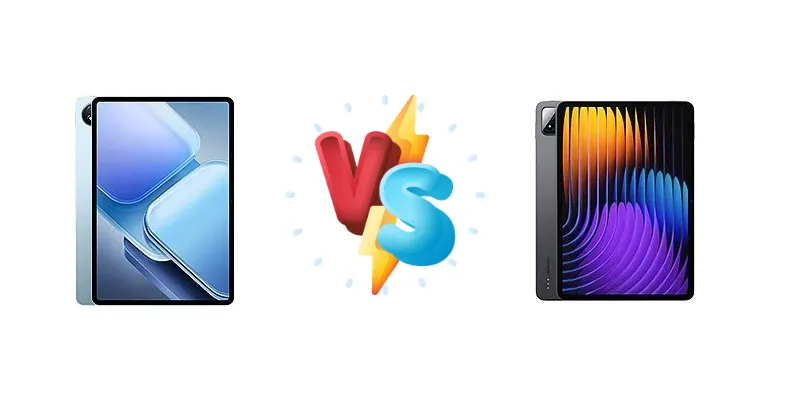
The Android tablet market is heating up, with the vivo iQOO Pad2 Pro and Xiaomi Pad 7 Pro representing the latest push for premium experiences. Both tablets aim to deliver flagship performance and features, but they take different approaches. The iQOO Pad2 Pro leverages Mediatek’s top-tier Dimensity 9300+ chipset, while the Xiaomi Pad 7 Pro opts for Qualcomm’s Snapdragon 8s Gen 3. This comparison dives deep into the specifics to determine which tablet offers the best value and performance for your needs.
🏆 Quick Verdict
For users prioritizing raw processing power and potentially sustained performance, the iQOO Pad2 Pro with its Dimensity 9300+ chipset takes a slight edge. However, the Xiaomi Pad 7 Pro offers a more balanced package with excellent battery life (10:12h active use) and competitive charging speeds, making it the better all-rounder for most users.
| Network |
|---|
| 2G bands | N/A | N/A |
| 3G bands | N/A | N/A |
| 4G bands | N/A | - |
| EDGE | No | N/A |
| GPRS | No | N/A |
| Technology | No cellular connectivity | No cellular connectivity |
| Launch |
|---|
| Announced | 2024, May 31 | 2024, October 29 |
| Status | Available. Released 2024, June 04 | Available. Released 2024, October 29 |
| Body |
|---|
| Build | Glass front, aluminum back, aluminum frame | Glass front, aluminum frame, aluminum back |
| Dimensions | 289.6 x 198.3 x 6.6 mm (11.40 x 7.81 x 0.26 in) | 251.2 x 173.4 x 6.2 mm (9.89 x 6.83 x 0.24 in) |
| SIM | No | No |
| Weight | 679 g (1.50 lb) | 500 g (1.10 lb) |
| Display |
|---|
| Resolution | 2064 x 3096 pixels, 3:2 ratio (~286 ppi density) | 2136 x 3200 pixels, 3:2 ratio (~345 ppi density) |
| Size | 13.0 inches, 503.2 cm2 (~87.6% screen-to-body ratio) | 11.2 inches, 371.5 cm2 (~85.3% screen-to-body ratio) |
| Type | IPS LCD, 1B colors, 144Hz, HDR10, 900 nits (peak) | IPS LCD, 68B colors, 144Hz, HDR10, Dolby Vision, 800 nits (peak) |
| Platform |
|---|
| CPU | Octa-core (1x3.4 GHz Cortex-X4 & 3x2.85 GHz Cortex-X4 & 4x2.0 GHz Cortex-A720) | Octa-core (1x3.0 GHz Cortex-X4 & 4x2.8 GHz Cortex-A720 & 3x2.0 GHz Cortex-A520) |
| Chipset | Mediatek Dimensity 9300+ (4 nm) | Qualcomm SM8635 Snapdragon 8s Gen 3 (4 nm) |
| GPU | Immortalis-G720 MC12 | Adreno 735 |
| OS | Android 14, OriginOS 4 | Android 15, HyperOS 2 |
| Memory |
|---|
| Card slot | No | No |
| Internal | 256GB 8GB RAM, 256GB 12GB RAM, 512GB 16GB RAM | 128GB 8GB RAM, 256GB 8GB RAM, 256GB 12GB RAM, 512GB 12GB RAM |
| Main Camera |
|---|
| Dual | - | 50 MP, f/1.8, (wide), 1/2.76", 0.64µm, PDAF
Auxiliary lens |
| Features | LED flash | LED flash, HDR, panorama |
| Single | 13 MP | - |
| Video | 4K@30fps, 1080p@30fps | 4K@30/60fps, 1080p@30/60fps |
| Selfie camera |
|---|
| Features | - | HDR |
| Single | 8 MP | 32 MP, f/2.2, 19mm (ultrawide), 1/3.6", 0.61µm |
| Video | 1080p@30fps | 1080p@30fps |
| Sound |
|---|
| 35mm jack | No | No |
| Loudspeaker | Yes, with stereo speakers (8 speakers) | Yes, with stereo speakers (4 speakers) |
| Comms |
|---|
| Bluetooth | 5.4, A2DP, LE | 5.4, A2DP, LE, LHDC 5 |
| Infrared port | - | Yes |
| NFC | Yes | No |
| Positioning | Unspecified | No |
| Radio | No | No |
| USB | USB Type-C 3.2, OTG, magnetic connector | USB Type-C 3.2, accessory connector |
| WLAN | Wi-Fi 802.11 a/b/g/n/ac/6/7, dual-band | Wi-Fi 802.11 a/b/g/n/ac/6e/7, dual-band, Wi-Fi Direct |
| Features |
|---|
| Sensors | Accelerometer, gyro, proximity (accessories only) | Fingerprint (side-mounted), accelerometer, gyro, proximity, compass |
| Battery |
|---|
| Charging | 66W wired, PD
5W reverse wired | 67W wired, PD3.0, QC3+, 40% in 20 min |
| Type | 11500 mAh | 8850 mAh |
| Misc |
|---|
| Colors | Gray, Blue, Silver | Gray, Blue, Green |
| Models | - | 24091RPADG |
| Price | About 440 EUR | About 500 EUR |
| SAR EU | - | 0.99 W/kg (body) |
vivo iQOO Pad2 Pro
- Potentially higher peak CPU performance with Dimensity 9300+
- 66W fast charging with PD support
- 5W reverse wired charging for accessory top-ups
- Battery life potentially lower due to more powerful chipset
- Display specifications currently unknown
Xiaomi Pad 7 Pro
- Excellent battery life (10:12h active use)
- 67W fast charging with PD3.0 and QC3+ support
- Balanced chipset with Snapdragon 8s Gen 3
- CPU performance slightly lower than iQOO Pad2 Pro
- Camera details currently unavailable
Display Comparison
While display specifications are missing for the iQOO Pad2 Pro, the Xiaomi Pad 7 Pro’s focus on battery life suggests a potentially more efficient panel. Both devices utilize a 4nm process, which contributes to power efficiency. The choice between them will likely hinge on panel technology (LTPO for variable refresh rates) and color accuracy, details currently unavailable for the iQOO Pad2 Pro. Bezels and peak brightness will also be key differentiators once reviewed.
Camera Comparison
Camera details are absent for both devices, making a direct comparison impossible. Given the tablet form factor, camera quality is often secondary to other features. However, we can expect both manufacturers to include capable main sensors. The presence or absence of Optical Image Stabilization (OIS) will be a significant factor, as will lens apertures and image processing algorithms. Without further information, it’s difficult to assess which tablet will offer a superior photography experience.
Performance
The core of the difference lies in the chipsets. The iQOO Pad2 Pro’s Mediatek Dimensity 9300+ features a unique CPU configuration with a 1x3.4 GHz Cortex-X4, 3x2.85 GHz Cortex-X4, and 4x2.0 GHz Cortex-A720 cores. This contrasts with the Xiaomi Pad 7 Pro’s Qualcomm SM8635 Snapdragon 8s Gen 3, which has a 1x3.0 GHz Cortex-X4, 4x2.8 GHz Cortex-A720, and 3x2.0 GHz Cortex-A520 cores. The iQOO’s heavier reliance on the high-performance X4 cores suggests a potential advantage in single-core tasks and burst performance. However, the Snapdragon 8s Gen 3’s more balanced core configuration and Qualcomm’s optimization could lead to more consistent performance under sustained loads. Both utilize a 4nm process, but thermal management will be crucial in determining real-world performance.
Battery Life
The Xiaomi Pad 7 Pro clearly leads in battery performance with a reported 10:12h of active use. While the iQOO Pad2 Pro’s battery capacity is unknown, its more powerful chipset could potentially consume more power. Both tablets offer fast charging – 67W for the Xiaomi and 66W for the iQOO – with the Xiaomi boasting 40% charge in 20 minutes. The Xiaomi also supports PD3.0 and QC3+ standards, offering broader compatibility. The iQOO includes 5W reverse wired charging, a useful feature for topping up accessories.
Buying Guide
Buy the vivo iQOO Pad2 Pro if you are a power user who frequently engages in demanding tasks like video editing, high-end gaming, or multitasking, and are willing to potentially trade some battery life for that extra performance headroom. Buy the Xiaomi Pad 7 Pro if you prioritize a longer-lasting battery, faster charging, and a more refined overall experience for everyday tasks, media consumption, and moderate gaming.
Frequently Asked Questions
❓ Will the Dimensity 9300+ in the iQOO Pad2 Pro overheat during extended gaming sessions?
The Dimensity 9300+ is a powerful chipset, and sustained performance will depend heavily on the iQOO Pad2 Pro’s thermal management system. While the 4nm process helps with efficiency, demanding games could still generate significant heat. Without testing, it’s difficult to say definitively, but a robust cooling solution will be crucial to prevent throttling.
❓ Does the Xiaomi Pad 7 Pro support stylus input and keyboard accessories?
While not explicitly stated in the provided data, Xiaomi typically offers stylus and keyboard accessories for its Pad series. It’s highly likely the Pad 7 Pro will support these, enhancing its productivity capabilities. Check Xiaomi’s official website for compatible accessories.
❓ How does the Snapdragon 8s Gen 3 in the Xiaomi Pad 7 Pro compare to the Snapdragon 8 Gen 2 in terms of gaming performance?
The Snapdragon 8s Gen 3 is a slightly down-clocked version of the Snapdragon 8 Gen 2, offering very similar performance. While the 8 Gen 2 has a slight edge in raw power, the 8s Gen 3 provides excellent gaming performance with improved efficiency. The difference in real-world gaming will likely be minimal.