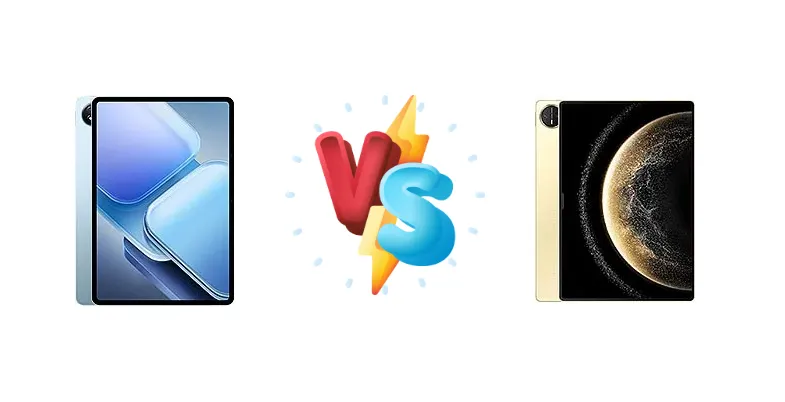
The Android tablet market is heating up, with the vivo iQOO Pad2 Pro and the Huawei MatePad Pro 13.2 (2025) representing compelling options for power users and entertainment enthusiasts. This comparison focuses on the core differences – the Mediatek Dimensity 9300+ powering the iQOO versus Huawei’s in-house Kirin T92, and the significant disparity in their charging capabilities.
🏆 Quick Verdict
For users prioritizing raw processing power and a more established Android ecosystem, the iQOO Pad2 Pro with its Dimensity 9300+ chipset is the stronger choice. However, the Huawei MatePad Pro 13.2 (2025) counters with significantly faster 100W charging, appealing to those who value minimal downtime.
| Network |
|---|
| 2G bands | N/A | GSM 850 / 900 / 1800 / 1900 |
| 3G bands | N/A | HSDPA 850 / 900 / 1900 / 2100 |
| 4G bands | N/A | LTE |
| EDGE | No | - |
| GPRS | No | - |
| Speed | - | HSPA, LTE - cellular model only |
| Technology | No cellular connectivity | GSM / HSPA / LTE |
| Launch |
|---|
| Announced | 2024, May 31 | 2024, November 26 |
| Status | Available. Released 2024, June 04 | Available. Released 2024, December 12 |
| Body |
|---|
| Build | Glass front, aluminum back, aluminum frame | Glass front, nylon fiber back, magnesium alloy frame |
| Dimensions | 289.6 x 198.3 x 6.6 mm (11.40 x 7.81 x 0.26 in) | 289.1 x 196.1 x 5.5 mm (11.38 x 7.72 x 0.22 in) |
| SIM | No | Nano-SIM (cellular model only) |
| Weight | 679 g (1.50 lb) | 580 g (Wi-FI) or 590 g (LTE) (1.28 lb) |
| Display |
|---|
| Resolution | 2064 x 3096 pixels, 3:2 ratio (~286 ppi density) | 2880 x 1920 pixels, 3:2 ratio (~262 ppi density) |
| Size | 13.0 inches, 503.2 cm2 (~87.6% screen-to-body ratio) | 13.2 inches, 518.8 cm2 (~91.5% screen-to-body ratio) |
| Type | IPS LCD, 1B colors, 144Hz, HDR10, 900 nits (peak) | OLED, 1B colors, 144Hz, HDR Vivid, 1000 nits (peak) |
| Platform |
|---|
| CPU | Octa-core (1x3.4 GHz Cortex-X4 & 3x2.85 GHz Cortex-X4 & 4x2.0 GHz Cortex-A720) | Octa-core |
| Chipset | Mediatek Dimensity 9300+ (4 nm) | Kirin T92 |
| GPU | Immortalis-G720 MC12 | - |
| OS | Android 14, OriginOS 4 | Harmony OS 4.3 |
| Memory |
|---|
| Card slot | No | No |
| Internal | 256GB 8GB RAM, 256GB 12GB RAM, 512GB 16GB RAM | 256GB 12GB RAM, 512GB 12GB RAM, 1TB 16GB RAM |
| Main Camera |
|---|
| Dual | - | 50 MP, f/1.8, (wide), PDAF
8 MP, f/2.2, (ultrawide) |
| Features | LED flash | LED flash |
| Single | 13 MP | - |
| Video | 4K@30fps, 1080p@30fps | 4K@30fps, 1080p@30fps |
| Selfie camera |
|---|
| Single | 8 MP | 16 MP, f/2.2 |
| Video | 1080p@30fps | 1080p@30fps |
| Sound |
|---|
| 35mm jack | No | No |
| Loudspeaker | Yes, with stereo speakers (8 speakers) | Yes, with stereo speakers (6 speakers) |
| Comms |
|---|
| Bluetooth | 5.4, A2DP, LE | 5.2, A2DP, LE, L2HC |
| NFC | Yes | No |
| Positioning | Unspecified | GPS, GALILEO, GLONASS, BDS |
| Radio | No | No |
| USB | USB Type-C 3.2, OTG, magnetic connector | USB Type-C 3.1, OTG, DisplayPort 1.2, accessory connector pins |
| WLAN | Wi-Fi 802.11 a/b/g/n/ac/6/7, dual-band | Wi-Fi 802.11 a/b/g/n/ac/6, dual-band |
| Features |
|---|
| Sensors | Accelerometer, gyro, proximity (accessories only) | Fingerprint (side-mounted), accelerometer, gyro, compass, proximity (accessories only) |
| Battery |
|---|
| Charging | 66W wired, PD
5W reverse wired | 100W wired
7.5W reverse wired |
| Type | 11500 mAh | Li-Po 10100 mAh |
| Misc |
|---|
| Colors | Gray, Blue, Silver | Black, White, Gold |
| Models | - | WEB-W00, PCE-W29 |
| Price | About 440 EUR | About 680 EUR |
vivo iQOO Pad2 Pro
- Superior CPU performance with Dimensity 9300+
- Likely better thermal management due to 4nm process
- Established Android ecosystem and Google Play Store access
- Slower 66W charging compared to Huawei
- Potentially less optimized software experience than HarmonyOS
Huawei MatePad Pro 13.2 (2025)
- Ultra-fast 100W wired charging
- Larger 13.2-inch display for immersive viewing
- Potentially optimized software experience with HarmonyOS
- Kirin T92 likely offers lower peak CPU performance
- Reliance on Huawei’s AppGallery and potential app compatibility issues
Display Comparison
While display specifications are absent, the iQOO Pad2 Pro likely targets a high refresh rate panel given its performance focus. The larger 13.2-inch screen of the Huawei MatePad Pro 13.2 (2025) suggests a focus on media consumption and productivity. The absence of LTPO information for either device means we can't assess dynamic refresh rate capabilities for power saving. Bezels and color accuracy will be key differentiators, but require further testing.
Camera Comparison
Without camera specifications, a direct comparison is impossible. However, given the tablet form factor, camera quality is less of a primary concern than on smartphones. Both devices likely feature a main camera and ultrawide lens, but image processing algorithms and sensor sizes will determine the final image quality. We anticipate Huawei’s image processing to lean towards vibrant colors, while iQOO may aim for a more natural look.
Performance
The iQOO Pad2 Pro’s Mediatek Dimensity 9300+ (4nm) is a clear advantage on paper. Its octa-core configuration, featuring a prime Cortex-X4 core clocked at 3.4 GHz, promises exceptional single-core and multi-core performance. The Kirin T92 in the Huawei MatePad Pro 13.2 (2025) lacks detailed CPU specifications, but Huawei’s silicon typically prioritizes efficiency. The 4nm process node of the Dimensity 9300+ should translate to better thermal management under sustained load, potentially reducing throttling during extended gaming sessions. The iQOO’s LPDDR5x RAM (assumed) will further enhance performance.
Battery Life
The charging capabilities are a major point of divergence. The Huawei MatePad Pro 13.2 (2025) boasts 100W wired charging, significantly faster than the iQOO Pad2 Pro’s 66W. This translates to a much quicker 0-100% charge time for the Huawei. While battery capacity is unknown for both, the faster charging of the MatePad Pro mitigates the impact of a potentially smaller battery. The iQOO Pad2 Pro offers 5W reverse wired charging, a useful feature for topping up accessories, while the Huawei provides 7.5W, offering slightly more power for reverse charging.
Buying Guide
Buy the vivo iQOO Pad2 Pro if you need uncompromising performance for demanding tasks like gaming and video editing, and prefer a tablet deeply integrated with the Google Play Store. Buy the Huawei MatePad Pro 13.2 (2025) if you prioritize incredibly fast charging speeds and are comfortable within Huawei’s HarmonyOS ecosystem, potentially relying more on Huawei’s AppGallery.
Frequently Asked Questions
❓ Will the Huawei MatePad Pro 13.2 (2025) run all my Android apps seamlessly?
Huawei’s HarmonyOS, while Android-based, doesn’t have full Google Mobile Services (GMS) support. This means some apps may require sideloading or may not function correctly. Huawei’s AppGallery is growing, but app availability remains a potential concern.
❓ How well will the iQOO Pad2 Pro handle graphically intensive games like Genshin Impact?
The Mediatek Dimensity 9300+ is a flagship-level chipset designed for demanding tasks. It should handle Genshin Impact and other graphically intensive games at high settings with minimal frame drops, especially given the likely inclusion of advanced cooling solutions.
❓ Is the 7.5W reverse charging on the Huawei MatePad Pro 13.2 (2025) fast enough to quickly charge my earbuds?
While 7.5W is better than the iQOO's 5W, it's still relatively slow for charging earbuds. It's sufficient for a trickle charge or maintaining a charge level, but a full charge will still take a considerable amount of time.