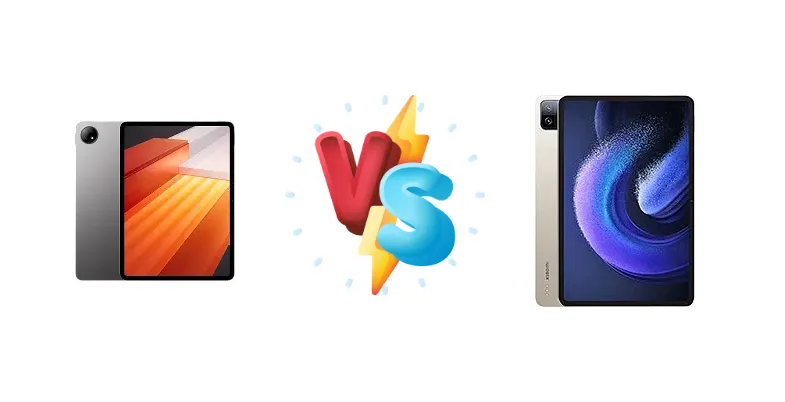
The Android tablet market is heating up, with the vivo iQOO Pad and Xiaomi Pad 6 Pro offering compelling performance at competitive price points. Both devices target power users, but diverge in their chipset and charging approaches. This comparison dives deep into the specifics to determine which tablet best suits your needs.
🏆 Quick Verdict
For most users, the Xiaomi Pad 6 Pro emerges as the stronger choice. Its Snapdragon 8+ Gen 1 offers a slight edge in sustained performance, and the significantly faster 67W charging is a major convenience. However, the iQOO Pad remains a viable option for those prioritizing value.
| Network |
|---|
| 2G bands | N/A | N/A |
| 3G bands | N/A | N/A |
| 4G bands | N/A | - |
| EDGE | No | N/A |
| GPRS | No | N/A |
| Technology | No cellular connectivity | No cellular connectivity |
| Launch |
|---|
| Announced | 2023, May 23 | 2023, April 18 |
| Status | Available. Released 2023, May 23 | Available. Released 2023, April 30 |
| Body |
|---|
| Build | Glass front, aluminum back, aluminum frame | Glass front (Gorilla Glass 3), aluminum frame, aluminum back |
| Dimensions | 266 x 191.6 x 6.6 mm (10.47 x 7.54 x 0.26 in) | 254 x 165.2 x 6.5 mm (10.0 x 6.50 x 0.26 in) |
| SIM | No | No |
| Weight | 585 g (1.29 lb) | 490 g (1.08 lb) |
| | - | Stylus support (magnetic) |
| Display |
|---|
| Protection | - | Corning Gorilla Glass 3 |
| Resolution | 1968 x 2800 pixels (~283 ppi density) | 1800 x 2880 pixels, 16:10 ratio (~309 ppi density) |
| Size | 12.1 inches, 444.4 cm2 (~87.2% screen-to-body ratio) | 11.0 inches, 350.9 cm2 (~83.6% screen-to-body ratio) |
| Type | IPS LCD, 1B colors, 144Hz, HDR10, 600 nits | IPS LCD, 1B colors, 144Hz, HDR10, Dolby Vision, 550 nits |
| Platform |
|---|
| CPU | Octa-core (1x3.2 GHz Cortex-X2 & 3x2.85 GHz Cortex-A710 & 4x1.80 GHz Cortex-A510) | Octa-core (1x3.19 GHz Cortex-X2 & 3x2.75 GHz Cortex-A710 & 4x1.80 GHz Cortex-A510) |
| Chipset | Mediatek Dimensity 9000+ (4 nm) | Qualcomm SM8475 Snapdragon 8+ Gen 1 (4 nm) |
| GPU | Mali-G710 MC10 | Adreno 730 |
| OS | Android 13, OriginOS 3 | Android 13, MIUI 14 |
| Memory |
|---|
| Card slot | No | No |
| Internal | 128GB 8GB RAM, 256GB 8GB RAM, 256GB 12GB RAM, 512GB 12GB RAM | 128GB 8GB RAM, 256GB 8GB RAM, 256GB 12GB RAM, 512GB 12GB RAM |
| | - | UFS 3.1 |
| Main Camera |
|---|
| Dual | 13 MP, f/2.2, 21mm, 112˚ (ultrawide), 1.12µm, AF
2 MP (macro) | 50 MP, f/1.8, (wide), 1/2.76", 0.64µm, PDAF
Auxiliary lens |
| Features | LED flash, panorama | Dual-LED flash, HDR, panorama |
| Video | 4K@30fps, 1080p@30fps | 4K@30/60fps, 1080p@30/60fps |
| Selfie camera |
|---|
| Single | 8 MP, f/2.0, (wide), 1/4.0", 1.12µm | 20 MP, f/2.2, (wide), 1/3.4", 0.8µm |
| Video | 1080p@30fps | 1080p@30/60fps |
| Sound |
|---|
| 3.5mm jack | - | No |
| 35mm jack | No | No |
| Loudspeaker | Yes, with stereo speakers (4 speakers) | Yes, with stereo speakers (4 speakers) |
| | - | 24-bit/192kHz audio |
| Comms |
|---|
| Bluetooth | 5.3, A2DP, LE | 5.3, A2DP, LE |
| NFC | Yes | No |
| Positioning | No | No |
| Radio | No | No |
| USB | USB Type-C 3.2, OTG, DisplayPort, magnetic connector | USB Type-C 3.2, accessory connector |
| WLAN | Wi-Fi 802.11 a/b/g/n/ac/6, dual-band, Wi-Fi Direct | Wi-Fi 802.11 a/b/g/n/a/6e, dual-band, Wi-Fi Direct |
| Features |
|---|
| Sensors | Accelerometer, gyro, proximity, compass | Accelerometer, gyro, proximity (accessories only) |
| Battery |
|---|
| Charging | 44W wired, PD
5W reverse wired | 67W wired, PD3.0, QC4, 100% in 1 hour |
| Type | 10000 mAh | Li-Po 8600 mAh |
| Misc |
|---|
| Colors | Gray | Black, Blue, Gold |
| Models | - | 23046RP50C |
| Price | About 340 EUR | About 330 EUR |
vivo iQOO Pad
- Potentially better value for money
- Strong CPU performance with Dimensity 9000+
- PD charging support
- Slower 44W charging
- Potentially less optimized GPU performance
Xiaomi Pad 6 Pro
- Faster 67W charging with QC4 support
- Snapdragon 8+ Gen 1 offers strong sustained performance
- Likely superior GPU performance
- Potentially higher price point
- May run slightly warmer under heavy load
Display Comparison
Both tablets are expected to feature high-quality LCD panels, though specific details like peak brightness and color gamut coverage are currently unavailable. The absence of LTPO technology in either device suggests refresh rates will likely be fixed, impacting battery life during intensive use. Bezels are a key area to watch, as slimmer bezels contribute to a more immersive viewing experience. Color accuracy will be crucial for content creators, and independent testing will be needed to determine which tablet delivers more accurate color reproduction.
Camera Comparison
Given the tablet form factor, camera performance isn't a primary concern for most users. However, the Xiaomi Pad 6 Pro is expected to have a more refined camera system, potentially leveraging Qualcomm’s image signal processor (ISP) for better image quality. Details on sensor sizes and apertures are currently lacking for both devices, making a definitive comparison difficult. The inclusion of Optical Image Stabilization (OIS) would be a significant advantage for the Xiaomi Pad 6 Pro, reducing blur in photos and videos. We anticipate both tablets will offer adequate cameras for video conferencing and casual snapshots.
Performance
The core difference lies in the chipsets. The Xiaomi Pad 6 Pro’s Snapdragon 8+ Gen 1 (4nm) and the iQOO Pad’s MediaTek Dimensity 9000+ (4nm) are both high-end performers. While the Dimensity 9000+ boasts a slightly higher peak CPU clock speed (3.2 GHz vs 3.19 GHz), the Snapdragon 8+ Gen 1 is known for its superior GPU performance and thermal management. Both CPUs share the same core configuration (1x Cortex-X2, 3x Cortex-A710, 4x Cortex-A510), but Qualcomm’s optimizations often translate to more consistent frame rates in demanding games. The use of LPDDR5x RAM in both devices ensures fast memory access, but the specific RAM speed could vary, impacting overall system responsiveness.
Battery Life
The Xiaomi Pad 6 Pro’s 67W charging is a clear advantage over the iQOO Pad’s 44W charging. The Xiaomi Pad 6 Pro promises a full charge in approximately one hour, while the iQOO Pad will take considerably longer. While battery capacity isn’t specified, the faster charging speed of the Xiaomi Pad 6 Pro mitigates any potential disadvantage from a slightly smaller battery. Both devices support Power Delivery (PD) for versatile charging options, but the Xiaomi Pad 6 Pro also supports Quick Charge 4 (QC4), offering compatibility with a wider range of chargers.
Buying Guide
Buy the vivo iQOO Pad if you prioritize maximizing value and are comfortable with slightly slower charging speeds. It’s ideal for students or casual users who need a capable tablet for productivity and media consumption. Buy the Xiaomi Pad 6 Pro if you demand the best possible performance for gaming or demanding applications, and value the convenience of rapid charging. This tablet is geared towards power users and mobile gamers.
Frequently Asked Questions
❓ Will the Dimensity 9000+ in the iQOO Pad throttle during extended gaming sessions?
While the Dimensity 9000+ is a powerful chip, sustained performance can be affected by thermal throttling. The Xiaomi Pad 6 Pro’s Snapdragon 8+ Gen 1 is generally known for better thermal efficiency, potentially leading to more consistent frame rates over longer gaming periods. However, the iQOO Pad’s cooling solution will play a crucial role in mitigating throttling.
❓ How much faster is the 67W charging on the Xiaomi Pad 6 Pro compared to the 44W charging on the iQOO Pad?
The Xiaomi Pad 6 Pro’s 67W charging can realistically shave off 20-30 minutes of charging time compared to the iQOO Pad’s 44W charging. Xiaomi claims a full charge in around an hour, while the iQOO Pad will likely take closer to 1.5-2 hours to reach 100%.
❓ Does either tablet support stylus input or keyboard covers?
While not explicitly stated in the provided specs, both vivo and Xiaomi frequently offer accessories like styluses and keyboard covers for their tablets. Checking the official websites or retail listings for each device is recommended to confirm compatibility and availability.