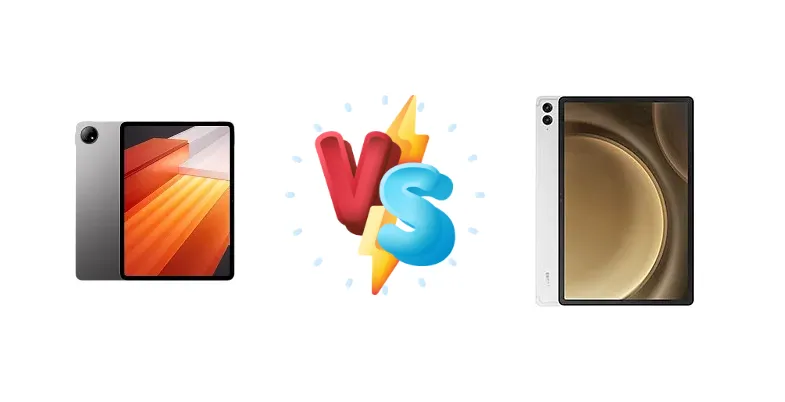
The Android tablet market is heating up, with the vivo iQOO Pad and Samsung Galaxy Tab S9 FE+ vying for attention. The iQOO Pad arrives with a focus on raw performance thanks to the Dimensity 9000+, while the S9 FE+ aims for a balance of features and Samsung’s ecosystem integration. This comparison dives deep into the specs to determine which tablet best suits your needs.
🏆 Quick Verdict
For users prioritizing raw processing power and faster charging, the vivo iQOO Pad is the clear winner. Its Dimensity 9000+ chipset offers a significant performance advantage over the Exynos 1380 in the S9 FE+. However, the S9 FE+ benefits from Samsung’s software and broader ecosystem, making it a strong contender for those already invested in the brand.
| Network |
|---|
| 2G bands | N/A | GSM 850 / 900 / 1800 / 1900 |
| 3G bands | N/A | HSDPA 850 / 900 / 1700(AWS) / 1900 / 2100 |
| 4G bands | N/A | 1, 2, 3, 4, 5, 7, 8, 12, 13, 17, 20, 26, 28, 32, 38, 40, 41, 66 |
| 5G bands | - | 1, 3, 5, 7, 8, 20, 28, 38, 40, 41, 66, 77, 78 SA/NSA/Sub6 |
| EDGE | No | - |
| GPRS | No | - |
| Speed | - | HSPA, LTE, 5G - cellular model only |
| Technology | No cellular connectivity | GSM / HSPA / LTE / 5G |
| Launch |
|---|
| Announced | 2023, May 23 | 2023, October 04 |
| Status | Available. Released 2023, May 23 | Available. Released 2023, October 16 |
| Body |
|---|
| Build | Glass front, aluminum back, aluminum frame | Glass front, aluminum back, aluminum frame |
| Dimensions | 266 x 191.6 x 6.6 mm (10.47 x 7.54 x 0.26 in) | 285.4 x 185.4 x 6.5 mm (11.24 x 7.30 x 0.26 in) |
| SIM | No | Nano-SIM + eSIM (cellular model only) |
| Weight | 585 g (1.29 lb) | 627 g or 628 g (1.38 lb) |
| Display |
|---|
| Resolution | 1968 x 2800 pixels (~283 ppi density) | 1600 x 2560 pixels, 16:10 ratio (~243 ppi density) |
| Size | 12.1 inches, 444.4 cm2 (~87.2% screen-to-body ratio) | 12.4 inches, 445.8 cm2 (~84.3% screen-to-body ratio) |
| Type | IPS LCD, 1B colors, 144Hz, HDR10, 600 nits | IPS LCD, 90Hz |
| Platform |
|---|
| CPU | Octa-core (1x3.2 GHz Cortex-X2 & 3x2.85 GHz Cortex-A710 & 4x1.80 GHz Cortex-A510) | Octa-core (4x2.4 GHz Cortex-A78 & 4x2.0 GHz Cortex-A55) |
| Chipset | Mediatek Dimensity 9000+ (4 nm) | Exynos 1380 (5 nm) |
| GPU | Mali-G710 MC10 | Mali-G68 MP5 |
| OS | Android 13, OriginOS 3 | Android 13, up to 4 major Android upgrades, One UI 6 |
| Memory |
|---|
| Card slot | No | microSDXC (dedicated slot) |
| Internal | 128GB 8GB RAM, 256GB 8GB RAM, 256GB 12GB RAM, 512GB 12GB RAM | 128GB 6GB RAM, 128GB 8GB RAM, 256GB 8GB RAM, 256GB 12GB RAM |
| Main Camera |
|---|
| Dual | 13 MP, f/2.2, 21mm, 112˚ (ultrawide), 1.12µm, AF
2 MP (macro) | 8 MP, (wide)
8 MP, (ultrawide) |
| Features | LED flash, panorama | - |
| Video | 4K@30fps, 1080p@30fps | 4K@30fps, 1080p@30fps |
| Selfie camera |
|---|
| Single | 8 MP, f/2.0, (wide), 1/4.0", 1.12µm | 12 MP, (ultrawide) |
| Video | 1080p@30fps | Yes |
| Sound |
|---|
| 35mm jack | No | No |
| Loudspeaker | Yes, with stereo speakers (4 speakers) | Yes, with stereo speakers |
| Comms |
|---|
| Bluetooth | 5.3, A2DP, LE | 5.3, A2DP, LE |
| NFC | Yes | No |
| Positioning | No | GPS, GALILEO, GLONASS, BDS, QZSS - cellular model only |
| Radio | No | No |
| USB | USB Type-C 3.2, OTG, DisplayPort, magnetic connector | USB Type-C 2.0, magnetic connector |
| WLAN | Wi-Fi 802.11 a/b/g/n/ac/6, dual-band, Wi-Fi Direct | Wi-Fi 802.11 a/b/g/n/ac/6, dual-band, Wi-Fi Direct |
| Features |
|---|
| Sensors | Accelerometer, gyro, proximity, compass | Fingerprint (side-mounted), accelerometer, gyro, compass, proximity (accessories only) |
| Battery |
|---|
| Charging | 44W wired, PD
5W reverse wired | 45W wired, QC2.0 |
| Type | 10000 mAh | Li-Po 10090 mAh |
| Misc |
|---|
| Colors | Gray | Mint, Silver, Gray, Lavender |
| Models | - | SM-X610, SM-X616B |
| Price | About 340 EUR | About 770 EUR |
| SAR | - | 0.77 W/kg (body) |
| SAR EU | - | 0.50 W/kg (body) |
vivo iQOO Pad
- Superior processing power with Dimensity 9000+
- Faster charging speeds (44W)
- Potential for better thermal management
- Brand recognition is lower than Samsung
- Software experience may not be as polished as One UI
Samsung Galaxy Tab S9 FE+
- Samsung’s established ecosystem and software (One UI)
- Wider availability and support network
- Potential for S Pen support (sold separately)
- Less powerful processor (Exynos 1380)
- May experience more throttling under heavy load
Display Comparison
While both tablets likely feature LCD panels (spec not provided), the core difference lies in the processing power driving them. The iQOO Pad’s Dimensity 9000+ will handle graphically intensive tasks with greater ease, potentially resulting in smoother animations and higher sustained frame rates in games. The S9 FE+'s display is likely tuned for Samsung’s vibrant color profile, but without specific brightness or color accuracy data, it’s difficult to definitively declare a winner. Bezels are also a key consideration, and visual inspection would be needed to determine which device offers a more immersive viewing experience.
Camera Comparison
Given the tablet form factor, camera quality isn’t a primary concern for most users. However, the iQOO Pad’s camera specifications (not provided) would need to be significantly superior to the S9 FE+'s to justify a purchase based on imaging. Without detailed sensor information, it’s safe to assume both tablets offer adequate cameras for casual snapshots and video calls. We can expect Samsung’s image processing to lean towards vibrant colors and boosted contrast, while vivo’s approach may prioritize a more natural look. The presence or absence of OIS (Optical Image Stabilization) would be a key differentiator, but this information is currently unavailable.
Performance
The Mediatek Dimensity 9000+ (4nm) in the iQOO Pad is a significant step up from the Exynos 1380 (5nm) found in the Galaxy Tab S9 FE+. The Dimensity 9000+ boasts a Cortex-X2 prime core clocked at 3.2 GHz, compared to the S9 FE+'s Cortex-A78 cores at 2.4 GHz. This translates to substantially faster single-core performance, crucial for responsive UI and app loading. The 4nm process node of the Dimensity 9000+ also offers better thermal efficiency, potentially leading to less throttling during prolonged gaming sessions. While the Exynos 1380 is a capable chip, it’s geared towards efficiency rather than outright speed. The iQOO Pad will excel in demanding applications.
Battery Life
Both tablets offer comparable charging speeds – 44W for the iQOO Pad and 45W for the S9 FE+. The iQOO Pad also includes 5W reverse wired charging, a useful feature for topping up accessories. While battery capacity isn’t specified, the more efficient Dimensity 9000+ in the iQOO Pad could potentially offset a slightly smaller battery size. The S9 FE+ utilizes QC2.0 for fast charging, while the iQOO Pad supports PD, offering broader compatibility with chargers. Real-world battery life will depend heavily on usage patterns, but the iQOO Pad’s chipset efficiency gives it an edge.
Buying Guide
Buy the vivo iQOO Pad if you need a tablet primarily for demanding tasks like gaming, video editing, or multitasking, and value the fastest possible performance for the price. Buy the Samsung Galaxy Tab S9 FE+ if you prefer a tablet with a more refined software experience, seamless integration with other Samsung devices, and a focus on productivity features like the S Pen support (sold separately).
Frequently Asked Questions
❓ Does the Exynos 1380 in the Galaxy Tab S9 FE+ overheat during extended gaming sessions?
The Exynos 1380 is a relatively efficient chip, but it's not designed for sustained peak performance like the Dimensity 9000+. While it won't likely overheat to the point of shutdown, users may experience noticeable throttling after 30-60 minutes of demanding games, leading to dropped frame rates and reduced performance.
❓ Is the 44W charging on the iQOO Pad significantly faster than the 45W on the Galaxy Tab S9 FE+ in real-world use?
While the wattage is similar, the iQOO Pad's Power Delivery (PD) support offers broader charger compatibility. In practice, the difference in charging speed will likely be minimal, with both tablets reaching a full charge in around 1.5-2 hours. However, PD allows for potentially faster charging with compatible chargers.
❓ Can the iQOO Pad handle demanding games like Genshin Impact or Call of Duty Mobile at high settings?
Yes, the Dimensity 9000+ is more than capable of running demanding games like Genshin Impact and Call of Duty Mobile at high settings. Expect consistently high frame rates and smooth gameplay, even during intense action sequences. The iQOO Pad’s superior processing power and thermal management will provide a better gaming experience than the S9 FE+.