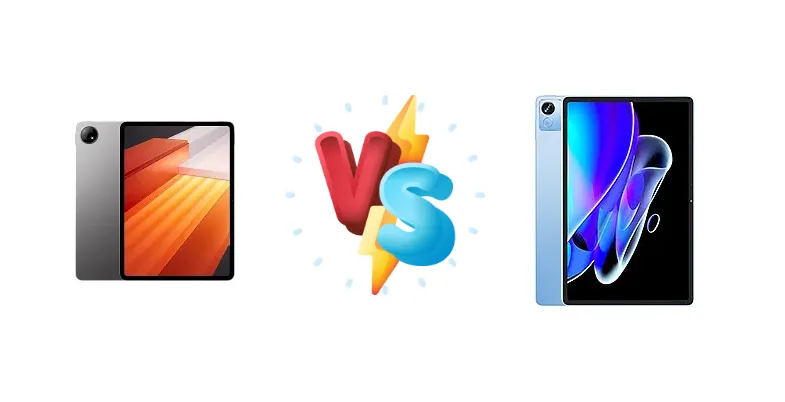
The Android tablet market is heating up, with the vivo iQOO Pad and Realme Pad X vying for attention. While both aim to deliver a compelling tablet experience, they take drastically different approaches. The iQOO Pad prioritizes raw processing power with the flagship Dimensity 9000+, while the Realme Pad X focuses on a balance of 5G connectivity and efficiency with the Snapdragon 695. This comparison will dissect their strengths and weaknesses to determine which tablet best suits your needs.
🏆 Quick Verdict
For users prioritizing performance and demanding tasks like gaming or video editing, the iQOO Pad is the clear winner. Its Dimensity 9000+ chipset offers a substantial performance advantage. However, the Realme Pad X provides a more efficient experience for everyday tasks and benefits from 5G connectivity, making it a solid choice for on-the-go users.
| Network |
|---|
| 2G bands | N/A | GSM 850 / 900 / 1800 / 1900 |
| 3G bands | N/A | HSDPA 850 / 900 / 2100 |
| 4G bands | N/A | LTE |
| 5G bands | - | SA/NSA |
| EDGE | No | - |
| GPRS | No | - |
| Speed | - | HSPA, LTE, 5G - cellular model only |
| Technology | No cellular connectivity | GSM / HSPA / LTE / 5G |
| Launch |
|---|
| Announced | 2023, May 23 | 2022, May 25 |
| Status | Available. Released 2023, May 23 | Available. Released 2022, June 12 |
| Body |
|---|
| Build | Glass front, aluminum back, aluminum frame | Glass front, plastic frame, plastic back |
| Dimensions | 266 x 191.6 x 6.6 mm (10.47 x 7.54 x 0.26 in) | 256.5 x 161.1 x 7.1 mm (10.10 x 6.34 x 0.28 in) |
| SIM | No | Nano-SIM + Nano-SIM (cellular model only) |
| Weight | 585 g (1.29 lb) | 499 g / 506 g (1.10 lb) |
| | - | Stylus support (magnetic charging) |
| Display |
|---|
| Resolution | 1968 x 2800 pixels (~283 ppi density) | 1200 x 2000 pixels, 5:3 ratio (~213 ppi density) |
| Size | 12.1 inches, 444.4 cm2 (~87.2% screen-to-body ratio) | 10.95 inches, 341.3 cm2 (~82.6% screen-to-body ratio) |
| Type | IPS LCD, 1B colors, 144Hz, HDR10, 600 nits | IPS LCD, 450 nits (peak) |
| Platform |
|---|
| CPU | Octa-core (1x3.2 GHz Cortex-X2 & 3x2.85 GHz Cortex-A710 & 4x1.80 GHz Cortex-A510) | Octa-core (2x2.2 GHz Kryo 660 Gold & 6x1.7 GHz Kryo 660 Silver) |
| Chipset | Mediatek Dimensity 9000+ (4 nm) | Qualcomm SM6375 Snapdragon 695 5G (6 nm) |
| GPU | Mali-G710 MC10 | Adreno 619 |
| OS | Android 13, OriginOS 3 | Android, Realme UI 3.0 |
| Memory |
|---|
| Card slot | No | microSDXC |
| Internal | 128GB 8GB RAM, 256GB 8GB RAM, 256GB 12GB RAM, 512GB 12GB RAM | 64GB 4GB RAM, 128GB 6GB RAM |
| Main Camera |
|---|
| Dual | 13 MP, f/2.2, 21mm, 112˚ (ultrawide), 1.12µm, AF
2 MP (macro) | - |
| Features | LED flash, panorama | - |
| Single | - | 13 MP, f/2.2, (wide), AF |
| Video | 4K@30fps, 1080p@30fps | 1080p@30fps |
| Selfie camera |
|---|
| Single | 8 MP, f/2.0, (wide), 1/4.0", 1.12µm | 8 MP, f/2.0, 105˚ (ultrawide) |
| Video | 1080p@30fps | 1080p@30fps |
| Sound |
|---|
| 3.5mm jack | - | No |
| 35mm jack | No | No |
| Loudspeaker | Yes, with stereo speakers (4 speakers) | Yes, with stereo speakers (4 speakers) |
| | - | 24-bit/192kHz audio |
| Comms |
|---|
| Bluetooth | 5.3, A2DP, LE | 5.1, A2DP, LE |
| NFC | Yes | No |
| Positioning | No | GPS, GLONASS, GALILEO, BDS - cellular model only |
| Radio | No | No |
| USB | USB Type-C 3.2, OTG, DisplayPort, magnetic connector | USB Type-C 2.0, OTG |
| WLAN | Wi-Fi 802.11 a/b/g/n/ac/6, dual-band, Wi-Fi Direct | Wi-Fi 802.11 b/g/n/ac, hotspot |
| Features |
|---|
| Sensors | Accelerometer, gyro, proximity, compass | Accelerometer, gyro, compass |
| Battery |
|---|
| Charging | 44W wired, PD
5W reverse wired | 33W wired, PD
5W reverse wired |
| Type | 10000 mAh | 8340 mAh |
| Misc |
|---|
| Colors | Gray | Glowing Gray, Glacier Blue, Green |
| Models | - | RMP2107, RMP2108 |
| Price | About 340 EUR | About 250 EUR |
| Tests |
|---|
| Display | - |
Contrast ratio: 1664:1 |
| Loudspeaker | - |
-22.5 LUFS (Excellent)
|
| Performance | - |
AnTuTu: 395824 (v9)
GeekBench: 2026 (v5.1)
GFXBench: 18fps (ES 3.1 onscreen) |
vivo iQOO Pad
- Significantly more powerful processor (Dimensity 9000+)
- Faster 44W wired charging
- Potentially better thermal management due to 4nm process
- Display specifications currently unknown
- Potentially higher price point
Realme Pad X
- 5G connectivity for on-the-go access
- Efficient Snapdragon 695 processor for everyday tasks
- Measured 496 nits peak brightness
- Substantially less powerful processor
- Slower 33W wired charging
- Limited camera capabilities (likely)
Display Comparison
The Realme Pad X boasts a measured peak brightness of 496 nits and a 1655:1 contrast ratio, offering a visually acceptable experience. However, the iQOO Pad’s display specifications are currently unavailable, leaving a gap in direct comparison. Given the iQOO brand’s focus on multimedia, we anticipate a comparable or superior display quality. The Realme Pad X’s contrast ratio of 1664:1 is respectable, but without knowing the iQOO Pad’s panel technology (e.g., IPS, LCD, or OLED) or color accuracy, it’s difficult to definitively declare a winner. The Realme Pad X’s brightness is sufficient for indoor use, but may struggle in direct sunlight.
Camera Comparison
Neither tablet is positioned as a photography powerhouse, and detailed camera specifications are lacking. Without information on sensor sizes, apertures, or image processing capabilities for the iQOO Pad, it’s impossible to make a meaningful comparison. The Realme Pad X likely features a standard tablet camera setup, prioritizing video conferencing over high-quality photography. Given the focus on performance, the iQOO Pad may have a slightly more advanced camera system, but this remains speculative.
Performance
The performance disparity is significant. The iQOO Pad’s Mediatek Dimensity 9000+ (4nm) is a flagship-level chipset, featuring an octa-core configuration with a high-clocked Cortex-X2 prime core at 3.2 GHz. This architecture is designed for sustained peak performance. In contrast, the Realme Pad X utilizes the Qualcomm Snapdragon 695 5G (6nm), an octa-core processor geared towards efficiency and 5G connectivity. While the Snapdragon 695 is capable, its Kryo 660 Gold cores max out at 2.2 GHz, representing a substantial performance deficit compared to the iQOO Pad. The 4nm process node of the Dimensity 9000+ also contributes to better thermal efficiency, potentially reducing throttling during extended gaming sessions. The iQOO Pad will excel in demanding tasks, while the Realme Pad X is better suited for everyday use.
Battery Life
Both tablets offer 5W reverse wired charging, a useful feature for topping up accessories. The Realme Pad X features 33W wired charging, while the iQOO Pad supports 44W wired charging. This faster charging speed on the iQOO Pad translates to quicker top-ups, potentially offsetting any battery capacity differences (which are currently unknown for the iQOO Pad). While the Realme Pad X’s 33W charging is respectable, the iQOO Pad’s 44W charging provides a tangible advantage for users who prioritize minimizing downtime.
Buying Guide
Buy the vivo iQOO Pad if you need uncompromising performance for gaming, content creation, or multitasking. Its powerful chipset will handle demanding applications with ease. Buy the Realme Pad X if you prioritize portability, 5G connectivity for constant access, and a more efficient processor for everyday tasks like browsing, streaming, and light productivity. It’s the better choice for users who value battery life and convenience over raw power.
Frequently Asked Questions
❓ Will the Dimensity 9000+ in the iQOO Pad get noticeably hot during extended gaming sessions?
The Dimensity 9000+ is a powerful chip, but its 4nm manufacturing process helps mitigate heat generation. While some warmth is expected during intensive gaming, the iQOO Pad is likely to manage thermals better than devices with less efficient chipsets. However, sustained peak performance may still lead to some throttling over very long periods.
❓ Is the 5G connectivity on the Realme Pad X useful for a tablet, or is Wi-Fi sufficient?
5G connectivity on the Realme Pad X provides a significant advantage for users who frequently travel or work remotely. It allows for consistent internet access even in areas with poor Wi-Fi coverage. While Wi-Fi is sufficient for most home and office use, 5G offers a valuable fallback and increased flexibility.
❓ Can either tablet be used for video editing, and if so, which one is better suited?
The iQOO Pad, with its Dimensity 9000+ chipset, is far better suited for video editing. The processor's raw power and multi-core performance will significantly reduce rendering times and ensure a smoother editing experience. The Realme Pad X's Snapdragon 695 would struggle with demanding video editing tasks.