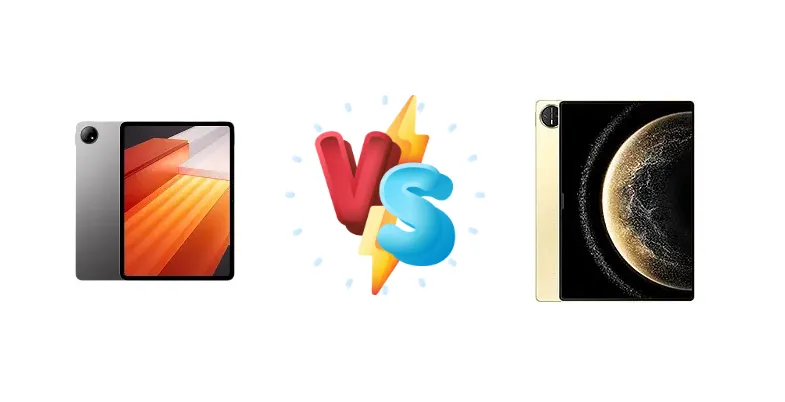
The tablet market is heating up, with the vivo iQOO Pad offering a compelling performance package and the Huawei MatePad Pro 13.2 (2025) pushing the boundaries of charging speed. This comparison dissects these two devices, focusing on their core strengths – processing power and power delivery – to determine which tablet best suits your needs.
🏆 Quick Verdict
For users prioritizing raw performance and a more established software ecosystem, the iQOO Pad with its Dimensity 9000+ chipset is the better choice. However, the Huawei MatePad Pro 13.2 (2025) wins for those who value incredibly fast charging and are comfortable within the Huawei ecosystem.
| Network |
|---|
| 2G bands | N/A | GSM 850 / 900 / 1800 / 1900 |
| 3G bands | N/A | HSDPA 850 / 900 / 1900 / 2100 |
| 4G bands | N/A | LTE |
| EDGE | No | - |
| GPRS | No | - |
| Speed | - | HSPA, LTE - cellular model only |
| Technology | No cellular connectivity | GSM / HSPA / LTE |
| Launch |
|---|
| Announced | 2023, May 23 | 2024, November 26 |
| Status | Available. Released 2023, May 23 | Available. Released 2024, December 12 |
| Body |
|---|
| Build | Glass front, aluminum back, aluminum frame | Glass front, nylon fiber back, magnesium alloy frame |
| Dimensions | 266 x 191.6 x 6.6 mm (10.47 x 7.54 x 0.26 in) | 289.1 x 196.1 x 5.5 mm (11.38 x 7.72 x 0.22 in) |
| SIM | No | Nano-SIM (cellular model only) |
| Weight | 585 g (1.29 lb) | 580 g (Wi-FI) or 590 g (LTE) (1.28 lb) |
| Display |
|---|
| Resolution | 1968 x 2800 pixels (~283 ppi density) | 2880 x 1920 pixels, 3:2 ratio (~262 ppi density) |
| Size | 12.1 inches, 444.4 cm2 (~87.2% screen-to-body ratio) | 13.2 inches, 518.8 cm2 (~91.5% screen-to-body ratio) |
| Type | IPS LCD, 1B colors, 144Hz, HDR10, 600 nits | OLED, 1B colors, 144Hz, HDR Vivid, 1000 nits (peak) |
| Platform |
|---|
| CPU | Octa-core (1x3.2 GHz Cortex-X2 & 3x2.85 GHz Cortex-A710 & 4x1.80 GHz Cortex-A510) | Octa-core |
| Chipset | Mediatek Dimensity 9000+ (4 nm) | Kirin T92 |
| GPU | Mali-G710 MC10 | - |
| OS | Android 13, OriginOS 3 | Harmony OS 4.3 |
| Memory |
|---|
| Card slot | No | No |
| Internal | 128GB 8GB RAM, 256GB 8GB RAM, 256GB 12GB RAM, 512GB 12GB RAM | 256GB 12GB RAM, 512GB 12GB RAM, 1TB 16GB RAM |
| Main Camera |
|---|
| Dual | 13 MP, f/2.2, 21mm, 112˚ (ultrawide), 1.12µm, AF
2 MP (macro) | 50 MP, f/1.8, (wide), PDAF
8 MP, f/2.2, (ultrawide) |
| Features | LED flash, panorama | LED flash |
| Video | 4K@30fps, 1080p@30fps | 4K@30fps, 1080p@30fps |
| Selfie camera |
|---|
| Single | 8 MP, f/2.0, (wide), 1/4.0", 1.12µm | 16 MP, f/2.2 |
| Video | 1080p@30fps | 1080p@30fps |
| Sound |
|---|
| 35mm jack | No | No |
| Loudspeaker | Yes, with stereo speakers (4 speakers) | Yes, with stereo speakers (6 speakers) |
| Comms |
|---|
| Bluetooth | 5.3, A2DP, LE | 5.2, A2DP, LE, L2HC |
| NFC | Yes | No |
| Positioning | No | GPS, GALILEO, GLONASS, BDS |
| Radio | No | No |
| USB | USB Type-C 3.2, OTG, DisplayPort, magnetic connector | USB Type-C 3.1, OTG, DisplayPort 1.2, accessory connector pins |
| WLAN | Wi-Fi 802.11 a/b/g/n/ac/6, dual-band, Wi-Fi Direct | Wi-Fi 802.11 a/b/g/n/ac/6, dual-band |
| Features |
|---|
| Sensors | Accelerometer, gyro, proximity, compass | Fingerprint (side-mounted), accelerometer, gyro, compass, proximity (accessories only) |
| Battery |
|---|
| Charging | 44W wired, PD
5W reverse wired | 100W wired
7.5W reverse wired |
| Type | 10000 mAh | Li-Po 10100 mAh |
| Misc |
|---|
| Colors | Gray | Black, White, Gold |
| Models | - | WEB-W00, PCE-W29 |
| Price | About 340 EUR | About 680 EUR |
vivo iQOO Pad
- Proven Dimensity 9000+ performance
- 4nm process for better efficiency
- Established Android ecosystem
- Slower 44W charging
- Limited information on display specs
Huawei MatePad Pro 13.2 (2025)
- Ultra-fast 100W charging
- Potentially superior display quality (based on Huawei’s history)
- Higher reverse charging wattage
- Kirin T92 performance is unknown
- HarmonyOS ecosystem limitations
Display Comparison
While display specifications are missing for both devices, the MatePad Pro 13.2’s larger size suggests a focus on media consumption. The iQOO Pad, likely targeting gamers, may prioritize refresh rate. Without knowing panel technology (OLED vs. LCD) or resolution, it’s difficult to definitively state a winner. However, Huawei’s history with high-quality displays suggests a strong contender in this area.
Camera Comparison
Camera details are absent for both tablets. Given the tablet form factor, camera quality is typically secondary to performance and display. However, Huawei historically emphasizes camera capabilities, so the MatePad Pro 13.2 may have an edge. Without sensor size or aperture information, a definitive assessment is impossible.
Performance
The iQOO Pad’s Mediatek Dimensity 9000+ (4nm) is a proven performer, featuring a Cortex-X2 prime core for peak tasks and a cluster of Cortex-A710 cores for sustained performance. The Huawei MatePad Pro 13.2 (2025) utilizes the Kirin T92, a chipset with undisclosed architecture. The 4nm process node of the Dimensity 9000+ provides a thermal advantage, potentially leading to less throttling during extended gaming sessions. The iQOO Pad’s CPU configuration (1x3.2 GHz Cortex-X2, 3x2.85 GHz Cortex-A710, 4x1.80 GHz Cortex-A510) is clearly defined, offering a benchmark for comparison against the Kirin T92’s octa-core setup. Users heavily invested in demanding applications or mobile gaming will likely see a benefit from the iQOO Pad’s known performance profile.
Battery Life
The Huawei MatePad Pro 13.2 (2025) boasts a significant advantage in charging speed with its 100W wired charging, drastically reducing recharge times compared to the iQOO Pad’s 44W wired charging. While battery capacity is unknown for both, the faster charging of the Huawei device mitigates concerns about battery life, allowing for quicker top-ups. The iQOO Pad offers 5W reverse wired charging, a useful feature for topping up accessories, while the MatePad Pro 13.2 provides 7.5W reverse wired charging, offering slightly more power for this function.
Buying Guide
Buy the vivo iQOO Pad if you need a tablet focused on sustained gaming performance and benefit from the wider app compatibility of the Google Play Store. Buy the Huawei MatePad Pro 13.2 (2025) if you prioritize minimizing downtime with its blazing-fast 100W charging and are invested in Huawei’s HarmonyOS and its associated features, understanding potential limitations in app availability.
Frequently Asked Questions
❓ How will the Kirin T92 chipset perform in graphically intensive games compared to the Dimensity 9000+?
The Dimensity 9000+ is a well-established performer in gaming, known for its sustained performance. The Kirin T92’s gaming capabilities are currently unknown. Without benchmark data, it’s difficult to predict how it will handle demanding titles, but the Dimensity 9000+ has a clear advantage based on existing performance profiles.
❓ Does the 100W charging on the Huawei MatePad Pro 13.2 generate significant heat during charging?
While 100W charging is incredibly fast, Huawei typically implements thermal management systems to mitigate heat generation. However, faster charging inherently produces more heat than slower charging. It’s likely the MatePad Pro 13.2 will get warmer during charging, but Huawei’s engineering should keep it within safe operating limits.
❓ What are the implications of using HarmonyOS instead of standard Android on the Huawei MatePad Pro 13.2?
HarmonyOS offers a unique user experience with features tailored to Huawei devices. However, it lacks full compatibility with the Google Play Store, meaning some apps may require sideloading or may not function correctly. This can be a significant drawback for users heavily reliant on the Google ecosystem.