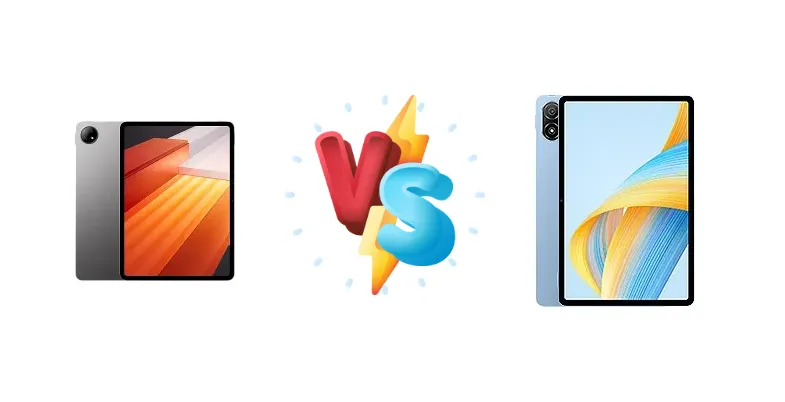
The Android tablet market is heating up, with the vivo iQOO Pad and Honor Pad V8 Pro vying for the attention of power users and gamers. Both tablets leverage Mediatek's Dimensity series, but significant differences in chipset generation and charging capabilities create a clear distinction. This comparison dissects these key areas to determine which tablet offers the best overall experience.
🏆 Quick Verdict
For users prioritizing raw performance and faster charging, the vivo iQOO Pad emerges as the winner. Its Dimensity 9000+ chipset, built on a 4nm process, provides a noticeable edge over the Honor Pad V8 Pro’s Dimensity 8100. While the Honor Pad V8 Pro remains a capable device, the iQOO Pad’s superior processing power and 44W charging make it the better choice for demanding tasks and gamers.
| Network |
|---|
| 2G bands | N/A | N/A |
| 3G bands | N/A | N/A |
| 4G bands | N/A | N/A |
| EDGE | No | N/A |
| GPRS | No | N/A |
| Technology | No cellular connectivity | No cellular connectivity |
| Launch |
|---|
| Announced | 2023, May 23 | 2022, December 26 |
| Status | Available. Released 2023, May 23 | Available. Released 2022, December 30 |
| Body |
|---|
| Build | Glass front, aluminum back, aluminum frame | Glass front, aluminum frame, aluminum back or eco leather back |
| Dimensions | 266 x 191.6 x 6.6 mm (10.47 x 7.54 x 0.26 in) | 277 x 179 x 6.6 mm or 7 mm |
| SIM | No | No |
| Weight | 585 g (1.29 lb) | 589 g or 599 g (1.30 lb) |
| | - | Honor Pencil 3 (15ms latency) |
| Display |
|---|
| Resolution | 1968 x 2800 pixels (~283 ppi density) | 2560 x 1600 pixels, 16:10 ratio (~249 ppi density) |
| Size | 12.1 inches, 444.4 cm2 (~87.2% screen-to-body ratio) | 12.1 inches, 424.5 cm2 (~85.6% screen-to-body ratio) |
| Type | IPS LCD, 1B colors, 144Hz, HDR10, 600 nits | IPS LCD, 1B colors, 144Hz, 600 nits |
| | - | IMAX enhanced |
| Platform |
|---|
| CPU | Octa-core (1x3.2 GHz Cortex-X2 & 3x2.85 GHz Cortex-A710 & 4x1.80 GHz Cortex-A510) | Octa-core (4x2.85 GHz Cortex-A78 & 4x2.0 GHz Cortex-A55) |
| Chipset | Mediatek Dimensity 9000+ (4 nm) | Mediatek Dimensity 8100 (5 nm) |
| GPU | Mali-G710 MC10 | Mali-G610 MC6 |
| OS | Android 13, OriginOS 3 | Android 12, MagicOS 7 |
| Memory |
|---|
| Card slot | No | No |
| Internal | 128GB 8GB RAM, 256GB 8GB RAM, 256GB 12GB RAM, 512GB 12GB RAM | 128GB 8GB RAM, 256GB 8GB RAM, 256GB 12GB RAM |
| Main Camera |
|---|
| Dual | 13 MP, f/2.2, 21mm, 112˚ (ultrawide), 1.12µm, AF
2 MP (macro) | - |
| Features | LED flash, panorama | LED flash, HDR |
| Single | - | 13 MP, f/2.0, (wide), 1/3.0", AF |
| Video | 4K@30fps, 1080p@30fps | 4K@30fps, 1080p@30fps |
| Selfie camera |
|---|
| Single | 8 MP, f/2.0, (wide), 1/4.0", 1.12µm | 5 MP, f/2.2 |
| Video | 1080p@30fps | 1080p@30fps |
| Sound |
|---|
| 3.5mm jack | - | No |
| 35mm jack | No | No |
| Loudspeaker | Yes, with stereo speakers (4 speakers) | Yes, with stereo speakers (8 speakers) |
| | - | 24-bit/192kHz audio |
| Comms |
|---|
| Bluetooth | 5.3, A2DP, LE | 5.2, A2DP, LE |
| NFC | Yes | No |
| Positioning | No | GPS, GLONASS, BDS |
| Radio | No | No |
| USB | USB Type-C 3.2, OTG, DisplayPort, magnetic connector | USB Type-C, magnetic connector |
| WLAN | Wi-Fi 802.11 a/b/g/n/ac/6, dual-band, Wi-Fi Direct | Wi-Fi 802.11 a/b/g/n/ac/6, dual-band |
| Features |
|---|
| Sensors | Accelerometer, gyro, proximity, compass | Accelerometer |
| Battery |
|---|
| Charging | 44W wired, PD
5W reverse wired | 35W wired |
| Type | 10000 mAh | Li-Po 10050 mAh |
| Misc |
|---|
| Colors | Gray | Grey, Blue, Orange |
| Models | - | ROD-W09 |
| Price | About 340 EUR | About 350 EUR |
vivo iQOO Pad
- Superior processing power with Dimensity 9000+
- Faster 44W wired charging
- 5W reverse wired charging capability
- Potential for higher price
- Software experience may be less refined than Honor
Honor Pad V8 Pro
- Potentially lower price point
- Honor’s software optimization
- Potentially better idle battery life
- Less powerful Dimensity 8100 chipset
- Slower 35W charging
- No reverse charging
Display Comparison
Detailed display specifications are missing, but both tablets likely feature high-resolution LCD panels. The key difference lies in the underlying chipsets, which impact the smoothness of animations and responsiveness. Without knowing refresh rates or peak brightness, it's difficult to declare a clear winner. However, the iQOO Pad’s more powerful GPU could potentially drive higher frame rates in games, enhancing the visual experience.
Camera Comparison
Camera details are absent, making a direct comparison impossible. However, given the tablet segment, camera performance is typically secondary to other features. Both devices likely feature multi-camera setups, but image quality will heavily depend on sensor size, lens quality, and software processing. Without specific details, it’s reasonable to assume both tablets offer adequate camera capabilities for casual photography and video calls.
Performance
The vivo iQOO Pad’s Mediatek Dimensity 9000+ (4nm) represents a significant leap over the Honor Pad V8 Pro’s Dimensity 8100 (5nm). The 4nm process node inherently offers better power efficiency and thermal performance, translating to sustained peak performance for longer durations. The iQOO Pad’s CPU configuration – a Cortex-X2 prime core alongside A710 performance cores – provides a substantial advantage in single-core tasks compared to the Honor Pad V8 Pro’s Cortex-A78 setup. While both utilize octa-core designs, the architectural improvements in the Dimensity 9000+ deliver superior overall performance. The Honor Pad V8 Pro’s Cortex-A55 efficiency cores are less power-hungry, potentially contributing to slightly better idle battery life, but the iQOO Pad’s superior processing power will dominate in demanding applications.
Battery Life
The iQOO Pad’s 44W wired charging is a clear advantage over the Honor Pad V8 Pro’s 35W charging. This faster charging speed will significantly reduce the time required to replenish the battery, a crucial benefit for users who rely on their tablets throughout the day. While battery capacity is unknown for both devices, the iQOO Pad’s more efficient Dimensity 9000+ chipset could potentially offset a slightly smaller battery capacity, resulting in comparable real-world battery life. The iQOO Pad also offers 5W reverse wired charging, a feature absent on the Honor Pad V8 Pro, allowing it to charge other devices on the go.
Buying Guide
Buy the vivo iQOO Pad if you need uncompromising performance for gaming, video editing, or multitasking, and value faster charging speeds to minimize downtime. Buy the Honor Pad V8 Pro if you prioritize a potentially more refined software experience (based on Honor’s track record) and are willing to trade a bit of processing power for a potentially lower price point. Consider the Honor Pad V8 Pro if battery life is paramount and you don't engage in sustained, heavy workloads.
Frequently Asked Questions
❓ Will the Dimensity 8100 in the Honor Pad V8 Pro struggle with demanding games like Genshin Impact?
While the Dimensity 8100 is a capable chipset, it may require lower graphics settings and frame rate caps in graphically intensive games like Genshin Impact to maintain a smooth experience. The iQOO Pad’s Dimensity 9000+ offers significantly more headroom for high-fidelity gaming.
❓ How long will it take to fully charge the iQOO Pad with its 44W charging?
Based on typical 44W charging profiles, the iQOO Pad should be able to charge from 0% to 100% in approximately 60-75 minutes, significantly faster than the Honor Pad V8 Pro’s 35W charging.
❓ Does the iQOO Pad’s reverse charging feature work with all devices?
The iQOO Pad’s 5W reverse wired charging is compatible with most devices that charge via USB-C, including smartphones, earbuds, and other tablets. However, charging speeds will be limited to 5W, so it’s best suited for topping up smaller devices.