
vivo iQOO Neo9S Pro+ vs Xiaomi Redmi K70 Pro: A Deep Dive into Snapdragon 8 Gen 3 Power
| Phones Images | |||||
|---|---|---|---|---|---|
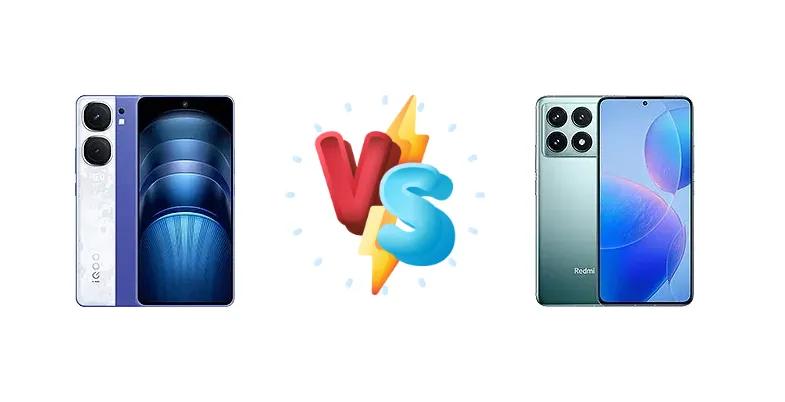
|
🏆 Quick Verdict
For the average user prioritizing the absolute fastest charging and potentially slightly better sustained performance, the vivo iQOO Neo9S Pro+ edges out the Redmi K70 Pro. While both reach 100% quickly, the iQOO’s 28-minute full charge is marginally faster. However, the Redmi K70 Pro remains a compelling option, offering similar performance at a potentially lower price point.
| PHONES | ||
|---|---|---|
| Phone Names | vivo iQOO Neo9S Pro+ | Xiaomi Redmi K70 Pro |
| Network | ||
|---|---|---|
| 2G bands | GSM 850 / 900 / 1800 / 1900 | GSM 850 / 900 / 1800 / 1900 |
| 3G bands | HSDPA 850 / 900 / 1700(AWS) / 1900 / 2100 | HSDPA 800 / 850 / 900 / 1700(AWS) / 2100 |
| 4G bands | 1, 3, 4, 5, 7, 8, 18, 19, 26, 28, 34, 38, 39, 40, 41 | 1, 3, 4, 5, 8, 18, 19, 26, 28, 34, 38, 39, 40, 41, 42, 48, 66 |
| 5G bands | 1, 3, 5, 8, 28, 38, 40, 41, 77, 78 SA/NSA | 1, 3, 5, 8, 28, 38, 41, 48, 66, 77, 78 SA/NSA |
| Speed | HSPA, LTE, 5G | HSPA, LTE, 5G |
| Technology | GSM / CDMA / HSPA / CDMA2000 / LTE / 5G | GSM / CDMA / HSPA / CDMA2000 / LTE / 5G |
| Launch | ||
|---|---|---|
| Announced | 2024, July 11 | 2023, November 29 |
| Status | Available. Released 2024, July 16 | Available. Released 2023, November 29 |
| Body | ||
|---|---|---|
| Dimensions | 163.5 x 75.7 x 8 mm or 8.3 mm | 160.9 x 75 x 8.2 mm (6.33 x 2.95 x 0.32 in) |
| SIM | Nano-SIM + Nano-SIM | Nano-SIM + Nano-SIM |
| Weight | 193 g or 198 g (6.81 oz) | 209 g (7.37 oz) |
| Display | ||
|---|---|---|
| Resolution | 1260 x 2800 pixels, 20:9 ratio (~453 ppi density) | 1440 x 3200 pixels, 20:9 ratio (~526 ppi density) |
| Size | 6.78 inches, 111.0 cm2 (~89.7% screen-to-body ratio) | 6.67 inches, 107.4 cm2 (~89.0% screen-to-body ratio) |
| Type | LTPO AMOLED, 1B colors, 144Hz, HDR10+, 1400 nits (HBM) | OLED, 68B colors, 120Hz, Dolby Vision, HDR10+, 4000 nits (peak) |
| Platform | ||
|---|---|---|
| CPU | Octa-core (1x3.3 GHz Cortex-X4 & 3x3.2 GHz Cortex-A720 & 2x3.0 GHz Cortex-A720 & 2x2.3 GHz Cortex-A520) | Octa-core (1x3.3 GHz Cortex-X4 & 3x3.2 GHz Cortex-A720 & 2x3.0 GHz Cortex-A720 & 2x2.3 GHz Cortex-A520) |
| Chipset | Qualcomm SM8650-AB Snapdragon 8 Gen 3 (4 nm) | Qualcomm SM8650-AB Snapdragon 8 Gen 3 (4 nm) |
| GPU | Adreno 750 | Adreno 750 |
| OS | Android 14, upgradable to Android 15, OriginOS 5 | Android 14, HyperOS |
| Memory | ||
|---|---|---|
| Card slot | No | No |
| Internal | 256GB 12GB RAM, 256GB 16GB RAM, 512GB 12GB RAM, 512GB 16GB RAM, 1TB 16GB RAM | 256GB 12GB RAM, 256GB 16GB RAM, 512GB 12GB RAM, 512GB 16GB RAM, 1TB 24GB RAM |
| Main Camera | ||
|---|---|---|
| Dual | 50 MP, f/1.9, (wide), 1/1.56", PDAF, OIS 50 MP, f/2.0, 119˚ (ultrawide), 1/2.76", 0.64µm, AF | - |
| Features | LED flash, panorama, HDR | Color spectrum sensor, LED flash, HDR, panorama |
| Triple | - | 50 MP, f/1.6, (wide), 1/1.55", 1.0µm, PDAF, OIS 50 MP, (telephoto), PDAF, 2x optical zoom 12 MP, (ultrawide) |
| Video | 8K, 4K, 1080p, gyro-EIS | 8K@24fps, 4K@24/30/60fps, 1080p@30/60/120/240/960fps, 720p@1920fps, gyro-EIS |
| Selfie camera | ||
|---|---|---|
| Features | - | HDR |
| Single | 16 MP, f/2.5, (wide) | 16 MP, (wide) |
| Video | 1080p@30fps | 1080p@30/60fps, gyro-EIS |
| Sound | ||
|---|---|---|
| 35mm jack | No | No |
| Loudspeaker | Yes, with stereo speakers | Yes, with stereo speakers |
| Comms | ||
|---|---|---|
| Bluetooth | 5.4, A2DP, LE, aptX HD, aptX Adaptive, aptX Lossless, LHDC | 5.4, A2DP, LE, aptX HD, aptX Adaptive, aptX Lossless |
| Infrared port | Yes | Yes |
| NFC | Yes | Yes |
| Positioning | GPS (L1+L5), BDS (B1I+B1c+B2a), GALILEO (E1+E5a), QZSS (L1+L5), GLONASS | GPS (L1+L5), GLONASS (G1), BDS (B1I+B1c+B2a), GALILEO (E1+E5a), QZSS (L1+L5), NavIC (L5) |
| Radio | No | No |
| USB | USB Type-C 2.0, OTG | USB Type-C, OTG |
| WLAN | Wi-Fi 802.11 a/b/g/n/ac/6/7, dual-band | Wi-Fi 802.11 a/b/g/n/ac/6e/7, dual-band, Wi-Fi Direct |
| Features | ||
|---|---|---|
| Sensors | Fingerprint (under display, ultrasonic), accelerometer, gyro, proximity, compass | Fingerprint (under display, optical), accelerometer, proximity, gyro, compass |
| Battery | ||
|---|---|---|
| Charging | 120W wired, 70% in 17 min, 100% in 28 min Reverse wired | 120W wired, PD3.0, QC3+, 100% in 18 min |
| Type | 5500 mAh | Li-Po 5000 mAh |
| Misc | ||
|---|---|---|
| Colors | Blue/White, Black, White | Black, Silver, Blue/Green, Lamborgini Green, Lamborgini Yellow |
| Models | V2403A | 23117RK66C |
| Price | About 380 EUR | About 430 EUR |
vivo iQOO Neo9S Pro+
- Slightly faster 120W charging (28 minutes to full)
- Potentially superior thermal management for sustained performance
- Aggressive cooling solutions historically implemented by iQOO
- Software experience may be more heavily customized
- Camera details currently unknown
Xiaomi Redmi K70 Pro
- Competitive price point expected
- Potentially cleaner software experience
- Fast 120W charging (18 minutes to full)
- Charging is marginally slower than iQOO
- Thermal performance needs further evaluation
Display Comparison
Both devices are expected to feature high-refresh-rate AMOLED displays, though specific details like peak brightness and panel technology (LTPO) are not provided. However, given the flagship positioning, both will likely offer excellent color accuracy and viewing angles. The absence of display specs necessitates focusing on other areas for differentiation.
Camera Comparison
Camera specifications are absent from the provided data. However, given the competitive landscape, both phones are expected to feature multi-camera systems. The presence of a large main sensor with Optical Image Stabilization (OIS) will be crucial for low-light performance. Image processing style will likely differ – iQOO often favors vibrant, saturated colors, while Xiaomi tends towards a more natural look. The absence of details prevents a meaningful comparison beyond speculation.
Performance
Both the iQOO Neo9S Pro+ and Redmi K70 Pro utilize the Qualcomm SM8650-AB Snapdragon 8 Gen 3 (4nm). The CPU configuration is identical – 1x3.3 GHz Cortex-X4, 3x3.2 GHz Cortex-A720, 2x3.0 GHz Cortex-A720, and 2x2.3 GHz Cortex-A520. This means raw CPU performance will be nearly indistinguishable. The key differentiator will be thermal management. The 4nm process node is efficient, but sustained loads will generate heat. iQOO’s history suggests aggressive cooling solutions, potentially allowing for longer peak performance before throttling, while Xiaomi’s implementation remains to be seen. RAM speed (likely LPDDR5x) is also a critical factor, but not specified in the provided data.
Battery Life
Both devices boast 120W wired charging, a significant advantage over slower charging standards. The iQOO Neo9S Pro+ claims 70% charge in 17 minutes and 100% in 28 minutes, while the Redmi K70 Pro reaches 100% in 18 minutes. This 10-minute difference, while measurable, is unlikely to be a major deciding factor for most users. The battery capacity (mAh) is not specified, but the fast charging mitigates the impact of a potentially smaller battery. Both support reverse wired charging, adding to their versatility.
Buying Guide
Buy the vivo iQOO Neo9S Pro+ if you need the absolute fastest charging speeds available and prioritize sustained gaming performance, potentially benefiting from optimized thermal management. Buy the Xiaomi Redmi K70 Pro if you prefer a potentially more streamlined software experience and are seeking flagship-level performance at a competitive price, accepting a slightly slower (but still incredibly fast) charging time.