
vivo iQOO Neo9S Pro+ vs Xiaomi 14 Pro: A Deep Dive into Snapdragon 8 Gen 3 Flagships
| Phones Images | |||||
|---|---|---|---|---|---|
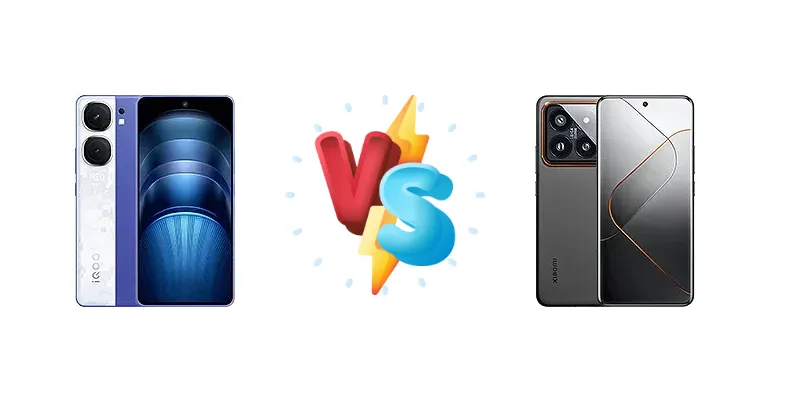
|
🏆 Quick Verdict
For the average user prioritizing the fastest possible wired charging and a potentially more aggressive price point, the vivo iQOO Neo9S Pro+ emerges as the winner. However, the Xiaomi 14 Pro’s addition of 50W wireless charging and potentially more refined software experience make it a compelling alternative for those valuing convenience and a broader feature set.
| PHONES | ||
|---|---|---|
| Phone Names | vivo iQOO Neo9S Pro+ | Xiaomi 14 Pro |
| Network | ||
|---|---|---|
| 2G bands | GSM 850 / 900 / 1800 / 1900 | GSM 850 / 900 / 1800 / 1900 |
| 3G bands | HSDPA 850 / 900 / 1700(AWS) / 1900 / 2100 | HSDPA 800 / 850 / 900 / 1700(AWS) / 1900 / 2100 |
| 4G bands | 1, 3, 4, 5, 7, 8, 18, 19, 26, 28, 34, 38, 39, 40, 41 | 1, 3, 4, 5, 7, 8, 18, 19, 26, 28, 34, 38, 39, 40, 41, 42, 48, 66 |
| 5G bands | 1, 3, 5, 8, 28, 38, 40, 41, 77, 78 SA/NSA | 1, 3, 5, 7, 8, 28, 38, 40, 41, 48, 66, 77, 78, 79 SA/NSA |
| Speed | HSPA, LTE, 5G | HSPA, LTE, 5G |
| Technology | GSM / CDMA / HSPA / CDMA2000 / LTE / 5G | GSM / CDMA / HSPA / CDMA2000 / LTE / 5G |
| Launch | ||
|---|---|---|
| Announced | 2024, July 11 | 2023, October 26 |
| Status | Available. Released 2024, July 16 | Available. Released 2023, November 01 |
| Body | ||
|---|---|---|
| Build | - | Glass front, aluminum frame or titanium frame, glass back |
| Dimensions | 163.5 x 75.7 x 8 mm or 8.3 mm | 161.4 x 75.3 x 8.5 mm |
| SIM | Nano-SIM + Nano-SIM | Nano-SIM + Nano-SIM |
| Weight | 193 g or 198 g (6.81 oz) | 223 g or 230 g (7.87 oz) |
| Display | ||
|---|---|---|
| Protection | - | Shatterproof glass |
| Resolution | 1260 x 2800 pixels, 20:9 ratio (~453 ppi density) | 1440 x 3200 pixels, 20:9 ratio (~522 ppi density) |
| Size | 6.78 inches, 111.0 cm2 (~89.7% screen-to-body ratio) | 6.73 inches, 108.9 cm2 (~89.6% screen-to-body ratio) |
| Type | LTPO AMOLED, 1B colors, 144Hz, HDR10+, 1400 nits (HBM) | LTPO AMOLED, 68B colors, 120Hz, Dolby Vision, HDR10+, 3000 nits (peak) |
| Platform | ||
|---|---|---|
| CPU | Octa-core (1x3.3 GHz Cortex-X4 & 3x3.2 GHz Cortex-A720 & 2x3.0 GHz Cortex-A720 & 2x2.3 GHz Cortex-A520) | Octa-core (1x3.3 GHz Cortex-X4 & 3x3.2 GHz Cortex-A720 & 2x3.0 GHz Cortex-A720 & 2x2.3 GHz Cortex-A520) |
| Chipset | Qualcomm SM8650-AB Snapdragon 8 Gen 3 (4 nm) | Qualcomm SM8650-AB Snapdragon 8 Gen 3 (4 nm) |
| GPU | Adreno 750 | Adreno 750 |
| OS | Android 14, upgradable to Android 15, OriginOS 5 | Android 14, HyperOS |
| Memory | ||
|---|---|---|
| Card slot | No | No |
| Internal | 256GB 12GB RAM, 256GB 16GB RAM, 512GB 12GB RAM, 512GB 16GB RAM, 1TB 16GB RAM | 256GB 12GB RAM, 512GB 16GB RAM, 1TB 16GB RAM |
| Main Camera | ||
|---|---|---|
| Dual | 50 MP, f/1.9, (wide), 1/1.56", PDAF, OIS 50 MP, f/2.0, 119˚ (ultrawide), 1/2.76", 0.64µm, AF | - |
| Features | LED flash, panorama, HDR | Laser AF, color spectrum sensor, Leica lens, Dual-LED dual-tone flash, HDR, panorama |
| Triple | - | 50 MP, f/1.4-f/4.0, 23mm (wide), 1/1.31", 1.2µm, dual pixel PDAF, OIS 50 MP, f/2.0, 75mm (telephoto), PDAF (10cm - ∞), OIS, 3.2x optical zoom 50 MP, f/2.2, 14mm, 115˚ (ultrawide), AF |
| Video | 8K, 4K, 1080p, gyro-EIS | 8K@24fps (HDR), 4K@24/30/60fps (HDR10+, 10-bit Dolby Vision HDR, 10-bit LOG), 1080p@30/60/120/240/960fps, 720p@1920fps, gyro-EIS |
| Selfie camera | ||
|---|---|---|
| Features | - | HDR, panorama |
| Single | 16 MP, f/2.5, (wide) | 32 MP, f/2.0, 22mm (wide), 0.7µm |
| Video | 1080p@30fps | 4K@30/60fps, 1080p@30/60fps, gyro-EIS |
| Sound | ||
|---|---|---|
| 35mm jack | No | No |
| Loudspeaker | Yes, with stereo speakers | Yes, with stereo speakers |
| Comms | ||
|---|---|---|
| Bluetooth | 5.4, A2DP, LE, aptX HD, aptX Adaptive, aptX Lossless, LHDC | 5.4, A2DP, LE, aptX HD, aptX Adaptive |
| Infrared port | Yes | Yes |
| NFC | Yes | Yes |
| Positioning | GPS (L1+L5), BDS (B1I+B1c+B2a), GALILEO (E1+E5a), QZSS (L1+L5), GLONASS | GPS (L1+L5), GLONASS (G1), BDS (B1I+B1c+B2a), GALILEO (E1+E5a), QZSS (L1+L5), NavIC (L5) |
| Radio | No | No |
| USB | USB Type-C 2.0, OTG | USB Type-C 3.2 Gen 2, OTG |
| WLAN | Wi-Fi 802.11 a/b/g/n/ac/6/7, dual-band | Wi-Fi 802.11 a/b/g/n/ac/6e/7, dual-band, Wi-Fi Direct |
| Features | ||
|---|---|---|
| Sensors | Fingerprint (under display, ultrasonic), accelerometer, gyro, proximity, compass | Fingerprint (under display, optical), accelerometer, proximity, gyro, compass, barometer |
| Battery | ||
|---|---|---|
| Charging | 120W wired, 70% in 17 min, 100% in 28 min Reverse wired | 120W wired, PD3.0, QC4, 100% in 18 min 50W wireless, 100% in 40 min 10W reverse wireless |
| Type | 5500 mAh | Li-Po 4880 mAh |
| Misc | ||
|---|---|---|
| Colors | Blue/White, Black, White | Black, Silver, Titanium, Green |
| Models | V2403A | 23116PN5BC |
| Price | About 380 EUR | About 650 EUR |
vivo iQOO Neo9S Pro+
- Faster wired charging (28 minutes to 100%)
- Potentially more aggressive cooling for sustained performance
- Likely more competitive pricing
- No wireless charging
- Potentially less refined camera system
- Software experience may be less polished
Xiaomi 14 Pro
- 50W wireless charging for added convenience
- 10W reverse wireless charging
- Potentially more refined software experience
- Slightly slower wired charging (18 minutes to 100%)
- May be more expensive
- Thermal management might prioritize efficiency over sustained peak performance
Display Comparison
While both devices are expected to feature high-refresh-rate AMOLED displays, specific details like peak brightness and panel technology (LTPO) are missing. However, given the flagship positioning, both will likely offer excellent color accuracy and viewing angles. The absence of display specs necessitates focusing on other differentiating factors. Expect both to target 120Hz refresh rates for smooth scrolling and gaming.
Camera Comparison
Without detailed camera specifications, a direct comparison is limited. However, both brands are known for incorporating high-resolution sensors. The Xiaomi 14 Pro is likely to feature a more sophisticated camera system, given Xiaomi’s emphasis on camera technology. The iQOO Neo series typically prioritizes performance over camera prowess, so expect a capable but potentially less refined camera experience. Lens apertures and OIS implementation will be crucial factors, but are currently unknown. We can safely assume both will offer a range of shooting modes, but image processing styles will likely differ – Xiaomi tending towards more vibrant, saturated images, while iQOO might aim for a more natural look.
Performance
Both the iQOO Neo9S Pro+ and Xiaomi 14 Pro utilize the Qualcomm SM8650-AB Snapdragon 8 Gen 3 (4nm). The CPU configuration is identical – 1x3.3 GHz Cortex-X4, 3x3.2 GHz Cortex-A720, 2x3.0 GHz Cortex-A720, and 2x2.3 GHz Cortex-A520. This means theoretical CPU performance will be nearly indistinguishable. The key differentiator will be thermal management. iQOO historically focuses on aggressive cooling solutions for sustained performance, while Xiaomi often balances thermal performance with power efficiency. RAM speed (likely LPDDR5x) is also expected to be similar, but the effectiveness of each phone’s cooling system will dictate how consistently they maintain peak performance during extended gaming or demanding tasks.
Battery Life
The charging capabilities are a significant point of divergence. Both phones support 120W wired charging, with the iQOO Neo9S Pro+ claiming 70% in 17 minutes and 100% in 28 minutes, while the Xiaomi 14 Pro reaches 100% in 18 minutes. This suggests a slightly faster charging curve for the iQOO. Crucially, the Xiaomi 14 Pro adds 50W wireless charging (100% in 40 minutes) and 10W reverse wireless charging, features absent in the iQOO Neo9S Pro+. While battery capacity isn’t specified, the inclusion of wireless charging on the Xiaomi 14 Pro likely necessitates a slightly larger battery to compensate for the inherent efficiency loss of wireless power transfer.
Buying Guide
Buy the vivo iQOO Neo9S Pro+ if you need the absolute fastest wired charging available, prioritizing minimizing downtime and maximizing gaming sessions. Buy the Xiaomi 14 Pro if you prefer the convenience of wireless charging, value a more holistic feature set including wireless capabilities, and are willing to trade a few minutes of wired charging speed for that added flexibility.