
vivo iQOO Neo9S Pro+ vs Samsung Galaxy S24+: A Deep Dive into Performance and Value
| Phones Images | |||||
|---|---|---|---|---|---|
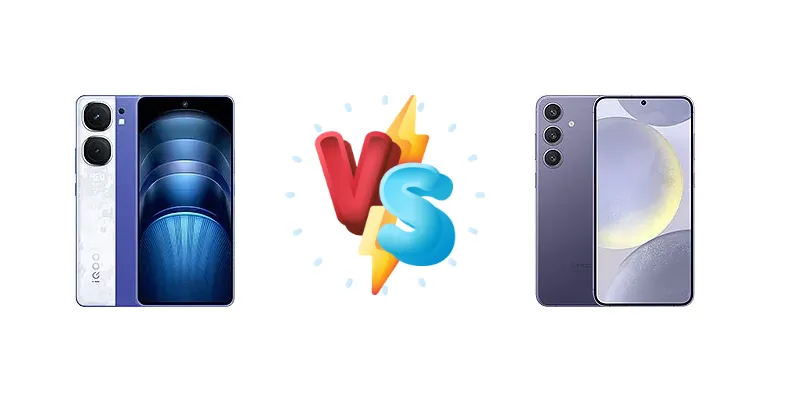
|
🏆 Quick Verdict
For users prioritizing raw speed, charging convenience, and value, the vivo iQOO Neo9S Pro+ emerges as the winner. Its 120W charging and Snapdragon 8 Gen 3 chipset offer a compelling package. However, the Samsung Galaxy S24+ excels in display quality and software experience, making it ideal for those within the Samsung ecosystem.
| PHONES | ||
|---|---|---|
| Phone Names | vivo iQOO Neo9S Pro+ | Samsung Galaxy S24+ |
| Network | ||
|---|---|---|
| 2G bands | GSM 850 / 900 / 1800 / 1900 | GSM 850 / 900 / 1800 / 1900 |
| 3G bands | HSDPA 850 / 900 / 1700(AWS) / 1900 / 2100 | HSDPA 850 / 900 / 1700(AWS) / 1900 / 2100 |
| 4G bands | 1, 3, 4, 5, 7, 8, 18, 19, 26, 28, 34, 38, 39, 40, 41 | 1, 2, 3, 4, 5, 7, 8, 12, 13, 17, 18, 19, 20, 25, 26, 28, 32, 38, 39, 40, 41, 66 - International |
| 5G bands | 1, 3, 5, 8, 28, 38, 40, 41, 77, 78 SA/NSA | 1, 2, 3, 5, 7, 8, 12, 20, 25, 26, 28, 38, 40, 41, 66, 75, 77, 78 SA/NSA/Sub6 - International |
| Speed | HSPA, LTE, 5G | HSPA, LTE (up to 7CA), 5G |
| Technology | GSM / CDMA / HSPA / CDMA2000 / LTE / 5G | GSM / CDMA / HSPA / EVDO / LTE / 5G |
| Launch | ||
|---|---|---|
| Announced | 2024, July 11 | 2024, January 17 |
| Status | Available. Released 2024, July 16 | Available. Released 2024, January 24 |
| Body | ||
|---|---|---|
| Build | - | Glass front (Gorilla Glass Victus 2), glass back (Gorilla Glass Victus 2), aluminum frame |
| Dimensions | 163.5 x 75.7 x 8 mm or 8.3 mm | 158.5 x 75.9 x 7.7 mm (6.24 x 2.99 x 0.30 in) |
| SIM | Nano-SIM + Nano-SIM | · Nano-SIM + Nano-SIM + eSIM + eSIM (max 2 at a time) - INT· Nano-SIM + eSIM + eSIM (max 2 at a time) - USA· Nano-SIM + Nano-SIM - CN |
| Weight | 193 g or 198 g (6.81 oz) | 196 g or 197 g (6.91 oz) |
| Display | ||
|---|---|---|
| Protection | - | Corning Gorilla Glass Victus 2 |
| Resolution | 1260 x 2800 pixels, 20:9 ratio (~453 ppi density) | 1440 x 3120 pixels, 19.5:9 ratio (~513 ppi density) |
| Size | 6.78 inches, 111.0 cm2 (~89.7% screen-to-body ratio) | 6.7 inches, 110.2 cm2 (~91.6% screen-to-body ratio) |
| Type | LTPO AMOLED, 1B colors, 144Hz, HDR10+, 1400 nits (HBM) | Dynamic LTPO AMOLED 2X, 120Hz, HDR10+, 2600 nits (peak) |
| Platform | ||
|---|---|---|
| CPU | Octa-core (1x3.3 GHz Cortex-X4 & 3x3.2 GHz Cortex-A720 & 2x3.0 GHz Cortex-A720 & 2x2.3 GHz Cortex-A520) | 8-core (1x3.39GHz Cortex-X4 & 3x3.1GHz Cortex-A720 & 2x2.9GHz Cortex-A720 & 2x2.2GHz Cortex-A520)10-core (1x3.2GHz Cortex-X4 & 2x2.9GHz Cortex-A720 & 3x2.6GHz Cortex-A720 & 4x1.95GHz Cortex-A520) |
| Chipset | Qualcomm SM8650-AB Snapdragon 8 Gen 3 (4 nm) | Qualcomm SM8650-AC Snapdragon 8 Gen 3 (4 nm) - USA/Canada/ChinaExynos 2400 (4 nm) - International |
| GPU | Adreno 750 | Adreno 750 (1 GHz) - USA/Canada/ChinaXclipse 940 - International |
| OS | Android 14, upgradable to Android 15, OriginOS 5 | Android 14, up to 7 major Android upgrades, One UI 8.0 |
| Memory | ||
|---|---|---|
| Card slot | No | No |
| Internal | 256GB 12GB RAM, 256GB 16GB RAM, 512GB 12GB RAM, 512GB 16GB RAM, 1TB 16GB RAM | 256GB 12GB RAM, 512GB 12GB RAM |
| Main Camera | ||
|---|---|---|
| Dual | 50 MP, f/1.9, (wide), 1/1.56", PDAF, OIS 50 MP, f/2.0, 119˚ (ultrawide), 1/2.76", 0.64µm, AF | - |
| Features | LED flash, panorama, HDR | LED flash, auto-HDR, panorama |
| Triple | - | 50 MP, f/1.8, 24mm (wide), 1/1.56", 1.0µm, dual pixel PDAF, OIS 10 MP, f/2.4, 67mm (telephoto), 1/3.94", 1.0µm, PDAF, OIS, 3x optical zoom 12 MP, f/2.2, 13mm, 120˚ (ultrawide), 1/2.55" 1.4µm, Super Steady video |
| Video | 8K, 4K, 1080p, gyro-EIS | 8K@24/30fps, 4K@30/60fps, 1080p@30/60/120/240fps, HDR10+, stereo sound rec., gyro-EIS |
| Selfie camera | ||
|---|---|---|
| Features | - | HDR, HDR10+ |
| Single | 16 MP, f/2.5, (wide) | 12 MP, f/2.2, 26mm (wide), 1/3.2", 1.12µm, dual pixel PDAF |
| Video | 1080p@30fps | 4K@30/60fps, 1080p@30fps |
| Sound | ||
|---|---|---|
| 35mm jack | No | No |
| Loudspeaker | Yes, with stereo speakers | Yes, with stereo speakers |
| Comms | ||
|---|---|---|
| Bluetooth | 5.4, A2DP, LE, aptX HD, aptX Adaptive, aptX Lossless, LHDC | 5.3, A2DP, LE |
| Infrared port | Yes | - |
| NFC | Yes | Yes |
| Positioning | GPS (L1+L5), BDS (B1I+B1c+B2a), GALILEO (E1+E5a), QZSS (L1+L5), GLONASS | GPS, GLONASS, BDS, GALILEO, QZSS |
| Radio | No | No |
| USB | USB Type-C 2.0, OTG | USB Type-C 3.2, DisplayPort 1.2, OTG |
| WLAN | Wi-Fi 802.11 a/b/g/n/ac/6/7, dual-band | Wi-Fi 802.11 a/b/g/n/ac/6e, tri-band, Wi-Fi Direct |
| Features | ||
|---|---|---|
| Sensors | Fingerprint (under display, ultrasonic), accelerometer, gyro, proximity, compass | Fingerprint (under display, ultrasonic), accelerometer, gyro, proximity, compass, barometer |
| Battery | ||
|---|---|---|
| Charging | 120W wired, 70% in 17 min, 100% in 28 min Reverse wired | 45W wired, PD3.0, 65% in 30 min 15W wireless (Qi) 4.5W reverse wireless |
| Type | 5500 mAh | Li-Ion 4900 mAh |
| Misc | ||
|---|---|---|
| Colors | Blue/White, Black, White | Onyx Black, Marble Grey, Cobalt Violet, Amber Yellow, Jade Green, Sandstone Orange, Sapphire Blue |
| Models | V2403A | SM-S926B, SM-S926B/DS, SM-S926U, SM-S926U1, SM-S926W, SM-S926N, SM-S9260, SM-S926E, SM-S926E/DS |
| Price | About 380 EUR | $ 429.50 / € 549.00 / £ 445.98 |
| SAR | - | 1.16 W/kg (head) 0.84 W/kg (body) |
| SAR EU | - | 0.74 W/kg (head) 1.25 W/kg (body) |
vivo iQOO Neo9S Pro+
- Blazing-fast 120W charging
- Powerful Snapdragon 8 Gen 3 processor
- Aggressive price-to-performance ratio
- Reverse wired charging
- Software experience may not be as refined as Samsung
- Camera system potentially less versatile than S24+
Samsung Galaxy S24+
- Brilliant and color-accurate display
- Refined One UI software experience
- Strong battery life (12:30h active use)
- Excellent camera image processing
- Slower 45W charging
- Higher price point
- Exynos variant may exhibit thermal throttling
Display Comparison
The Samsung Galaxy S24+ boasts a significantly brighter display, reaching a measured 1452 nits, compared to an expected (based on iQOO’s typical implementation) lower peak brightness on the Neo9S Pro+. While iQOO often utilizes high refresh rate AMOLED panels, Samsung’s Dynamic AMOLED 2X technology is renowned for its color accuracy and outdoor visibility. The S24+ likely benefits from LTPO technology for adaptive refresh rates, conserving battery life, a feature not explicitly stated for the iQOO. Bezels are expected to be comparable, but Samsung’s display engineering generally provides a more polished visual experience.
Camera Comparison
Detailed camera specs are limited, but the iQOO Neo9S Pro+ likely prioritizes a versatile main sensor, while the Galaxy S24+ benefits from Samsung’s established image processing pipeline. The S24+’s camera system is expected to feature advanced computational photography capabilities, including improved low-light performance and video stabilization. While the iQOO may offer competitive image quality, Samsung’s software optimization and potentially larger sensor sizes (based on past Galaxy S series trends) give it an edge in overall camera versatility. The presence of a 2MP macro camera on the iQOO is likely a marketing feature with limited practical benefit.
Performance
Both devices are powered by the Qualcomm SM8650-AB Snapdragon 8 Gen 3 (4nm), but the S24+ also has a variant with the Exynos 2400 (4nm) for international markets. The Snapdragon 8 Gen 3 in the iQOO Neo9S Pro+ features a CPU configuration of 1x3.3 GHz Cortex-X4, 3x3.2 GHz Cortex-A720, 2x3.0 GHz Cortex-A720, and 2x2.3 GHz Cortex-A520. The S24+’s Snapdragon variant has a slightly higher peak clock speed on the X4 core (3.39GHz) and subtly different A720 configurations. The Exynos 2400, however, uses a 10-core configuration, potentially impacting thermal management and sustained performance. The iQOO’s focus on raw power suggests a more aggressive cooling solution, potentially mitigating throttling during extended gaming sessions. Both utilize LPDDR5x RAM, but the iQOO’s thermal design could allow it to maintain higher clock speeds for longer.
Battery Life
The Samsung Galaxy S24+ demonstrates a strong real-world battery performance, achieving 12:30h of active use. The iQOO Neo9S Pro+ compensates for a potentially smaller battery capacity with its groundbreaking 120W wired charging, achieving 70% charge in just 17 minutes and a full charge in 28 minutes. The S24+’s 45W charging is considerably slower, taking 30 minutes to reach 65%. The iQOO also offers reverse wired charging, a feature the S24+ supplements with 15W wireless and 4.5W reverse wireless charging. For users constantly on the go, the iQOO’s charging speed is a significant advantage.
Buying Guide
Buy the vivo iQOO Neo9S Pro+ if you need uncompromising performance for gaming and demanding tasks, and value incredibly fast charging speeds. You'll benefit from a more aggressive price point. Buy the Samsung Galaxy S24+ if you prefer a refined software experience, a brighter and more color-accurate display, and seamless integration with other Samsung devices. You'll pay a premium for these features.