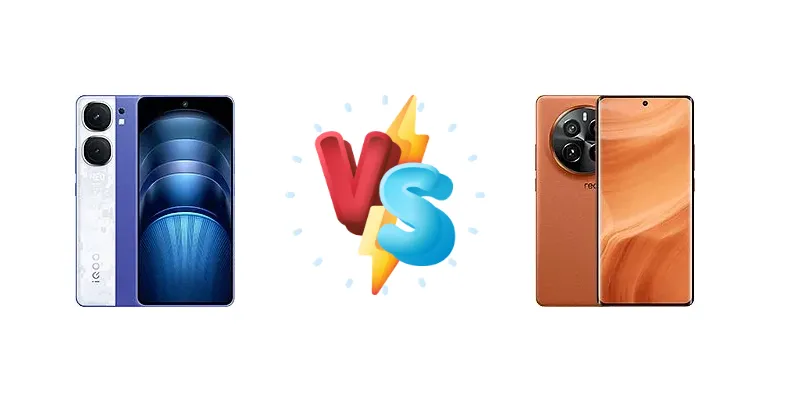
Both the vivo iQOO Neo9S Pro+ and the Realme GT5 Pro represent aggressive value in the flagship space, powered by Qualcomm’s latest Snapdragon 8 Gen 3 chipset. However, they diverge significantly in their approach to charging, battery optimization, and display technology, creating a clear choice for users prioritizing different aspects of the smartphone experience.
🏆 Quick Verdict
For users demanding the absolute fastest charging and a slightly more streamlined software experience, the iQOO Neo9S Pro+ is the winner. Its 120W charging significantly outperforms the Realme GT5 Pro’s 100W, and the 70% charge in 17 minutes is a tangible benefit. However, the GT5 Pro counters with superior battery life.
| Network |
|---|
| 2G bands | GSM 850 / 900 / 1800 / 1900 | GSM 850 / 900 / 1800 / 1900 |
| 3G bands | HSDPA 850 / 900 / 1700(AWS) / 1900 / 2100 | HSDPA 850 / 900 / 2100 |
| 4G bands | 1, 3, 4, 5, 7, 8, 18, 19, 26, 28, 34, 38, 39, 40, 41 | 1, 3, 5, 7, 8, 28, 34, 38, 39, 40, 41 |
| 5G bands | 1, 3, 5, 8, 28, 38, 40, 41, 77, 78 SA/NSA | 1, 3, 5, 8, 28, 41, 77, 78 SA/NSA |
| Speed | HSPA, LTE, 5G | HSPA, LTE, 5G |
| Technology | GSM / CDMA / HSPA / CDMA2000 / LTE / 5G | GSM / CDMA / HSPA / CDMA2000 / LTE / 5G |
| Launch |
|---|
| Announced | 2024, July 11 | 2023, December 07 |
| Status | Available. Released 2024, July 16 | Available. Released 2023, December 14 |
| Body |
|---|
| Build | - | Glass front, glass back or silicone polymer back (eco leather), aluminum frame |
| Dimensions | 163.5 x 75.7 x 8 mm or 8.3 mm | 161.7 x 75.1 x 9.2 mm (6.37 x 2.96 x 0.36 in) |
| SIM | Nano-SIM + Nano-SIM | Nano-SIM + Nano-SIM |
| Weight | 193 g or 198 g (6.81 oz) | 218 g / 224 g (7.69 oz) |
| Display |
|---|
| Resolution | 1260 x 2800 pixels, 20:9 ratio (~453 ppi density) | 1264 x 2780 pixels (~450 ppi density) |
| Size | 6.78 inches, 111.0 cm2 (~89.7% screen-to-body ratio) | 6.78 inches, 111.7 cm2 (~92.0% screen-to-body ratio) |
| Type | LTPO AMOLED, 1B colors, 144Hz, HDR10+, 1400 nits (HBM) | LTPO AMOLED, 1B colors, 144Hz, HDR10+, Dolby Vision, 4500 nits (peak) |
| Platform |
|---|
| CPU | Octa-core (1x3.3 GHz Cortex-X4 & 3x3.2 GHz Cortex-A720 & 2x3.0 GHz Cortex-A720 & 2x2.3 GHz Cortex-A520) | Octa-core (1x3.3 GHz Cortex-X4 & 3x3.2 GHz Cortex-A720 & 2x3.0 GHz Cortex-A720 & 2x2.3 GHz Cortex-A520) |
| Chipset | Qualcomm SM8650-AB Snapdragon 8 Gen 3 (4 nm) | Qualcomm SM8650-AB Snapdragon 8 Gen 3 (4 nm) |
| GPU | Adreno 750 | Adreno 750 |
| OS | Android 14, upgradable to Android 15, OriginOS 5 | Android 14, upgradable to Android 15, Realme UI 6.0 |
| Memory |
|---|
| Card slot | No | No |
| Internal | 256GB 12GB RAM, 256GB 16GB RAM, 512GB 12GB RAM, 512GB 16GB RAM, 1TB 16GB RAM | 256GB 12GB RAM, 256GB 16GB RAM, 512GB 16GB RAM, 1TB 16GB RAM |
| Main Camera |
|---|
| Dual | 50 MP, f/1.9, (wide), 1/1.56", PDAF, OIS
50 MP, f/2.0, 119˚ (ultrawide), 1/2.76", 0.64µm, AF | - |
| Features | LED flash, panorama, HDR | Color spectrum sensor, Dual-LED dual-tone flash, HDR, panorama |
| Triple | - | 50 MP, f/1.7, 23mm (wide), 1/1.43", 1.12µm, dual pixel PDAF, OIS
50 MP, f/2.6, 65mm (periscope telephoto), 1/1.56", 1.0µm, multi-directional PDAF, OIS, 2.7x optical zoom
8 MP, f/2.2, 16mm, 112˚ (ultrawide), 1/4.0", 1.12µm |
| Video | 8K, 4K, 1080p, gyro-EIS | 8K@24fps, 4K@30/60fps, 1080p@30/60fps, gyro-EIS, Dolby Vision |
| Selfie camera |
|---|
| Features | - | HDR, panorama |
| Single | 16 MP, f/2.5, (wide) | 32 MP, f/2.5, 22mm (wide), 1/2.74" |
| Video | 1080p@30fps | 4K@30fps, 1080p@30fps, gyro-EIS |
| Sound |
|---|
| 35mm jack | No | No |
| Loudspeaker | Yes, with stereo speakers | Yes, with stereo speakers (Dolby Atmos certified) |
| Comms |
|---|
| Bluetooth | 5.4, A2DP, LE, aptX HD, aptX Adaptive, aptX Lossless, LHDC | 5.4, A2DP, LE, aptX HD |
| Infrared port | Yes | Yes |
| NFC | Yes | Yes, 360˚ |
| Positioning | GPS (L1+L5), BDS (B1I+B1c+B2a), GALILEO (E1+E5a), QZSS (L1+L5), GLONASS | GPS (L1+L5), GLONASS, BDS (B1I+B1c+B2a), GALILEO (E1+E5a), QZSS (L1+L5), NavIC |
| Radio | No | No |
| USB | USB Type-C 2.0, OTG | USB Type-C 3.2 |
| WLAN | Wi-Fi 802.11 a/b/g/n/ac/6/7, dual-band | Wi-Fi 802.11 a/b/g/n/ac/6/7, tri-band, Wi-Fi Direct |
| Features |
|---|
| Sensors | Fingerprint (under display, ultrasonic), accelerometer, gyro, proximity, compass | Fingerprint (under display, optical), accelerometer, gyro, proximity, compass |
| Battery |
|---|
| Charging | 120W wired, 70% in 17 min, 100% in 28 min
Reverse wired | 100W wired, 50% in 12 min
50W wireless |
| Type | 5500 mAh | Li-Ion 5400 mAh |
| Misc |
|---|
| Colors | Blue/White, Black, White | Black, Silver, Orange |
| Models | V2403A | RMX3888 |
| Price | About 380 EUR | About 430 EUR |
vivo iQOO Neo9S Pro+
- Significantly faster 120W wired charging
- Potential for aggressive performance tuning
- Reverse wired charging capability
- Battery capacity not specified, potentially smaller than GT5 Pro
- Display brightness likely lower than GT5 Pro
Realme GT5 Pro
- Excellent 14:16h active use battery life
- Brighter 1660 nit display for outdoor visibility
- 50W wireless charging support
- Slower 100W wired charging
- Potential for more conservative performance tuning
Display Comparison
The Realme GT5 Pro boasts a notably brighter display, reaching a measured peak of 1660 nits, which will be advantageous in direct sunlight. While the iQOO Neo9S Pro+’s display specs aren’t provided, the GT5 Pro’s brightness advantage is significant. Both devices likely utilize AMOLED panels, but the GT5 Pro’s higher peak brightness suggests a more advanced panel capable of delivering a more vibrant and visible experience outdoors. The absence of refresh rate or resolution details for the iQOO hinders a complete comparison, but the GT5 Pro’s brightness is a clear win.
Camera Comparison
Detailed camera specifications are lacking for both devices, making a direct comparison challenging. However, the market positioning of both phones suggests a focus on versatile camera systems. The absence of information regarding sensor sizes, OIS, or lens apertures prevents a thorough analysis. We can assume both will feature multi-camera setups, but the image processing style and low-light performance will likely differ. Without more data, it’s impossible to determine which device offers a superior photographic experience.
Performance
Both the iQOO Neo9S Pro+ and the Realme GT5 Pro are equipped with the Qualcomm SM8650-AB Snapdragon 8 Gen 3 (4 nm) chipset, featuring the same Octa-core CPU configuration (1x3.3 GHz Cortex-X4, 3x3.2 GHz Cortex-A720, 2x3.0 GHz Cortex-A720, 2x2.3 GHz Cortex-A520). This means raw processing power will be nearly identical. However, thermal management and RAM configuration (not specified) will be key differentiators. The 4nm process node ensures relatively efficient power consumption, but sustained performance will depend on the cooling solutions implemented in each device. Without detailed thermal testing, it’s difficult to declare a clear winner, but the iQOO brand often prioritizes aggressive performance profiles.
Battery Life
The Realme GT5 Pro demonstrates a clear advantage in battery endurance, achieving an active use score of 14:16h. The iQOO Neo9S Pro+’s battery capacity is not specified, but its 120W wired charging (70% in 17 min, 100% in 28 min) is significantly faster than the GT5 Pro’s 100W charging (50% in 12 min) and the addition of 50W wireless charging. This trade-off – faster charging versus longer battery life – is a key consideration. The GT5 Pro is better for users who want to minimize charging frequency, while the iQOO is ideal for those who need quick top-ups.
Buying Guide
Buy the vivo iQOO Neo9S Pro+ if you need blazing-fast charging speeds and prioritize minimizing downtime. It’s ideal for power users and gamers who frequently top up their battery throughout the day. Buy the Realme GT5 Pro if you prioritize all-day battery life and a brighter display, even if it means slightly slower charging. This phone is better suited for users who want a reliable device that can last a full day on a single charge.
Frequently Asked Questions
❓ How much faster is the iQOO Neo9S Pro+'s 120W charging compared to the Realme GT5 Pro's 100W in real-world use?
While both are fast, the iQOO Neo9S Pro+ can reach 70% charge in just 17 minutes, while the GT5 Pro takes longer to reach 50%. This translates to a significantly quicker top-up for users who need a rapid boost, especially during short breaks.
❓ Does the Realme GT5 Pro's brighter display make a noticeable difference in everyday use?
Yes, the 1660 nits peak brightness of the GT5 Pro's display is particularly beneficial in direct sunlight, making the screen much easier to read outdoors. This is a significant advantage for users who spend a lot of time outside.
❓ Given both phones have the Snapdragon 8 Gen 3, will I notice a difference in gaming performance?
The core performance will be very similar due to the identical chipset. However, sustained gaming performance will depend on the thermal management systems of each phone. The iQOO brand often prioritizes maximizing performance, potentially leading to higher frame rates but also more heat.
❓ Is the 50W wireless charging on the Realme GT5 Pro a significant advantage?
50W wireless charging is a convenient feature, but it's still slower than the 100W wired charging. It's best suited for overnight charging or occasional top-ups, offering flexibility without the need for cables.