
iQOO Neo9S Pro+ vs Meizu 21 Pro: A Deep Dive into Performance and Power Delivery
| Phones Images | |||||
|---|---|---|---|---|---|
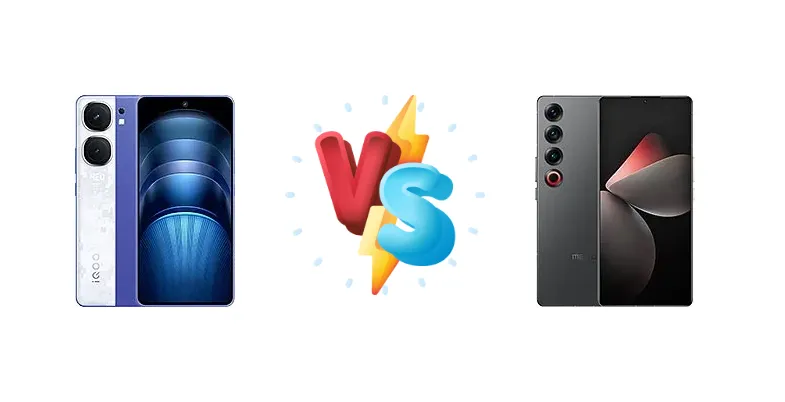
|
🏆 Quick Verdict
For users prioritizing the absolute fastest charging speeds and potentially more aggressive pricing, the iQOO Neo9S Pro+ emerges as the winner. Its 120W wired charging significantly outperforms the Meizu 21 Pro’s 80W, and the inclusion of reverse wired charging adds further utility. However, the Meizu 21 Pro counters with 50W wireless charging.
| PHONES | ||
|---|---|---|
| Phone Names | vivo iQOO Neo9S Pro+ | Meizu 21 Pro |
| Network | ||
|---|---|---|
| 2G bands | GSM 850 / 900 / 1800 / 1900 | GSM 850 / 900 / 1800 / 1900 |
| 3G bands | HSDPA 850 / 900 / 1700(AWS) / 1900 / 2100 | HSDPA 850 / 900 / 1900 / 2100 |
| 4G bands | 1, 3, 4, 5, 7, 8, 18, 19, 26, 28, 34, 38, 39, 40, 41 | 1, 2, 3, 4, 5, 7, 8, 12, 17, 18, 19, 20, 26, 28, 34, 38, 39, 40, 41 |
| 5G bands | 1, 3, 5, 8, 28, 38, 40, 41, 77, 78 SA/NSA | 1, 3, 5, 8, 20, 28, 38, 40, 41, 77, 78, 79 SA/NSA |
| Speed | HSPA, LTE, 5G | HSPA, LTE, 5G |
| Technology | GSM / CDMA / HSPA / CDMA2000 / LTE / 5G | GSM / HSPA / LTE / 5G |
| Launch | ||
|---|---|---|
| Announced | 2024, July 11 | 2024, February 29 |
| Status | Available. Released 2024, July 16 | Available. Released 2024, March 02 |
| Body | ||
|---|---|---|
| Dimensions | 163.5 x 75.7 x 8 mm or 8.3 mm | 165 x 74.4 x 8 mm (6.50 x 2.93 x 0.31 in) |
| SIM | Nano-SIM + Nano-SIM | Nano-SIM + Nano-SIM |
| Weight | 193 g or 198 g (6.81 oz) | 208 g or 214 g (7.34 oz) |
| Display | ||
|---|---|---|
| Protection | - | Meizu Titan Glass 2.0 |
| Resolution | 1260 x 2800 pixels, 20:9 ratio (~453 ppi density) | 1368 x 3192 pixels, 21:9 ratio (~512 ppi density) |
| Size | 6.78 inches, 111.0 cm2 (~89.7% screen-to-body ratio) | 6.79 inches, 107.3 cm2 (~87.4% screen-to-body ratio) |
| Type | LTPO AMOLED, 1B colors, 144Hz, HDR10+, 1400 nits (HBM) | LTPO AMOLED, 1B colors, 120Hz, HDR10+, 600 nits (typ), 1250 nits (HBM) |
| Platform | ||
|---|---|---|
| CPU | Octa-core (1x3.3 GHz Cortex-X4 & 3x3.2 GHz Cortex-A720 & 2x3.0 GHz Cortex-A720 & 2x2.3 GHz Cortex-A520) | Octa-core (1x3.3 GHz Cortex-X4 & 3x3.2 GHz Cortex-A720 & 2x3.0 GHz Cortex-A720 & 2x2.3 GHz Cortex-A520) |
| Chipset | Qualcomm SM8650-AB Snapdragon 8 Gen 3 (4 nm) | Qualcomm SM8650-AB Snapdragon 8 Gen 3 (4 nm) |
| GPU | Adreno 750 | Adreno 750 |
| OS | Android 14, upgradable to Android 15, OriginOS 5 | Flyme OS / Flyme AIOS 2 |
| Memory | ||
|---|---|---|
| Card slot | No | No |
| Internal | 256GB 12GB RAM, 256GB 16GB RAM, 512GB 12GB RAM, 512GB 16GB RAM, 1TB 16GB RAM | 256GB 12GB RAM, 512GB 16GB RAM, 1TB 16GB RAM |
| Main Camera | ||
|---|---|---|
| Dual | 50 MP, f/1.9, (wide), 1/1.56", PDAF, OIS 50 MP, f/2.0, 119˚ (ultrawide), 1/2.76", 0.64µm, AF | - |
| Features | LED flash, panorama, HDR | Ring-LED flash, panorama, HDR |
| Triple | - | 50 MP, f/1.9, 24mm (wide), 1/1.3", 1.2µm, PDAF, OIS 10 MP, f/2.0, 72mm (periscope telephoto), PDAF, OIS, 3x optical zoom 13 MP, f/2.4, 15mm, 122˚ (ultrawide) |
| Video | 8K, 4K, 1080p, gyro-EIS | 8K, 4K, 1080p; gyro-EIS |
| Selfie camera | ||
|---|---|---|
| Features | - | HDR |
| Single | 16 MP, f/2.5, (wide) | 32 MP, f/2.4, (wide) |
| Video | 1080p@30fps | Yes |
| Sound | ||
|---|---|---|
| 35mm jack | No | No |
| Loudspeaker | Yes, with stereo speakers | Yes, with stereo speakers |
| Comms | ||
|---|---|---|
| Bluetooth | 5.4, A2DP, LE, aptX HD, aptX Adaptive, aptX Lossless, LHDC | 5.4, A2DP, LE |
| Infrared port | Yes | Yes |
| NFC | Yes | Yes |
| Positioning | GPS (L1+L5), BDS (B1I+B1c+B2a), GALILEO (E1+E5a), QZSS (L1+L5), GLONASS | GPS (L1+L5), GLONASS (G1), BDS (B1I+B1c+B2a), GALILEO (E1+E5a), QZSS (L1+L5), NavIC (L5) |
| Radio | No | No |
| USB | USB Type-C 2.0, OTG | USB Type-C, OTG |
| WLAN | Wi-Fi 802.11 a/b/g/n/ac/6/7, dual-band | Wi-Fi 802.11 а/b/g/n/ac/6e/7, dual-band |
| Features | ||
|---|---|---|
| Sensors | Fingerprint (under display, ultrasonic), accelerometer, gyro, proximity, compass | Fingerprint (under display, ultrasonic), accelerometer, gyro, proximity, compass, barometer |
| Battery | ||
|---|---|---|
| Charging | 120W wired, 70% in 17 min, 100% in 28 min Reverse wired | 80W wired, PD3 PPS, QC4+ 50W wireless 10W reverse wireless |
| Type | 5500 mAh | 5050 mAh |
| Misc | ||
|---|---|---|
| Colors | Blue/White, Black, White | Black, White, Blue, Green, Gray |
| Models | V2403A | - |
| Price | About 380 EUR | About 640 EUR |
vivo iQOO Neo9S Pro+
- Significantly faster 120W wired charging
- Reverse wired charging capability
- Potentially more aggressive thermal management for gaming
- Software experience may be less refined than Meizu
- Potential for more aggressive power consumption
Meizu 21 Pro
- 50W wireless charging support
- Potentially more accurate and natural color calibration
- Meizu’s Flyme OS offers a unique software experience
- Slower 80W wired charging
- No reverse wired charging
- Potentially more conservative thermal management
Display Comparison
While both devices are expected to feature high-refresh-rate AMOLED displays, specific details like peak brightness and panel technology (LTPO) are missing. However, given iQOO’s focus on gaming, the Neo9S Pro+ likely prioritizes a higher refresh rate and potentially a more aggressive peak brightness for HDR content. Meizu typically focuses on color accuracy and calibration, suggesting a potentially more visually refined display experience, though without concrete specs, this remains speculative.
Camera Comparison
Without detailed camera specifications, a direct comparison is difficult. However, given the flagship positioning of both devices, we can expect multi-camera systems with a primary sensor capable of high-resolution photography. The absence of information regarding sensor size and lens apertures prevents a definitive assessment. Image processing styles will likely differ; iQOO often favors vibrant, punchy colors, while Meizu tends towards a more natural, realistic look. The presence or absence of advanced features like 8K video recording or enhanced low-light modes remains unknown.
Performance
Both the iQOO Neo9S Pro+ and the Meizu 21 Pro utilize the Qualcomm SM8650-AB Snapdragon 8 Gen 3 (4 nm) chipset, featuring the same Octa-core CPU configuration (1x3.3 GHz Cortex-X4, 3x3.2 GHz Cortex-A720, 2x3.0 GHz Cortex-A720, 2x2.3 GHz Cortex-A520). This means raw processing power will be nearly identical. The key differentiator will be thermal management. iQOO phones are often designed for sustained performance during gaming, potentially incorporating larger vapor chambers or more aggressive cooling solutions. Meizu’s thermal approach is typically more conservative, prioritizing stability over peak performance. RAM speed (likely LPDDR5x in both) will also play a role, but the chipset is the dominant factor.
Battery Life
The iQOO Neo9S Pro+ boasts a significant advantage in wired charging with its 120W capability, promising a 70% charge in just 17 minutes and a full charge in 28 minutes. The Meizu 21 Pro’s 80W wired charging, while still fast, falls short in comparison. Furthermore, the iQOO includes reverse wired charging, a feature absent in the Meizu. The Meizu 21 Pro compensates with 50W wireless charging and 10W reverse wireless charging, offering convenience for users who prefer cable-free power-ups. The actual battery capacity (mAh) of both devices is currently unknown, but the charging speed differential will likely be the more impactful factor for most users.
Buying Guide
Buy the vivo iQOO Neo9S Pro+ if you need the quickest possible charging, frequently top up your phone throughout the day, and value raw speed. Buy the Meizu 21 Pro if you prefer a more balanced approach with excellent wireless charging capabilities, and appreciate a potentially more refined software experience, typical of Meizu’s approach.