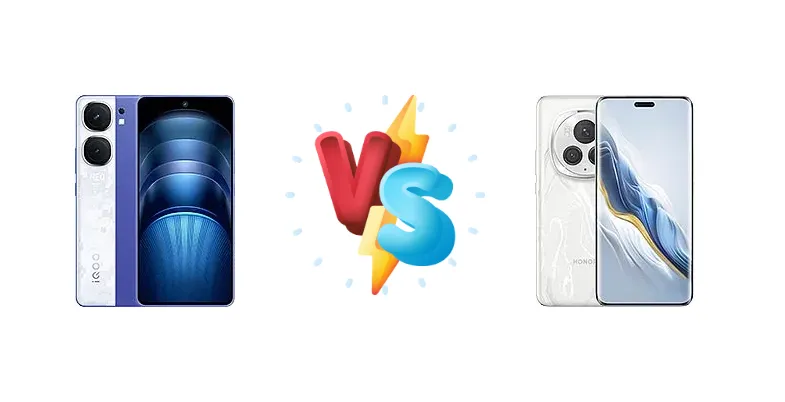
Both the vivo iQOO Neo9S Pro+ and the Honor Magic6 Pro represent the pinnacle of Android performance, powered by the latest Qualcomm Snapdragon 8 Gen 3 chipset. However, they diverge in key areas like charging technology and battery optimization, catering to distinct user priorities. This comparison dissects these differences to determine which device delivers the best overall experience.
🏆 Quick Verdict
For users prioritizing absolute charging speed and a more aggressive performance profile, the vivo iQOO Neo9S Pro+ is the clear winner. Its 120W charging significantly outperforms the Honor Magic6 Pro’s 80W, and while both share the same chipset, iQOO’s focus leans towards raw power. However, the Honor Magic6 Pro excels in sustained battery life and display brightness.
| Network |
|---|
| 2G bands | GSM 850 / 900 / 1800 / 1900 | GSM 850 / 900 / 1800 / 1900 |
| 3G bands | HSDPA 850 / 900 / 1700(AWS) / 1900 / 2100 | HSDPA 800 / 850 / 900 / 1700(AWS) / 1900 / 2100 |
| 4G bands | 1, 3, 4, 5, 7, 8, 18, 19, 26, 28, 34, 38, 39, 40, 41 | LTE |
| 5G bands | 1, 3, 5, 8, 28, 38, 40, 41, 77, 78 SA/NSA | SA/NSA |
| Speed | HSPA, LTE, 5G | HSPA, LTE, 5G |
| Technology | GSM / CDMA / HSPA / CDMA2000 / LTE / 5G | GSM / CDMA / HSPA / CDMA2000 / LTE / 5G |
| Launch |
|---|
| Announced | 2024, July 11 | 2024, January 11 |
| Status | Available. Released 2024, July 16 | Available. Released 2024, January 18 |
| Body |
|---|
| Build | - | Glass front (NanoCrystal Shield), glass back or silicone polymer back (eco leather) |
| Dimensions | 163.5 x 75.7 x 8 mm or 8.3 mm | 162.5 x 75.8 x 8.9 mm (6.40 x 2.98 x 0.35 in) |
| SIM | Nano-SIM + Nano-SIM | · Nano-SIM + eSIM· Nano-SIM + Nano-SIM |
| Weight | 193 g or 198 g (6.81 oz) | 225 g or 229 g (7.94 oz) |
| Display |
|---|
| Protection | - | NanoCrystal Shield |
| Resolution | 1260 x 2800 pixels, 20:9 ratio (~453 ppi density) | 1280 x 2800 pixels, 19.5:9 ratio (~453 ppi density) |
| Size | 6.78 inches, 111.0 cm2 (~89.7% screen-to-body ratio) | 6.8 inches, 112.8 cm2 (~91.6% screen-to-body ratio) |
| Type | LTPO AMOLED, 1B colors, 144Hz, HDR10+, 1400 nits (HBM) | LTPO OLED, 1B colors, 120Hz, Dolby Vision, HDR, 1600 nits (HBM), 5000 nits (peak) |
| Platform |
|---|
| CPU | Octa-core (1x3.3 GHz Cortex-X4 & 3x3.2 GHz Cortex-A720 & 2x3.0 GHz Cortex-A720 & 2x2.3 GHz Cortex-A520) | Octa-core (1x3.3 GHz Cortex-X4 & 3x3.2 GHz Cortex-A720 & 2x3.0 GHz Cortex-A720 & 2x2.3 GHz Cortex-A520) |
| Chipset | Qualcomm SM8650-AB Snapdragon 8 Gen 3 (4 nm) | Qualcomm SM8650-AB Snapdragon 8 Gen 3 (4 nm) |
| GPU | Adreno 750 | Adreno 750 |
| OS | Android 14, upgradable to Android 15, OriginOS 5 | Android 14, up to 4 major Android upgrades, MagicOS 8 |
| Memory |
|---|
| Card slot | No | No |
| Internal | 256GB 12GB RAM, 256GB 16GB RAM, 512GB 12GB RAM, 512GB 16GB RAM, 1TB 16GB RAM | 256GB 12GB RAM, 256GB 16GB RAM, 512GB 12GB RAM, 512GB 16GB RAM, 1TB 16GB RAM |
| Main Camera |
|---|
| Dual | 50 MP, f/1.9, (wide), 1/1.56", PDAF, OIS
50 MP, f/2.0, 119˚ (ultrawide), 1/2.76", 0.64µm, AF | - |
| Features | LED flash, panorama, HDR | Laser AF, color spectrum sensor, LED flash, HDR, panorama |
| Triple | - | 50 MP, f/1.4-2.0, 23mm (wide), 1/1.3", 1.2µm, PDAF, OIS
180 MP, f/2.6, (periscope telephoto), 1/1.49", 0.56µm, PDAF, OIS, 2.5x optical zoom
50 MP, f/2.0, 13mm, 122˚ (ultrawide), 1/2.88", 0.61µm, AF |
| Video | 8K, 4K, 1080p, gyro-EIS | 4K@24/30/60fps, 1080p@30/60/120/240fps, gyro-EIS, OIS, HDR, 10-bit video |
| Selfie camera |
|---|
| Single | 16 MP, f/2.5, (wide) | 50 MP, f/2.0, 22mm (wide), 1/2.93", 0.6µm, AF
TOF 3D, (depth/biometrics sensor) |
| Video | 1080p@30fps | 4K@30fps, 1080p@30/60fps, gyro-EIS |
| Sound |
|---|
| 35mm jack | No | No |
| Loudspeaker | Yes, with stereo speakers | Yes, with stereo speakers |
| Comms |
|---|
| Bluetooth | 5.4, A2DP, LE, aptX HD, aptX Adaptive, aptX Lossless, LHDC | 5.3, A2DP, LE, aptX HD |
| Infrared port | Yes | Yes |
| NFC | Yes | Yes |
| Positioning | GPS (L1+L5), BDS (B1I+B1c+B2a), GALILEO (E1+E5a), QZSS (L1+L5), GLONASS | GPS (L1+L5), GLONASS, BDS (B1I+B1c+B2a), GALILEO (E1+E5a) |
| Radio | No | No |
| USB | USB Type-C 2.0, OTG | USB Type-C 3.2, DisplayPort 1.2, OTG |
| WLAN | Wi-Fi 802.11 a/b/g/n/ac/6/7, dual-band | Wi-Fi 802.11 a/b/g/n/ac/6/7, dual-band, Wi-Fi Direct |
| Features |
|---|
| Sensors | Fingerprint (under display, ultrasonic), accelerometer, gyro, proximity, compass | Fingerprint (under display, optical), Face ID, accelerometer, gyro, proximity, compass |
| Battery |
|---|
| Charging | 120W wired, 70% in 17 min, 100% in 28 min
Reverse wired | 80W wired
66W wireless
Reverse wireless
5W reverse wired |
| Type | 5500 mAh | Si/C Li-Ion 5600 mAh |
| Misc |
|---|
| Colors | Blue/White, Black, White | Black, Green, Blue, Purple, White |
| Models | V2403A | BVL-AN16, BVL-N49 |
| Price | About 380 EUR | € 455.54 / $ 899.00 / £ 598.99 |
vivo iQOO Neo9S Pro+
- Ultra-fast 120W wired charging
- Potentially higher peak performance due to aggressive tuning
- Snapdragon 8 Gen 3 chipset for top-tier processing
- Battery life likely shorter than the Honor Magic6 Pro
- Potential for more thermal throttling under sustained load
- Wireless charging not supported
Honor Magic6 Pro
- Exceptional battery life (14:06h active use)
- Brighter display (1578 nits) for outdoor visibility
- Wireless and reverse wireless charging support
- Slower 80W wired charging
- Potentially less aggressive performance tuning
- May not match iQOO's peak performance
Display Comparison
The Honor Magic6 Pro boasts a significantly brighter display, reaching a measured 1578 nits, making it ideal for outdoor use under direct sunlight. While the iQOO Neo9S Pro+’s display specifications aren’t provided, the Magic6 Pro’s brightness advantage is substantial. Both devices likely utilize LTPO technology for adaptive refresh rates, conserving battery life, but the Honor’s peak brightness is a key differentiator. The Magic6 Pro’s panel is likely tuned for color accuracy, though specific details are unavailable for either device.
Camera Comparison
Without detailed camera specifications, a direct comparison is limited. However, the market positioning suggests the Honor Magic6 Pro may prioritize camera capabilities more heavily. The iQOO Neo9S Pro+ likely focuses on delivering a solid camera experience, but may not match the Magic6 Pro’s potential for advanced features or larger sensor sizes. The absence of information regarding sensor sizes and lens apertures prevents a deeper analysis, but the Magic6 Pro’s brand reputation suggests a more comprehensive camera system.
Performance
Both the iQOO Neo9S Pro+ and the Honor Magic6 Pro are equipped with the Qualcomm SM8650-AB Snapdragon 8 Gen 3 (4 nm) chipset, featuring an Octa-core CPU configuration (1x3.3 GHz Cortex-X4, 3x3.2 GHz Cortex-A720, 2x3.0 GHz Cortex-A720, 2x2.3 GHz Cortex-A520). This means raw processing power will be nearly identical. However, thermal management and sustained performance are where differences may emerge. iQOO typically prioritizes maximizing clock speeds, potentially leading to more aggressive throttling under prolonged load, while Honor often opts for a more balanced approach. RAM specifications are not provided, but both are expected to utilize LPDDR5x for fast memory access.
Battery Life
The Honor Magic6 Pro demonstrates a clear advantage in battery endurance, achieving an active use score of 14:06h. The iQOO Neo9S Pro+’s battery capacity is not specified, but its 120W wired charging significantly surpasses the Magic6 Pro’s 80W. This translates to a full charge in just 28 minutes for the iQOO, compared to an unspecified time for the Honor. The Magic6 Pro also offers 66W wireless and 5W reverse wireless charging, features absent in the iQOO. The trade-off is clear: the iQOO prioritizes speed, while the Honor prioritizes longevity and versatility.
Buying Guide
Buy the vivo iQOO Neo9S Pro+ if you need the fastest possible charging, frequently engage in demanding tasks like gaming, and prioritize peak performance over extended battery endurance. Buy the Honor Magic6 Pro if you prefer a phone that balances performance with exceptional battery life, boasts a brighter display for outdoor visibility, and offers the convenience of wireless charging.
Frequently Asked Questions
❓ How much faster is the iQOO Neo9S Pro+'s 120W charging compared to the Honor Magic6 Pro's 80W in a real-world scenario?
The iQOO Neo9S Pro+ can reach 100% charge in approximately 28 minutes. While the Honor Magic6 Pro's exact charging time isn't specified, 80W charging typically takes around 45-60 minutes for a full charge. This means the iQOO offers a roughly 20-30 minute advantage, ideal for users who need a quick power boost.
❓ Will the Snapdragon 8 Gen 3 in the iQOO Neo9S Pro+ overheat during extended gaming sessions?
The Snapdragon 8 Gen 3 is a powerful chipset, and both phones are likely to experience some heat during prolonged gaming. However, iQOO often prioritizes maximizing performance, which can lead to more aggressive throttling to manage temperatures. The Honor Magic6 Pro may employ a more conservative thermal profile, potentially resulting in slightly lower sustained performance but less throttling.
❓ Does the Honor Magic6 Pro's wireless charging significantly impact its battery health over time?
Wireless charging generally generates more heat than wired charging, which *can* contribute to slightly faster battery degradation over the long term. However, modern smartphones employ sophisticated battery management systems to mitigate this effect. The Honor Magic6 Pro's 66W wireless charging is relatively fast, but consistent use may result in a marginally faster decline in battery capacity compared to exclusively wired charging.