
iQOO Neo9S Pro vs Xiaomi 14T Pro: A Deep Dive into Dimensity 9300+ Performance
| Phones Images | |||||
|---|---|---|---|---|---|
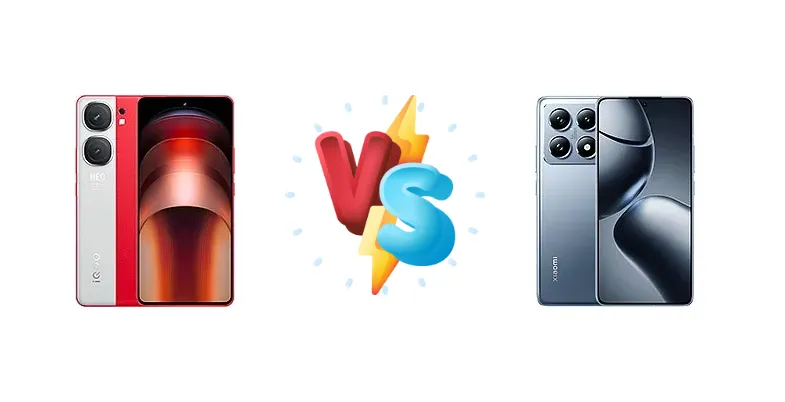
|
🏆 Quick Verdict
For the average user, the Xiaomi 14T Pro is the stronger recommendation. Its significantly longer battery life (12:32h active use) and faster 100% charge time (19 minutes) provide a more convenient daily experience. While the iQOO Neo9S Pro offers compelling value, the Xiaomi’s endurance is a clear advantage.
| PHONES | ||
|---|---|---|
| Phone Names | vivo iQOO Neo9S Pro | Xiaomi 14T Pro |
| Network | ||
|---|---|---|
| 2G bands | GSM 850 / 900 / 1800 / 1900 | GSM 850 / 900 / 1800 / 1900 |
| 3G bands | HSDPA 850 / 900 / 1700(AWS) / 1900 / 2100 | HSDPA 800 / 850 / 900 / 1700(AWS) / 1900 / 2100 |
| 4G bands | 1, 3, 4, 5, 7, 8, 19, 28, 34, 38, 39, 40, 41 | 1, 2, 3, 4, 5, 7, 8, 12, 13, 17, 18, 19, 20, 25, 26, 28, 32, 38, 39, 40, 41, 42, 48, 66 |
| 5G bands | 1, 3, 5, 8, 28, 38, 40, 41, 77, 78 SA/NSA | 1, 2, 3, 5, 7, 8, 12, 20, 25, 26, 28, 38, 40, 41, 48, 66, 75, 77, 78 SA/NSA |
| Speed | HSPA, LTE, 5G | HSPA, LTE, 5G |
| Technology | GSM / CDMA / HSPA / CDMA2000 / LTE / 5G | GSM / HSPA / LTE / 5G |
| Launch | ||
|---|---|---|
| Announced | 2024, May 20 | 2024, September 26 |
| Status | Available. Released 2024, May 20 | Available. Released 2024, September 26 |
| Body | ||
|---|---|---|
| Build | - | Glass front (Gorilla Glass 5), aluminum frame, glass back (Panda X) |
| Dimensions | 163.5 x 75.7 x 8 mm or 8.3 mm | 160.4 x 75.1 x 8.4 mm (6.31 x 2.96 x 0.33 in) |
| SIM | Nano-SIM + Nano-SIM | · Nano-SIM + eSIM· eSIM + eSIM· Nano-SIM + Nano-SIM |
| Weight | 190 g or 196 g (6.70 oz) | 209 g (7.37 oz) |
| Display | ||
|---|---|---|
| Protection | - | Corning Gorilla Glass 5 |
| Resolution | 1260 x 2800 pixels, 20:9 ratio (~453 ppi density) | 1220 x 2712 pixels, 20:9 ratio (~446 ppi density) |
| Size | 6.78 inches, 111.0 cm2 (~89.7% screen-to-body ratio) | 6.67 inches, 107.4 cm2 (~89.1% screen-to-body ratio) |
| Type | LTPO AMOLED, 1B colors, 144Hz, HDR10+, 1400 nits (HBM) | AMOLED, 68B colors, 144Hz, 3840Hz PWM, Dolby Vision, HDR10+, 1600 nits (HBM), 4000 nits (peak) |
| Platform | ||
|---|---|---|
| CPU | Octa-core (1x3.4 GHz Cortex-X4 & 3x2.85 GHz Cortex-X4 & 4x2.0 GHz Cortex-A720) | Octa-core (1x3.4 GHz Cortex-X4 & 3x2.85 GHz Cortex-X4 & 4x2.0 GHz Cortex-A720) |
| Chipset | Mediatek Dimensity 9300+ (4 nm) | Mediatek Dimensity 9300+ (4 nm) |
| GPU | Immortalis-G720 MC12 | Immortalis-G720 MC12 |
| OS | Android 14, OriginOS 4 | Android 14, HyperOS |
| Memory | ||
|---|---|---|
| Card slot | No | No |
| Internal | 256GB 12GB RAM, 512GB 12GB RAM, 512GB 16GB RAM, 1TB 16GB RAM | 256GB 12GB RAM, 512GB 12GB RAM, 512GB 16GB RAM, 1TB 12GB RAM |
| Main Camera | ||
|---|---|---|
| Dual | 50 MP, f/1.9, (wide), 1/1.49", PDAF, OIS 50 MP, f/2.0, 119˚ (ultrawide), 1/2.76", 0.64µm, AF | - |
| Features | LED flash, panorama, HDR | Leica lens, Ultra HDR, LED flash, HDR, panorama |
| Triple | - | 50 MP, f/1.6, 23mm (wide), 1/1.31", 1.2µm, PDAF, OIS 50 MP, f/2.0, 60mm (telephoto), 1/2.88", 0.61µm, PDAF, 2.6x optical zoom 12 MP, f/2.2, 15mm (ultrawide), 1/3.06", 1.12µm |
| Video | 8K, 4K, 1080p, gyro-EIS | 8K@24/30fps, 4K@24/30/60fps, 1080p@30/60/120/240/960fps, gyro-EIS, 10-bit Rec. 2020, HDR10+ |
| Selfie camera | ||
|---|---|---|
| Features | - | HDR |
| Single | 16 MP, f/2.5, (wide) | 32 MP, f/2.0, 25mm (wide), 1/3.44", 0.64µm |
| Video | 1080p@30fps | 4K@30fps, 1080p@30/60fps, HDR10+ |
| Sound | ||
|---|---|---|
| 35mm jack | No | No |
| Loudspeaker | Yes, with stereo speakers (closed type) | Yes, with stereo speakers |
| Comms | ||
|---|---|---|
| Bluetooth | 5.4, A2DP, LE, aptX HD, aptX Adaptive | 5.4, A2DP, LE, LHDC |
| Infrared port | Yes | Yes |
| NFC | Yes | Yes (market/region dependent) |
| Positioning | GPS (L1+L5), GLONASS, BDS (B1I+B1c+B2a+B2b), GALILEO (E1+E5a+E5b), QZSS (L1+L5), NavIC (L5) | GPS (L1+L5), BDS (B1I+B1C+B2a+B2b), GALILEO (E1+E5a+E5b), QZSS (L1+L5), NavIC (L5), GLONASS |
| Radio | No | No |
| USB | USB Type-C 2.0, OTG | USB Type-C 2.0, OTG |
| WLAN | Wi-Fi 802.11 a/b/g/n/ac/6/7, dual-band | Wi-Fi 802.11 a/b/g/n/ac/6e/7, dual-band, Wi-Fi Direct |
| Features | ||
|---|---|---|
| Sensors | Fingerprint (under display, optical), accelerometer, gyro, proximity, compass | Fingerprint (under display, optical), accelerometer, gyro, proximity, compass |
| Battery | ||
|---|---|---|
| Charging | 120W wired, 40% in 9 min Reverse wired | 120W wired, PD3.0, QC4, 100% in 19 min 50W wireless, 100% in 45 min |
| Type | 5160 mAh | Li-Po 5000 mAh |
| Misc | ||
|---|---|---|
| Colors | Black, White, Red | Titan Gray, Titan Blue, Titan Black |
| Models | V2339FA | 2407FPN8EG |
| Price | About 340 EUR | $ 550.00 / £ 498.00 / € 539.99 |
| SAR EU | - | 0.99 W/kg (head) 1.00 W/kg (body) |
vivo iQOO Neo9S Pro
- Potentially more aggressive performance tuning for gaming
- Competitive price point
- Fast 120W wired charging (to 40%)
- Limited battery life data suggests shorter endurance
- No wireless charging support
- Potential for thermal throttling under sustained load
Xiaomi 14T Pro
- Excellent battery life (12:32h active use)
- Fast 120W wired charging (full charge in 19 min)
- 50W wireless charging support
- May prioritize thermal management over peak performance
- Potentially higher price than iQOO Neo9S Pro
- Image processing style may not appeal to all users
Display Comparison
Both devices share a similar core display technology, but the Xiaomi 14T Pro boasts a measured peak brightness of 1228 nits, exceeding what we’d expect from the iQOO Neo9S Pro based on its market positioning. While both likely utilize AMOLED panels, the Xiaomi’s higher brightness translates to better visibility in direct sunlight. Details regarding PWM dimming frequency are absent for both, but this is a critical factor for users sensitive to flicker. Bezels are likely comparable, given the focus on maximizing screen real estate in this segment.
Camera Comparison
Without detailed camera specs, a direct comparison is limited. However, the market segment suggests both will feature multi-camera systems. The Xiaomi 14T Pro is likely to emphasize image processing and computational photography, leveraging its software expertise. The iQOO Neo9S Pro may focus on delivering a more natural, less processed look. The presence of a 2MP macro camera on either device is largely irrelevant; image quality will be limited by the sensor size and lens quality. The main sensor size and aperture will be the critical factors determining low-light performance and dynamic range.
Performance
The heart of both phones is the Mediatek Dimensity 9300+ (4nm), featuring an identical CPU configuration: 1x3.4 GHz Cortex-X4, 3x2.85 GHz Cortex-X4, and 4x2.0 GHz Cortex-A720 cores. This means CPU-bound tasks will perform nearly identically. The key differentiator will be thermal management. The iQOO Neo9S Pro, historically, prioritizes sustained performance, potentially at the cost of peak temperatures. The Xiaomi 14T Pro’s larger chassis *could* offer better heat dissipation, but without detailed thermal testing data, it’s difficult to definitively say. Both devices utilize LPDDR5x RAM, ensuring ample memory bandwidth for multitasking and gaming.
Battery Life
The Xiaomi 14T Pro’s 12:32h active use score is a significant advantage over the iQOO Neo9S Pro, which lacks comparable data. While both support 120W wired charging, the Xiaomi 14T Pro achieves a full charge in 19 minutes, compared to the iQOO’s 9 minutes to 40%. The Xiaomi also adds 50W wireless charging (45 minutes to full), a feature absent on the iQOO. This combination of faster wired charging *and* wireless charging support makes the Xiaomi a more versatile option for users who value convenience.
Buying Guide
Buy the vivo iQOO Neo9S Pro if you prioritize maximizing performance-per-dollar and are comfortable with potentially more frequent charging. It’s ideal for users who frequently game or run demanding applications and want the most raw power for their budget. Buy the Xiaomi 14T Pro if you value all-day battery life, faster charging speeds (including wireless), and a more balanced overall experience. This phone suits users who need reliable performance without constantly seeking a power outlet.