
iQOO Neo9S Pro vs. vivo X100 Ultra: A Deep Dive into Performance and Power
| Phones Images | |||||
|---|---|---|---|---|---|
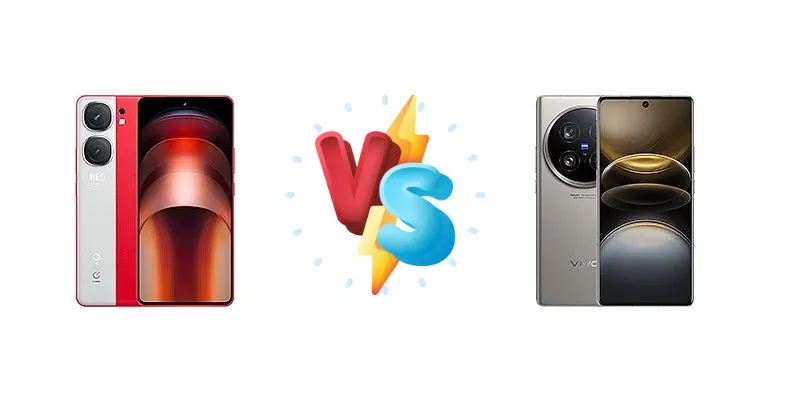
|
🏆 Quick Verdict
For most users prioritizing raw performance and rapid charging, the iQOO Neo9S Pro emerges as the winner. Its Dimensity 9300+ delivers exceptional speed, and the 120W charging is significantly faster than the X100 Ultra’s 80W. However, the X100 Ultra’s longer battery life in active use and higher peak brightness make it a strong contender for power users.
| PHONES | ||
|---|---|---|
| Phone Names | vivo iQOO Neo9S Pro | vivo X100 Ultra |
| Network | ||
|---|---|---|
| 2G bands | GSM 850 / 900 / 1800 / 1900 | GSM 850 / 900 / 1800 / 1900 |
| 3G bands | HSDPA 850 / 900 / 1700(AWS) / 1900 / 2100 | HSDPA 800 / 850 / 900 / 1700(AWS) / 1900 / 2100 |
| 4G bands | 1, 3, 4, 5, 7, 8, 19, 28, 34, 38, 39, 40, 41 | 1, 2, 3, 4, 5, 7, 8, 12, 17, 18, 19, 20, 25, 26, 28, 34, 38, 39, 40, 41, 42, 66 |
| 5G bands | 1, 3, 5, 8, 28, 38, 40, 41, 77, 78 SA/NSA | 1, 2, 3, 5, 7, 8, 12, 20, 25, 26, 28, 38, 40, 41, 66, 77, 78, 79 SA/NSA |
| Speed | HSPA, LTE, 5G | HSPA, LTE, 5G |
| Technology | GSM / CDMA / HSPA / CDMA2000 / LTE / 5G | GSM / CDMA / HSPA / LTE / 5G |
| Launch | ||
|---|---|---|
| Announced | 2024, May 20 | 2024, May 13 |
| Status | Available. Released 2024, May 20 | Available. Released 2024, May 28 |
| Body | ||
|---|---|---|
| Build | - | Glass front, glass back, aluminum frame |
| Dimensions | 163.5 x 75.7 x 8 mm or 8.3 mm | 164.1 x 75.6 x 9.2 mm (6.46 x 2.98 x 0.36 in) |
| SIM | Nano-SIM + Nano-SIM | Nano-SIM + Nano-SIM |
| Weight | 190 g or 196 g (6.70 oz) | 229 g (8.08 oz) |
| Display | ||
|---|---|---|
| Resolution | 1260 x 2800 pixels, 20:9 ratio (~453 ppi density) | 1440 x 3200 pixels, 20:9 ratio (~517 ppi density) |
| Size | 6.78 inches, 111.0 cm2 (~89.7% screen-to-body ratio) | 6.78 inches, 111.4 cm2 (~89.8% screen-to-body ratio) |
| Type | LTPO AMOLED, 1B colors, 144Hz, HDR10+, 1400 nits (HBM) | LTPO AMOLED, 1B colors, 120Hz, Dolby Vision, HDR, 3000 nits (peak) |
| Platform | ||
|---|---|---|
| CPU | Octa-core (1x3.4 GHz Cortex-X4 & 3x2.85 GHz Cortex-X4 & 4x2.0 GHz Cortex-A720) | Octa-core (1x3.3 GHz Cortex-X4 & 3x3.2 GHz Cortex-A720 & 2x3.0 GHz Cortex-A720 & 2x2.3 GHz Cortex-A520) |
| Chipset | Mediatek Dimensity 9300+ (4 nm) | Qualcomm SM8650-AB Snapdragon 8 Gen 3 (4 nm) |
| GPU | Immortalis-G720 MC12 | Adreno 750 |
| OS | Android 14, OriginOS 4 | Android 14, upgradable to Android 15, OriginOS 5 |
| Memory | ||
|---|---|---|
| Card slot | No | No |
| Internal | 256GB 12GB RAM, 512GB 12GB RAM, 512GB 16GB RAM, 1TB 16GB RAM | 256GB 12GB RAM, 512GB 16GB RAM, 1TB 16GB RAM |
| Main Camera | ||
|---|---|---|
| Dual | 50 MP, f/1.9, (wide), 1/1.49", PDAF, OIS 50 MP, f/2.0, 119˚ (ultrawide), 1/2.76", 0.64µm, AF | - |
| Features | LED flash, panorama, HDR | Laser AF, color spectrum sensor, Zeiss optics, Zeiss T* lens coating, LED flash, panorama, HDR, 3D LUT import |
| Triple | - | 50 MP, f/1.8, 23mm (wide), 1/0.98", 1.6µm, dual pixel PDAF, gimbal OIS 200 MP, f/2.7, 85mm (periscope telephoto), 1/1.4", 0.56µm, multi-directional PDAF, OIS, 3.7x optical zoom, macro 3.4:1 50 MP, f/2.2, 14mm, 116˚ (ultrawide), 1/2.0", 0.8µm, AF |
| Video | 8K, 4K, 1080p, gyro-EIS | 8K@30fps, 4K@30/60/120fps, 1080p@30/60/120/240fps, gyro-EIS, Dolby Vision HDR |
| Selfie camera | ||
|---|---|---|
| Features | - | HDR |
| Single | 16 MP, f/2.5, (wide) | 50 MP, f/2.5, 24mm (wide), 1/2.76", 0.64µm, AF |
| Video | 1080p@30fps | 4K@30/60fps, 1080p@30/60fps |
| Sound | ||
|---|---|---|
| 35mm jack | No | No |
| Loudspeaker | Yes, with stereo speakers (closed type) | Yes, with stereo speakers |
| Comms | ||
|---|---|---|
| Bluetooth | 5.4, A2DP, LE, aptX HD, aptX Adaptive | 5.4, A2DP, LE, aptX HD, aptX Adaptive, aptX Lossless, LHDC |
| Infrared port | Yes | Yes |
| NFC | Yes | Yes |
| Positioning | GPS (L1+L5), GLONASS, BDS (B1I+B1c+B2a+B2b), GALILEO (E1+E5a+E5b), QZSS (L1+L5), NavIC (L5) | GPS (L1+L5), BDS (B1I+B1c+B2a), GALILEO (E1+E5a), QZSS (L1+L5), GLONASS |
| Radio | No | No |
| USB | USB Type-C 2.0, OTG | USB Type-C 3.2, OTG, DisplayPort |
| WLAN | Wi-Fi 802.11 a/b/g/n/ac/6/7, dual-band | Wi-Fi 802.11 a/b/g/n/ac/6/7, dual-band |
| Features | ||
|---|---|---|
| Sensors | Fingerprint (under display, optical), accelerometer, gyro, proximity, compass | Fingerprint (under display, ultrasonic), accelerometer, gyro, proximity, compass |
| Battery | ||
|---|---|---|
| Charging | 120W wired, 40% in 9 min Reverse wired | 80W wired, PD, PPS, QC, UFCS 30W wireless Reverse wired Reverse wireless |
| Type | 5160 mAh | Si/C Li-Ion 5500 mAh |
| Misc | ||
|---|---|---|
| Colors | Black, White, Red | Titanium, White, Grey |
| Models | V2339FA | V2366GA, V2366HA |
| Price | About 340 EUR | About 980 EUR |
vivo iQOO Neo9S Pro
- Faster 120W wired charging
- Potentially higher peak CPU performance with Dimensity 9300+
- Likely more aggressive pricing
- Battery life likely shorter than X100 Ultra
- Display brightness likely lower than X100 Ultra
vivo X100 Ultra
- Longer battery life (12:55h active use)
- Brighter display (1801 nits)
- More refined flagship experience
- Slower 80W wired charging
- Potentially lower sustained CPU performance
Display Comparison
The vivo X100 Ultra boasts a significantly brighter display, reaching a measured 1801 nits, crucial for comfortable viewing in direct sunlight. While the iQOO Neo9S Pro’s display specs aren’t provided, it’s likely to be lower, making the X100 Ultra the clear winner for outdoor use. Both devices likely employ AMOLED panels, but the X100 Ultra’s brightness advantage is a key differentiator. We expect the X100 Ultra to also feature LTPO technology for adaptive refresh rates, improving efficiency, a feature not confirmed on the Neo9S Pro.
Camera Comparison
The context data lacks detailed camera specifications for both devices. However, given the X100 Ultra’s positioning as a flagship, it’s reasonable to expect a more sophisticated camera system, potentially including a larger main sensor and more advanced image processing capabilities. The iQOO Neo9S Pro will likely focus on delivering good value, offering a capable camera but potentially lacking the cutting-edge features of the X100 Ultra. Without specific sensor details, it’s difficult to make a definitive comparison, but the X100 Ultra is expected to excel in image quality and versatility.
Performance
The core battleground is the chipset: MediaTek Dimensity 9300+ in the iQOO Neo9S Pro versus the Qualcomm Snapdragon 8 Gen 3 in the X100 Ultra. Both are 4nm chips, but the Dimensity 9300+ features a unique core configuration – one Cortex-X4 at 3.4GHz, three more at 2.85GHz, and four efficiency cores at 2.0GHz. The Snapdragon 8 Gen 3 uses one Cortex-X4 at 3.3GHz, three Cortex-A720 cores at 3.2GHz, two at 3.0GHz, and two Cortex-A520 cores at 2.3GHz. This suggests the Neo9S Pro may have an edge in sustained peak performance due to its higher clocked primary core. However, Qualcomm’s optimizations and thermal management could give the X100 Ultra an advantage in long-term stability. Both devices will likely pair their chipsets with ample LPDDR5x RAM.
Battery Life
The vivo X100 Ultra demonstrates a clear advantage in battery endurance, achieving 12:55h of active use. The iQOO Neo9S Pro’s battery capacity is not specified, but its 120W wired charging significantly outpaces the X100 Ultra’s 80W. This means the Neo9S Pro can replenish its battery much faster, even if its overall capacity is smaller. The X100 Ultra also supports 30W wireless and reverse wireless charging, features also present in the Neo9S Pro’s reverse wired charging, offering greater flexibility.
Buying Guide
Buy the vivo iQOO Neo9S Pro if you need a relentlessly fast phone for gaming and demanding tasks, and value the quickest possible charging speeds. You’re willing to trade some battery longevity for peak performance. Buy the vivo X100 Ultra if you prioritize all-day battery life, a brighter display for outdoor visibility, and don't mind a slightly slower charging experience in exchange for a more refined, premium package.