
vivo iQOO Neo9S Pro vs iQOO 12 Pro: A Deep Dive into Performance and Value
| Phones Images | |||||
|---|---|---|---|---|---|
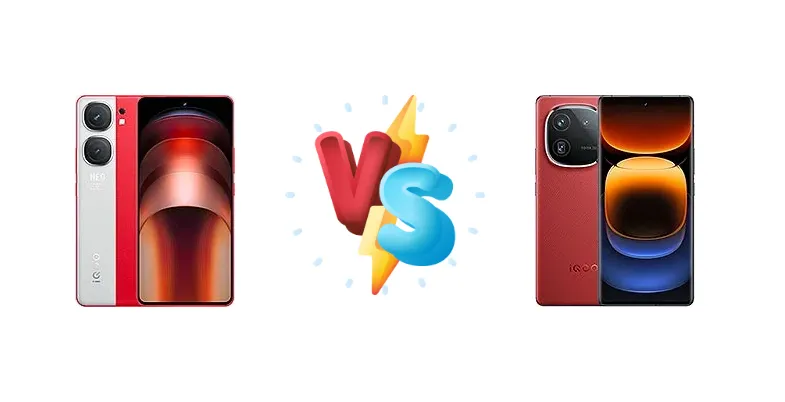
|
🏆 Quick Verdict
For most users, the iQOO 12 Pro emerges as the superior choice. While the Neo9S Pro delivers impressive performance with the Dimensity 9300+, the Snapdragon 8 Gen 3 in the 12 Pro offers a more refined and consistently powerful experience, coupled with the added benefit of 50W wireless charging.
| PHONES | ||
|---|---|---|
| Phone Names | vivo iQOO Neo9S Pro | vivo iQOO 12 Pro |
| Network | ||
|---|---|---|
| 2G bands | GSM 850 / 900 / 1800 / 1900 | GSM 850 / 900 / 1800 / 1900 |
| 3G bands | HSDPA 850 / 900 / 1700(AWS) / 1900 / 2100 | HSDPA 800 / 850 / 900 / 1700(AWS) / 1900 / 2100 |
| 4G bands | 1, 3, 4, 5, 7, 8, 19, 28, 34, 38, 39, 40, 41 | 1, 2, 3, 4, 5, 7, 8, 12, 17, 18, 19, 20, 25, 26, 28, 34, 38, 39, 40, 41, 42, 66 |
| 5G bands | 1, 3, 5, 8, 28, 38, 40, 41, 77, 78 SA/NSA | 1, 2, 3, 5, 7, 8, 12, 20, 25, 26, 28, 66, 38, 40, 41, 77, 78 SA/NSA |
| Speed | HSPA, LTE, 5G | HSPA, LTE, 5G |
| Technology | GSM / CDMA / HSPA / CDMA2000 / LTE / 5G | GSM / CDMA / HSPA / CDMA2000 / LTE / 5G |
| Launch | ||
|---|---|---|
| Announced | 2024, May 20 | 2023, November 07 |
| Status | Available. Released 2024, May 20 | Available. Released 2023, November 14 |
| Body | ||
|---|---|---|
| Dimensions | 163.5 x 75.7 x 8 mm or 8.3 mm | 164.6 x 75.4 x 8.6 mm or 8.8 mm |
| SIM | Nano-SIM + Nano-SIM | Nano-SIM + Nano-SIM |
| Weight | 190 g or 196 g (6.70 oz) | 205 g or 210 g (7.23 oz) |
| Display | ||
|---|---|---|
| Resolution | 1260 x 2800 pixels, 20:9 ratio (~453 ppi density) | 1440 x 3200 pixels, 20:9 ratio (~518 ppi density) |
| Size | 6.78 inches, 111.0 cm2 (~89.7% screen-to-body ratio) | 6.78 inches, 111.0 cm2 (~89.4% screen-to-body ratio) |
| Type | LTPO AMOLED, 1B colors, 144Hz, HDR10+, 1400 nits (HBM) | LTPO AMOLED, 1B colors, 144Hz, HDR10+, 1600 nits (HBM), 3000 nits (peak) |
| Platform | ||
|---|---|---|
| CPU | Octa-core (1x3.4 GHz Cortex-X4 & 3x2.85 GHz Cortex-X4 & 4x2.0 GHz Cortex-A720) | Octa-core (1x3.3 GHz Cortex-X4 & 3x3.2 GHz Cortex-A720 & 2x3.0 GHz Cortex-A720 & 2x2.3 GHz Cortex-A520) |
| Chipset | Mediatek Dimensity 9300+ (4 nm) | Qualcomm SM8650-AB Snapdragon 8 Gen 3 (4 nm) |
| GPU | Immortalis-G720 MC12 | Adreno 750 |
| OS | Android 14, OriginOS 4 | Android 14, up to 2 major Android upgrades, Funtouch 14 (International), OriginOS 4 (China) |
| Memory | ||
|---|---|---|
| Card slot | No | No |
| Internal | 256GB 12GB RAM, 512GB 12GB RAM, 512GB 16GB RAM, 1TB 16GB RAM | 256GB 16GB RAM, 512GB 16GB RAM, 1TB 16GB RAM |
| Main Camera | ||
|---|---|---|
| Dual | 50 MP, f/1.9, (wide), 1/1.49", PDAF, OIS 50 MP, f/2.0, 119˚ (ultrawide), 1/2.76", 0.64µm, AF | - |
| Features | LED flash, panorama, HDR | Color spectrum sensor, Dual-LED flash, HDR, panorama |
| Triple | - | 50 MP, f/1.7, 23mm (wide), 1/1.3", 1.2µm, ulti-directional PDAF, OIS 64 MP, f/2.6, 70mm (periscope telephoto), 1/2.0", PDAF, OIS, 3x optical zoom 50 MP, f/2.0, 15mm, 119˚ (ultrawide), AF |
| Video | 8K, 4K, 1080p, gyro-EIS | 8K@30fps, 4K@24/30/60fps, 1080p@30/60/120/240fps, gyro-EIS |
| Selfie camera | ||
|---|---|---|
| Features | - | HDR |
| Single | 16 MP, f/2.5, (wide) | 16 MP, f/2.5, (wide) |
| Video | 1080p@30fps | 1080p@30fps, gyro-EIS |
| Sound | ||
|---|---|---|
| 35mm jack | No | No |
| Loudspeaker | Yes, with stereo speakers (closed type) | Yes, with stereo speakers |
| Comms | ||
|---|---|---|
| Bluetooth | 5.4, A2DP, LE, aptX HD, aptX Adaptive | 5.4, A2DP, LE, aptX HD, aptX Adaptive, aptX Lossless |
| Infrared port | Yes | Yes |
| NFC | Yes | Yes |
| Positioning | GPS (L1+L5), GLONASS, BDS (B1I+B1c+B2a+B2b), GALILEO (E1+E5a+E5b), QZSS (L1+L5), NavIC (L5) | GPS (L1+L5), GLONASS (G1), BDS (B1I+B1c+B2a), GALILEO (E1+E5a), QZSS (L1+L5) |
| Radio | No | No |
| USB | USB Type-C 2.0, OTG | USB Type-C 2.0, OTG |
| WLAN | Wi-Fi 802.11 a/b/g/n/ac/6/7, dual-band | Wi-Fi 802.11 a/b/g/n/ac/6/7, tri-band, Wi-Fi Direct |
| Features | ||
|---|---|---|
| Sensors | Fingerprint (under display, optical), accelerometer, gyro, proximity, compass | Fingerprint (under display, ultrasonic), accelerometer, gyro, proximity, compass |
| Battery | ||
|---|---|---|
| Charging | 120W wired, 40% in 9 min Reverse wired | 120W wired 50W wireless 10W reverse wireless |
| Type | 5160 mAh | 5100 mAh |
| Misc | ||
|---|---|---|
| Colors | Black, White, Red | Black, Red, White (BMW M branding) |
| Models | V2339FA | V2329A |
| Price | About 340 EUR | About 650 EUR |
vivo iQOO Neo9S Pro
- Potentially higher peak CPU performance due to the Dimensity 9300+’s clock speed.
- Competitive 120W wired charging.
- Likely offers excellent value for its price point.
- Dimensity 9300+ may exhibit more thermal throttling under sustained load.
- Lacks wireless charging capabilities.
- Image processing may not be as refined as the Snapdragon counterpart.
vivo iQOO 12 Pro
- Snapdragon 8 Gen 3 offers superior sustained performance and thermal management.
- Includes 50W wireless charging and 10W reverse wireless charging.
- More refined software experience and potentially better camera performance.
- Slightly lower peak CPU clock speed compared to the Neo9S Pro.
- Generally more expensive than the Neo9S Pro.
- May not offer a dramatically different gaming experience for casual gamers.
Display Comparison
Both devices likely feature high refresh rate AMOLED displays, but specific details like peak brightness and color accuracy are not provided. However, given iQOO's focus on gaming, both are expected to offer excellent visual fidelity. The absence of LTPO information suggests both may not dynamically adjust refresh rates to the same extent as some competitors, potentially impacting battery life during static content viewing. Bezels are likely minimal on both, reflecting current flagship trends.
Camera Comparison
Without detailed camera specifications, a direct comparison is difficult. However, iQOO typically focuses on delivering strong main camera performance. The iQOO 12 Pro is likely to feature a larger sensor and more advanced image processing capabilities, benefiting from Qualcomm’s ISP. The Neo9S Pro will likely rely heavily on MediaTek’s image signal processor. The absence of information regarding OIS suggests both may or may not include optical image stabilization, impacting low-light photography and video recording. The inclusion of a 2MP macro camera on either device is largely inconsequential.
Performance
The core difference lies in the chipsets. The iQOO 12 Pro’s Snapdragon 8 Gen 3 (4nm) utilizes a 1+3+2+2 core configuration, peaking at 3.3 GHz. The Neo9S Pro’s Dimensity 9300+ (4nm) employs a 1+3+4 configuration, with a higher peak clock speed of 3.4 GHz on its primary Cortex-X4 core. While the Neo9S Pro's clock speed is higher, the Snapdragon 8 Gen 3 benefits from Qualcomm’s architectural optimizations and a more mature manufacturing process, leading to potentially better sustained performance and thermal efficiency. The iQOO 12 Pro's GPU is also expected to outperform the Mali-G720 MC12 in the Neo9S Pro, offering a smoother gaming experience. Both utilize LPDDR5x RAM, but the iQOO 12 Pro's superior thermal design will allow it to maintain peak RAM speeds for longer durations.
Battery Life
Both phones offer 120W wired charging, achieving a 40% charge in approximately 9 minutes. However, the iQOO 12 Pro adds 50W wireless charging and 10W reverse wireless charging, providing significantly more versatility. While battery capacity isn't specified, the iQOO 12 Pro’s more efficient chipset and potentially larger battery (based on typical iQOO 12 series sizing) will likely translate to longer real-world battery life. The addition of wireless charging on the 12 Pro is a significant convenience factor for many users.
Buying Guide
Buy the vivo iQOO Neo9S Pro if you prioritize raw CPU performance for demanding tasks and are comfortable with a slightly less polished software experience. It's ideal for users who frequently engage in CPU-intensive workloads like video editing or emulation. Buy the vivo iQOO 12 Pro if you value a more balanced experience with superior thermal management, wireless charging convenience, and a generally more refined user experience, making it the better all-rounder for gaming, photography, and everyday use.