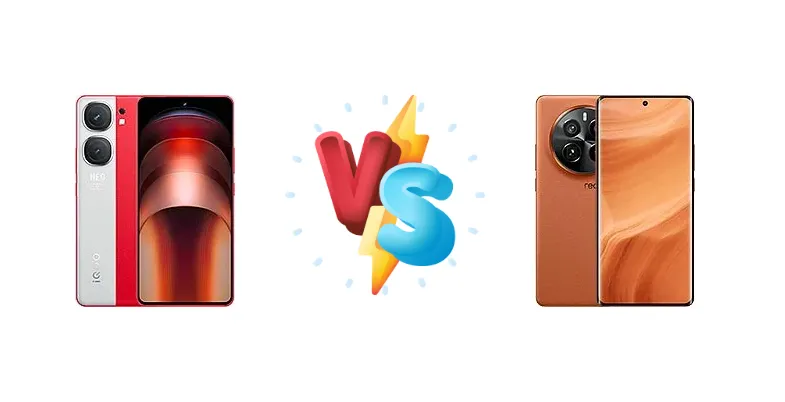
The sub-$600 flagship space is heating up. The Realme GT5 Pro, powered by the latest Snapdragon 8 Gen 3, challenges the vivo iQOO Neo9S Pro, which boasts the Mediatek Dimensity 9300+. Both aim to deliver top-tier performance without the ultra-premium price tag, but they take different approaches to get there. This comparison breaks down the key differences to help you choose the right phone for your needs.
🏆 Quick Verdict
For most users, the Realme GT5 Pro emerges as the stronger contender. Its Snapdragon 8 Gen 3 chipset, coupled with a brighter display and longer battery life, provides a more consistently powerful experience. However, the iQOO Neo9S Pro’s incredibly fast 120W charging is a compelling advantage for those prioritizing speed.
| Network |
|---|
| 2G bands | GSM 850 / 900 / 1800 / 1900 | GSM 850 / 900 / 1800 / 1900 |
| 3G bands | HSDPA 850 / 900 / 1700(AWS) / 1900 / 2100 | HSDPA 850 / 900 / 2100 |
| 4G bands | 1, 3, 4, 5, 7, 8, 19, 28, 34, 38, 39, 40, 41 | 1, 3, 5, 7, 8, 28, 34, 38, 39, 40, 41 |
| 5G bands | 1, 3, 5, 8, 28, 38, 40, 41, 77, 78 SA/NSA | 1, 3, 5, 8, 28, 41, 77, 78 SA/NSA |
| Speed | HSPA, LTE, 5G | HSPA, LTE, 5G |
| Technology | GSM / CDMA / HSPA / CDMA2000 / LTE / 5G | GSM / CDMA / HSPA / CDMA2000 / LTE / 5G |
| Launch |
|---|
| Announced | 2024, May 20 | 2023, December 07 |
| Status | Available. Released 2024, May 20 | Available. Released 2023, December 14 |
| Body |
|---|
| Build | - | Glass front, glass back or silicone polymer back (eco leather), aluminum frame |
| Dimensions | 163.5 x 75.7 x 8 mm or 8.3 mm | 161.7 x 75.1 x 9.2 mm (6.37 x 2.96 x 0.36 in) |
| SIM | Nano-SIM + Nano-SIM | Nano-SIM + Nano-SIM |
| Weight | 190 g or 196 g (6.70 oz) | 218 g / 224 g (7.69 oz) |
| Display |
|---|
| Resolution | 1260 x 2800 pixels, 20:9 ratio (~453 ppi density) | 1264 x 2780 pixels (~450 ppi density) |
| Size | 6.78 inches, 111.0 cm2 (~89.7% screen-to-body ratio) | 6.78 inches, 111.7 cm2 (~92.0% screen-to-body ratio) |
| Type | LTPO AMOLED, 1B colors, 144Hz, HDR10+, 1400 nits (HBM) | LTPO AMOLED, 1B colors, 144Hz, HDR10+, Dolby Vision, 4500 nits (peak) |
| Platform |
|---|
| CPU | Octa-core (1x3.4 GHz Cortex-X4 & 3x2.85 GHz Cortex-X4 & 4x2.0 GHz Cortex-A720) | Octa-core (1x3.3 GHz Cortex-X4 & 3x3.2 GHz Cortex-A720 & 2x3.0 GHz Cortex-A720 & 2x2.3 GHz Cortex-A520) |
| Chipset | Mediatek Dimensity 9300+ (4 nm) | Qualcomm SM8650-AB Snapdragon 8 Gen 3 (4 nm) |
| GPU | Immortalis-G720 MC12 | Adreno 750 |
| OS | Android 14, OriginOS 4 | Android 14, upgradable to Android 15, Realme UI 6.0 |
| Memory |
|---|
| Card slot | No | No |
| Internal | 256GB 12GB RAM, 512GB 12GB RAM, 512GB 16GB RAM, 1TB 16GB RAM | 256GB 12GB RAM, 256GB 16GB RAM, 512GB 16GB RAM, 1TB 16GB RAM |
| Main Camera |
|---|
| Dual | 50 MP, f/1.9, (wide), 1/1.49", PDAF, OIS
50 MP, f/2.0, 119˚ (ultrawide), 1/2.76", 0.64µm, AF | - |
| Features | LED flash, panorama, HDR | Color spectrum sensor, Dual-LED dual-tone flash, HDR, panorama |
| Triple | - | 50 MP, f/1.7, 23mm (wide), 1/1.43", 1.12µm, dual pixel PDAF, OIS
50 MP, f/2.6, 65mm (periscope telephoto), 1/1.56", 1.0µm, multi-directional PDAF, OIS, 2.7x optical zoom
8 MP, f/2.2, 16mm, 112˚ (ultrawide), 1/4.0", 1.12µm |
| Video | 8K, 4K, 1080p, gyro-EIS | 8K@24fps, 4K@30/60fps, 1080p@30/60fps, gyro-EIS, Dolby Vision |
| Selfie camera |
|---|
| Features | - | HDR, panorama |
| Single | 16 MP, f/2.5, (wide) | 32 MP, f/2.5, 22mm (wide), 1/2.74" |
| Video | 1080p@30fps | 4K@30fps, 1080p@30fps, gyro-EIS |
| Sound |
|---|
| 35mm jack | No | No |
| Loudspeaker | Yes, with stereo speakers (closed type) | Yes, with stereo speakers (Dolby Atmos certified) |
| Comms |
|---|
| Bluetooth | 5.4, A2DP, LE, aptX HD, aptX Adaptive | 5.4, A2DP, LE, aptX HD |
| Infrared port | Yes | Yes |
| NFC | Yes | Yes, 360˚ |
| Positioning | GPS (L1+L5), GLONASS, BDS (B1I+B1c+B2a+B2b), GALILEO (E1+E5a+E5b), QZSS (L1+L5), NavIC (L5) | GPS (L1+L5), GLONASS, BDS (B1I+B1c+B2a), GALILEO (E1+E5a), QZSS (L1+L5), NavIC |
| Radio | No | No |
| USB | USB Type-C 2.0, OTG | USB Type-C 3.2 |
| WLAN | Wi-Fi 802.11 a/b/g/n/ac/6/7, dual-band | Wi-Fi 802.11 a/b/g/n/ac/6/7, tri-band, Wi-Fi Direct |
| Features |
|---|
| Sensors | Fingerprint (under display, optical), accelerometer, gyro, proximity, compass | Fingerprint (under display, optical), accelerometer, gyro, proximity, compass |
| Battery |
|---|
| Charging | 120W wired, 40% in 9 min
Reverse wired | 100W wired, 50% in 12 min
50W wireless |
| Type | 5160 mAh | Li-Ion 5400 mAh |
| Misc |
|---|
| Colors | Black, White, Red | Black, Silver, Orange |
| Models | V2339FA | RMX3888 |
| Price | About 340 EUR | About 430 EUR |
vivo iQOO Neo9S Pro
- Incredibly fast 120W wired charging
- Potentially superior multi-core CPU performance
- Competitive price point
- Battery life likely shorter than GT5 Pro
- Camera system details are unknown
- Thermal management may be a concern under sustained load
Realme GT5 Pro
- Brighter display for outdoor visibility
- Snapdragon 8 Gen 3 for sustained performance
- Longer battery life (14:16h active use)
- 50W wireless charging
- Slower wired charging than iQOO Neo9S Pro
- Potentially higher price
- May not excel in heavily multi-threaded tasks as much as iQOO
Display Comparison
The Realme GT5 Pro features a significantly brighter display, peaking at 1660 nits measured, making it far more usable outdoors under direct sunlight. While the iQOO Neo9S Pro’s display specs aren’t provided, the GT5 Pro’s brightness advantage is substantial. Both likely utilize AMOLED panels, but the GT5 Pro’s brightness and potential for higher color accuracy give it an edge. We expect both to have high refresh rates, but the GT5 Pro’s superior brightness is a key differentiator.
Camera Comparison
Context data is limited regarding camera specifics. However, given Realme’s recent focus on camera technology, the GT5 Pro likely features a more sophisticated camera system, potentially with a larger main sensor and more advanced image processing algorithms. The iQOO Neo9S Pro’s camera capabilities are less clear, but it’s reasonable to assume it will offer a competitive experience within its price range. We’d need detailed sensor specs to make a definitive judgment, but Realme’s brand positioning suggests a stronger emphasis on photography.
Performance
The core battle lies between the Qualcomm Snapdragon 8 Gen 3 (GT5 Pro) and the Mediatek Dimensity 9300+ (iQOO Neo9S Pro). The Snapdragon 8 Gen 3, with its 1x3.3 GHz Cortex-X4 prime core, is optimized for sustained performance, while the Dimensity 9300+ features a unique 1x3.4 GHz Cortex-X4 and *three* additional Cortex-X4 cores. This suggests the iQOO Neo9S Pro may excel in heavily multi-threaded workloads, but the Snapdragon 8 Gen 3’s architecture is generally considered more efficient, potentially leading to better thermal management during prolonged gaming. The GT5 Pro’s LPDDR5x RAM complements the Snapdragon, ensuring smooth multitasking.
Battery Life
The Realme GT5 Pro boasts a significant advantage in battery life, achieving an active use score of 14:16h. While the iQOO Neo9S Pro’s battery capacity isn’t specified, the GT5 Pro’s endurance is noteworthy. The charging speeds are a key differentiator: the iQOO Neo9S Pro’s 120W wired charging can reach 40% in just 9 minutes, while the GT5 Pro’s 100W wired charging takes 12 minutes to reach 50%. The GT5 Pro also adds 50W wireless charging, a feature absent on the iQOO Neo9S Pro. The iQOO’s faster wired charging is ideal for quick top-ups, but the GT5 Pro offers more versatile charging options and longer overall runtime.
Buying Guide
Buy the vivo iQOO Neo9S Pro if you absolutely need the fastest wired charging available and prioritize raw CPU performance for specific tasks. Buy the Realme GT5 Pro if you value sustained performance under load, a brighter and more visible display in sunlight, and a more balanced overall package with better battery endurance. Gamers will likely lean towards the GT5 Pro due to its thermal management.
Frequently Asked Questions
❓ Will the Dimensity 9300+ in the iQOO Neo9S Pro overheat during extended gaming sessions?
While the Dimensity 9300+ is a powerful chip, its thermal performance is a key concern. The Snapdragon 8 Gen 3 in the GT5 Pro is generally considered more thermally efficient. Expect the iQOO Neo9S Pro to potentially throttle performance under sustained heavy load, especially in demanding games, whereas the GT5 Pro is likely to maintain higher frame rates for longer.
❓ How much faster is the 120W charging on the iQOO Neo9S Pro compared to the 100W charging on the Realme GT5 Pro in real-world use?
The iQOO Neo9S Pro charges to 40% in 9 minutes, while the GT5 Pro reaches 50% in 12 minutes. This means the iQOO Neo9S Pro is significantly faster for initial charging bursts. However, the difference becomes less pronounced as the battery fills, and the GT5 Pro’s 50W wireless charging offers added convenience.
❓ Does the Realme GT5 Pro support high refresh rate gaming, and what frame rates can be expected in popular titles?
The Realme GT5 Pro, with its Snapdragon 8 Gen 3 and optimized thermal management, is well-equipped for high refresh rate gaming. Expect to consistently achieve 60-120fps in titles like PUBG Mobile and Genshin Impact at high settings, depending on the specific game optimizations and graphics settings chosen.