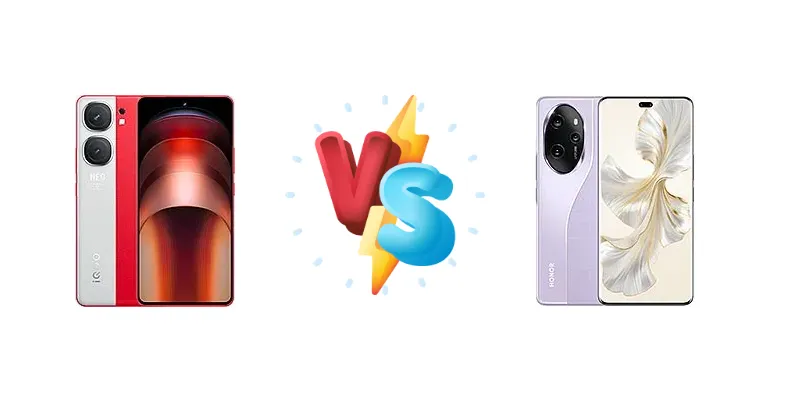
The iQOO Neo9S Pro and Honor 100 Pro represent compelling options in the increasingly competitive flagship smartphone market. The iQOO Neo9S Pro leverages the latest Mediatek Dimensity 9300+ chipset, prioritizing raw processing power, while the Honor 100 Pro opts for the established Qualcomm Snapdragon 8 Gen 2, balancing performance with efficiency. This comparison will dissect their key differences to determine which device best suits your needs.
🏆 Quick Verdict
For users prioritizing peak performance and blazing-fast 120W charging, the iQOO Neo9S Pro is the clear winner. However, the Honor 100 Pro offers a more refined experience with its 66W wireless charging and potentially better thermal management due to the Snapdragon 8 Gen 2’s proven track record.
| Network |
|---|
| 2G bands | GSM 850 / 900 / 1800 / 1900 | GSM 850 / 900 / 1800 / 1900 |
| 3G bands | HSDPA 850 / 900 / 1700(AWS) / 1900 / 2100 | HSDPA 800 / 850 / 900 / 1700(AWS) / 1900 / 2100 |
| 4G bands | 1, 3, 4, 5, 7, 8, 19, 28, 34, 38, 39, 40, 41 | LTE |
| 5G bands | 1, 3, 5, 8, 28, 38, 40, 41, 77, 78 SA/NSA | SA/NSA |
| Speed | HSPA, LTE, 5G | HSPA, LTE, 5G |
| Technology | GSM / CDMA / HSPA / CDMA2000 / LTE / 5G | GSM / CDMA / HSPA / CDMA2000 / LTE / 5G |
| Launch |
|---|
| Announced | 2024, May 20 | 2023, November 23 |
| Status | Available. Released 2024, May 20 | Available. Released 2023, November 23 |
| Body |
|---|
| Dimensions | 163.5 x 75.7 x 8 mm or 8.3 mm | 163.7 x 74.7 x 8.2 mm or 8.5 mm |
| SIM | Nano-SIM + Nano-SIM | Nano-SIM + Nano-SIM |
| Weight | 190 g or 196 g (6.70 oz) | 195 g (6.88 oz) |
| Display |
|---|
| Resolution | 1260 x 2800 pixels, 20:9 ratio (~453 ppi density) | 1224 x 2700 pixels (~437 ppi density) |
| Size | 6.78 inches, 111.0 cm2 (~89.7% screen-to-body ratio) | 6.78 inches, 111.5 cm2 (~91.2% screen-to-body ratio) |
| Type | LTPO AMOLED, 1B colors, 144Hz, HDR10+, 1400 nits (HBM) | OLED, 1B colors, 120Hz, HDR, 2600 nits (peak) |
| Platform |
|---|
| CPU | Octa-core (1x3.4 GHz Cortex-X4 & 3x2.85 GHz Cortex-X4 & 4x2.0 GHz Cortex-A720) | Octa-core (1x3.2 GHz Cortex-X3 & 2x2.8 GHz Cortex-A715 & 2x2.8 GHz Cortex-A710 & 3x2.0 GHz Cortex-A510) |
| Chipset | Mediatek Dimensity 9300+ (4 nm) | Qualcomm SM8550-AB Snapdragon 8 Gen 2 (4 nm) |
| GPU | Immortalis-G720 MC12 | Adreno 740 |
| OS | Android 14, OriginOS 4 | Android 13, MagicOS 7.2 |
| Memory |
|---|
| Card slot | No | No |
| Internal | 256GB 12GB RAM, 512GB 12GB RAM, 512GB 16GB RAM, 1TB 16GB RAM | 256GB 12GB RAM, 256GB 16GB RAM, 512GB 16GB RAM, 1TB 16GB RAM |
| Main Camera |
|---|
| Dual | 50 MP, f/1.9, (wide), 1/1.49", PDAF, OIS
50 MP, f/2.0, 119˚ (ultrawide), 1/2.76", 0.64µm, AF | - |
| Features | LED flash, panorama, HDR | LED flash, HDR, panorama |
| Triple | - | 50 MP, f/2.0, 27mm (wide), 1/1.56", 1.0µm, PDAF, OIS
32 MP, f/2.4, (telephoto), PDAF, OIS, 2.5x optical zoom
12 MP, f/2.2, 112˚ (ultrawide), AF |
| Video | 8K, 4K, 1080p, gyro-EIS | 4K@30fps, 1080p@30/60fps, gyro-EIS, OIS |
| Selfie camera |
|---|
| Dual | - | 50 MP, f/2.0
2 MP, f/2.4, (depth) |
| Features | - | HDR |
| Single | 16 MP, f/2.5, (wide) | - |
| Video | 1080p@30fps | 4K@30fps, 1080p@30fps, gyro-EIS |
| Sound |
|---|
| 35mm jack | No | No |
| Loudspeaker | Yes, with stereo speakers (closed type) | Yes, with stereo speakers |
| Comms |
|---|
| Bluetooth | 5.4, A2DP, LE, aptX HD, aptX Adaptive | 5.3, A2DP, LE, aptX HD |
| Infrared port | Yes | - |
| NFC | Yes | Yes |
| Positioning | GPS (L1+L5), GLONASS, BDS (B1I+B1c+B2a+B2b), GALILEO (E1+E5a+E5b), QZSS (L1+L5), NavIC (L5) | GPS, GALILEO, GLONASS, BDS, QZSS |
| Radio | No | No |
| USB | USB Type-C 2.0, OTG | USB Type-C 2.0, OTG |
| WLAN | Wi-Fi 802.11 a/b/g/n/ac/6/7, dual-band | Wi-Fi 802.11 a/b/g/n/ac/6, dual-band, Wi-Fi Direct |
| Features |
|---|
| Sensors | Fingerprint (under display, optical), accelerometer, gyro, proximity, compass | Fingerprint (under display, optical), accelerometer, gyro, compass, ultrasound proximity |
| Battery |
|---|
| Charging | 120W wired, 40% in 9 min
Reverse wired | 100W wired, 50% in 10 min
66W wireless, 100% in 42 min
5W reverse wired
Reverse wireless |
| Type | 5160 mAh | Li-Po 5000 mAh |
| Misc |
|---|
| Colors | Black, White, Red | Black, Silver, Blue, Violet |
| Models | V2339FA | MAA-AN10 |
| Price | About 340 EUR | About 440 EUR |
vivo iQOO Neo9S Pro
- Blazing-fast 120W wired charging
- Potentially higher CPU performance with Dimensity 9300+
- Latest generation chipset
- No wireless charging
- Potential for thermal throttling under sustained load
Honor 100 Pro
- 66W wireless charging support
- Snapdragon 8 Gen 2 offers excellent efficiency
- Established Qualcomm optimizations
- Slower wired charging compared to iQOO Neo9S Pro
- Slightly older chipset
Display Comparison
While both devices likely feature high-refresh-rate AMOLED displays (data not provided), the core difference lies in their processing power. The iQOO Neo9S Pro’s Dimensity 9300+ will benefit from a smoother experience when rendering complex UI elements or fast-paced games. The Snapdragon 8 Gen 2 in the Honor 100 Pro, while still incredibly capable, may exhibit slightly lower frame rates in graphically intensive scenarios. Without specific display specs, it's difficult to assess color accuracy or peak brightness, but both are expected to deliver vibrant visuals.
Camera Comparison
Without detailed camera specifications, a direct comparison is limited. However, the chipset plays a role in image processing speed. The Dimensity 9300+'s ISP (Image Signal Processor) will need to demonstrate its capabilities against Qualcomm's well-regarded Snapdragon 8 Gen 2 ISP. The Honor 100 Pro may benefit from Qualcomm’s established partnerships with camera sensor manufacturers and optimized image processing algorithms. The absence of information regarding sensor size and OIS makes it impossible to definitively declare a camera winner.
Performance
The Mediatek Dimensity 9300+ in the iQOO Neo9S Pro boasts a unique CPU configuration with a 1x3.4 GHz Cortex-X4 core, alongside three additional Cortex-X4 cores, suggesting a focus on single-core and multi-core performance. This contrasts with the Honor 100 Pro’s Snapdragon 8 Gen 2, which utilizes a 1x3.2 GHz Cortex-X3 core and a more traditional core arrangement. The Dimensity 9300+’s architecture *should* translate to higher benchmark scores, but real-world performance will depend on thermal throttling. The Snapdragon 8 Gen 2’s 4nm process is known for its efficiency, potentially allowing for more sustained performance during extended gaming sessions. Both devices utilize LPDDR5x RAM, ensuring fast memory access.
Battery Life
The iQOO Neo9S Pro’s 120W wired charging is a significant advantage, promising a 40% charge in just 9 minutes. This is substantially faster than the Honor 100 Pro’s 100W wired charging, which takes 10 minutes to reach 50%. Furthermore, the Honor 100 Pro offers 66W wireless charging, a feature absent in the iQOO Neo9S Pro. While battery capacity isn’t specified, the faster wired charging of the iQOO Neo9S Pro could offset a potentially smaller battery size, providing comparable real-world usage.
Buying Guide
Buy the vivo iQOO Neo9S Pro if you demand the absolute fastest CPU performance for demanding tasks like video editing or emulation, and if minimizing charging time is paramount. Buy the Honor 100 Pro if you value a more balanced experience with wireless charging convenience, potentially better sustained performance under load, and a wider ecosystem of Qualcomm optimizations.
Frequently Asked Questions
❓ Will the Dimensity 9300+ in the iQOO Neo9S Pro overheat during prolonged gaming sessions?
The Dimensity 9300+ is a powerful chipset, and generating significant heat is a possibility. However, iQOO likely employs advanced cooling solutions to mitigate throttling. Real-world performance will depend on the effectiveness of these cooling systems and the game's optimization. The Snapdragon 8 Gen 2 in the Honor 100 Pro is known for its thermal efficiency, potentially offering more consistent performance over extended periods.
❓ Does the Honor 100 Pro's 66W wireless charging significantly impact battery health over time?
Wireless charging generally generates more heat than wired charging, which *can* contribute to slightly faster battery degradation over the long term. However, modern smartphones employ battery management systems to minimize this effect. The Honor 100 Pro’s 66W wireless charging is relatively fast, and the impact on battery health is unlikely to be substantial for most users.
❓ Is the difference in CPU performance between the Dimensity 9300+ and Snapdragon 8 Gen 2 noticeable in everyday tasks?
For typical everyday tasks like browsing, social media, and video streaming, the difference in CPU performance will likely be minimal. Both chipsets are more than capable of handling these workloads smoothly. The Dimensity 9300+’s advantage will be most apparent in demanding applications like video editing, 3D rendering, or graphically intensive games.