
iQOO Neo9 vs Redmi K70 Pro: A Detailed Comparison of Snapdragon Powerhouses
| Phones Images | |||||
|---|---|---|---|---|---|
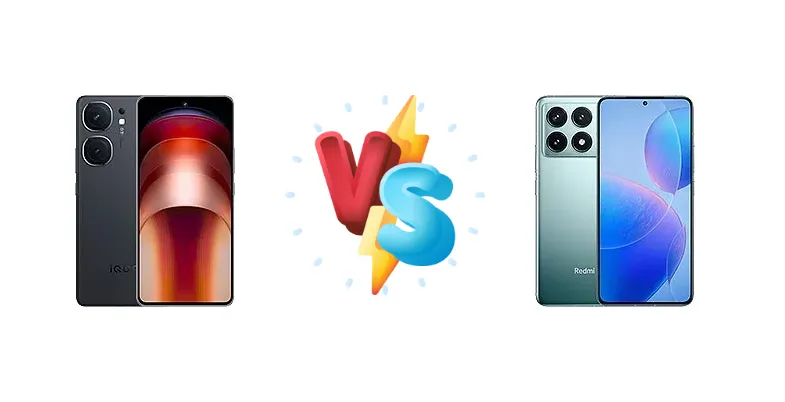
|
🏆 Quick Verdict
For most users, the Xiaomi Redmi K70 Pro emerges as the superior choice. The Snapdragon 8 Gen 3 provides a noticeable performance uplift, justifying the slightly higher price. However, the iQOO Neo9 remains a strong contender for budget-conscious gamers prioritizing a balanced experience.
| PHONES | ||
|---|---|---|
| Phone Names | vivo iQOO Neo9 | Xiaomi Redmi K70 Pro |
| Network | ||
|---|---|---|
| 2G bands | GSM 850 / 900 / 1800 / 1900 | GSM 850 / 900 / 1800 / 1900 |
| 3G bands | HSDPA 850 / 900 / 1700(AWS) / 1900 / 2100 | HSDPA 800 / 850 / 900 / 1700(AWS) / 2100 |
| 4G bands | 1, 3, 4, 5, 7, 8, 18, 19, 26, 28, 34, 38, 39, 40, 41 | 1, 3, 4, 5, 8, 18, 19, 26, 28, 34, 38, 39, 40, 41, 42, 48, 66 |
| 5G bands | 1, 3, 5, 8, 28, 38, 40, 41, 77, 78 SA/NSA | 1, 3, 5, 8, 28, 38, 41, 48, 66, 77, 78 SA/NSA |
| Speed | HSPA, LTE, 5G | HSPA, LTE, 5G |
| Technology | GSM / CDMA / HSPA / CDMA2000 / LTE / 5G | GSM / CDMA / HSPA / CDMA2000 / LTE / 5G |
| Launch | ||
|---|---|---|
| Announced | 2023, December 27 | 2023, November 29 |
| Status | Available. Released 2023, December 30 | Available. Released 2023, November 29 |
| Body | ||
|---|---|---|
| Dimensions | 163.5 x 75.7 x 8 mm or 8.3 mm | 160.9 x 75 x 8.2 mm (6.33 x 2.95 x 0.32 in) |
| SIM | Nano-SIM + Nano-SIM | Nano-SIM + Nano-SIM |
| Weight | 190 g or 196 g (6.70 oz) | 209 g (7.37 oz) |
| Display | ||
|---|---|---|
| Resolution | 1260 x 2800 pixels, 20:9 ratio (~453 ppi density) | 1440 x 3200 pixels, 20:9 ratio (~526 ppi density) |
| Size | 6.78 inches, 111.0 cm2 (~89.7% screen-to-body ratio) | 6.67 inches, 107.4 cm2 (~89.0% screen-to-body ratio) |
| Type | LTPO AMOLED, 1B colors, 144Hz, HDR10+, 1400 nits (HBM) | OLED, 68B colors, 120Hz, Dolby Vision, HDR10+, 4000 nits (peak) |
| Platform | ||
|---|---|---|
| CPU | Octa-core (1x3.2 GHz Cortex-X3 & 2x2.8 GHz Cortex-A715 & 2x2.8 GHz Cortex-A710 & 3x2.0 GHz Cortex-A510) | Octa-core (1x3.3 GHz Cortex-X4 & 3x3.2 GHz Cortex-A720 & 2x3.0 GHz Cortex-A720 & 2x2.3 GHz Cortex-A520) |
| Chipset | Qualcomm SM8550-AB Snapdragon 8 Gen 2 (4 nm) | Qualcomm SM8650-AB Snapdragon 8 Gen 3 (4 nm) |
| GPU | Adreno 740 | Adreno 750 |
| OS | Android 14, OriginOS 4 | Android 14, HyperOS |
| Memory | ||
|---|---|---|
| Card slot | No | No |
| Internal | 256GB 12GB RAM, 256GB 16GB RAM, 512GB 16GB RAM, 1TB 16GB RAM | 256GB 12GB RAM, 256GB 16GB RAM, 512GB 12GB RAM, 512GB 16GB RAM, 1TB 24GB RAM |
| Main Camera | ||
|---|---|---|
| Dual | 50 MP, f/1.9, (wide), 1/1.49", PDAF, OIS 8 MP, f/2.2, 119˚ (ultrawide) | - |
| Features | LED flash, panorama, HDR | Color spectrum sensor, LED flash, HDR, panorama |
| Triple | - | 50 MP, f/1.6, (wide), 1/1.55", 1.0µm, PDAF, OIS 50 MP, (telephoto), PDAF, 2x optical zoom 12 MP, (ultrawide) |
| Video | 8K, 4K, 1080p, gyro-EIS | 8K@24fps, 4K@24/30/60fps, 1080p@30/60/120/240/960fps, 720p@1920fps, gyro-EIS |
| Selfie camera | ||
|---|---|---|
| Features | - | HDR |
| Single | 16 MP, f/2.5, (wide) | 16 MP, (wide) |
| Video | 1080p@30fps | 1080p@30/60fps, gyro-EIS |
| Sound | ||
|---|---|---|
| 35mm jack | No | No |
| Loudspeaker | Yes, with stereo speakers (closed type) | Yes, with stereo speakers |
| Comms | ||
|---|---|---|
| Bluetooth | 5.3, A2DP, LE, aptX HD, aptX Adaptive, aptX Lossless | 5.4, A2DP, LE, aptX HD, aptX Adaptive, aptX Lossless |
| Infrared port | Yes | Yes |
| NFC | Yes | Yes |
| Positioning | GPS, GALILEO, GLONASS, QZSS, BDS (B1I+B1c) | GPS (L1+L5), GLONASS (G1), BDS (B1I+B1c+B2a), GALILEO (E1+E5a), QZSS (L1+L5), NavIC (L5) |
| Radio | No | No |
| USB | USB Type-C 2.0, OTG | USB Type-C, OTG |
| WLAN | Wi-Fi 802.11 a/b/g/n/ac/6/7, dual-band, Wi-Fi Direct | Wi-Fi 802.11 a/b/g/n/ac/6e/7, dual-band, Wi-Fi Direct |
| Features | ||
|---|---|---|
| Sensors | Fingerprint (under display, optical), accelerometer, gyro, proximity, compass | Fingerprint (under display, optical), accelerometer, proximity, gyro, compass |
| Battery | ||
|---|---|---|
| Charging | 120W wired, 40% in 9 min Reverse wired | 120W wired, PD3.0, QC3+, 100% in 18 min |
| Type | 5160 mAh | Li-Po 5000 mAh |
| Misc | ||
|---|---|---|
| Colors | Black, Blue, Red | Black, Silver, Blue/Green, Lamborgini Green, Lamborgini Yellow |
| Models | V2338A | 23117RK66C |
| Price | About 290 EUR | About 430 EUR |
vivo iQOO Neo9
- Excellent value for money
- Fast 120W charging with quick initial boost
- Proven Snapdragon 8 Gen 2 performance
- Older chipset compared to the K70 Pro
- Potentially less efficient than the K70 Pro
Xiaomi Redmi K70 Pro
- Latest Snapdragon 8 Gen 3 chipset for top-tier performance
- Faster full charge time (18 minutes)
- More advanced ISP for improved camera performance
- Higher price point
- Potential for increased thermal throttling under extreme load (though mitigated by Gen 3 improvements)
Display Comparison
While display specs aren't provided, both phones likely feature AMOLED panels given their market positioning. The Redmi K70 Pro, being newer, may benefit from advancements in panel technology, potentially offering slightly higher peak brightness and improved color accuracy. However, without specific nit ratings or color gamut coverage, it's difficult to definitively declare a winner. Both are expected to have high refresh rates, crucial for smooth gaming and scrolling.
Camera Comparison
Without detailed camera specifications, a direct comparison is limited. However, the Redmi K70 Pro, as a newer device, is likely to incorporate more advanced image processing algorithms and potentially a larger sensor. The Snapdragon 8 Gen 3’s ISP (Image Signal Processor) is also more capable than the 8 Gen 2’s, leading to improved image quality, especially in low-light conditions. We can assume both phones will offer capable main cameras, but the K70 Pro likely has an edge in overall image quality and video recording capabilities.
Performance
The core difference lies in the chipsets. The Redmi K70 Pro’s Snapdragon 8 Gen 3 (4nm) boasts a Cortex-X4 prime core clocked at 3.3 GHz, a step up from the iQOO Neo9’s Snapdragon 8 Gen 2 (4nm) with its 3.2 GHz Cortex-X3. The K70 Pro also features a revised CPU configuration with more Cortex-A720 cores (3x at 3.2 GHz and 2x at 3.0 GHz) compared to the Neo9’s A715/A710 mix. This translates to faster processing speeds and improved multi-core performance on the K70 Pro. The 4nm process node on both chips ensures good thermal efficiency, but the Gen 3’s architectural improvements should result in better sustained performance under heavy load. The K70 Pro will likely exhibit less throttling during extended gaming sessions.
Battery Life
Both devices feature 120W wired charging, a significant advantage for quick top-ups. The Redmi K70 Pro claims a full charge in 18 minutes, while the iQOO Neo9 achieves 40% in 9 minutes. While the Neo9's initial charge rate is impressive, the K70 Pro's complete charge time is faster. Battery capacity isn't specified, but the K70 Pro's more efficient chipset could offset a potentially smaller battery, resulting in comparable real-world battery life. The inclusion of PD3.0 and QC3+ on the K70 Pro offers broader compatibility with various chargers.
Buying Guide
Buy the vivo iQOO Neo9 if you need a highly capable gaming phone with excellent value and don't necessarily require the absolute latest chipset. It's ideal for users who prioritize a smooth experience across a wide range of tasks without breaking the bank. Buy the Xiaomi Redmi K70 Pro if you demand the best possible performance for demanding applications like gaming and video editing, and are willing to pay a premium for the Snapdragon 8 Gen 3's advancements.