
vivo iQOO Neo9 vs Xiaomi 14T Pro: A Deep Dive into Performance and Battery Life
| Phones Images | |||||
|---|---|---|---|---|---|
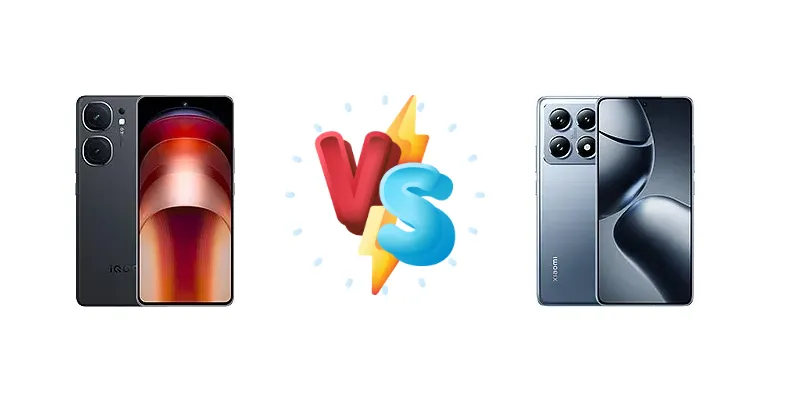
|
🏆 Quick Verdict
For users prioritizing raw processing power and gaming performance, the vivo iQOO Neo9 is the stronger choice thanks to its Snapdragon 8 Gen 2. However, the Xiaomi 14T Pro excels in battery endurance and offers the convenience of 50W wireless charging, making it ideal for power users who value longevity.
| PHONES | ||
|---|---|---|
| Phone Names | vivo iQOO Neo9 | Xiaomi 14T Pro |
| Network | ||
|---|---|---|
| 2G bands | GSM 850 / 900 / 1800 / 1900 | GSM 850 / 900 / 1800 / 1900 |
| 3G bands | HSDPA 850 / 900 / 1700(AWS) / 1900 / 2100 | HSDPA 800 / 850 / 900 / 1700(AWS) / 1900 / 2100 |
| 4G bands | 1, 3, 4, 5, 7, 8, 18, 19, 26, 28, 34, 38, 39, 40, 41 | 1, 2, 3, 4, 5, 7, 8, 12, 13, 17, 18, 19, 20, 25, 26, 28, 32, 38, 39, 40, 41, 42, 48, 66 |
| 5G bands | 1, 3, 5, 8, 28, 38, 40, 41, 77, 78 SA/NSA | 1, 2, 3, 5, 7, 8, 12, 20, 25, 26, 28, 38, 40, 41, 48, 66, 75, 77, 78 SA/NSA |
| Speed | HSPA, LTE, 5G | HSPA, LTE, 5G |
| Technology | GSM / CDMA / HSPA / CDMA2000 / LTE / 5G | GSM / HSPA / LTE / 5G |
| Launch | ||
|---|---|---|
| Announced | 2023, December 27 | 2024, September 26 |
| Status | Available. Released 2023, December 30 | Available. Released 2024, September 26 |
| Body | ||
|---|---|---|
| Build | - | Glass front (Gorilla Glass 5), aluminum frame, glass back (Panda X) |
| Dimensions | 163.5 x 75.7 x 8 mm or 8.3 mm | 160.4 x 75.1 x 8.4 mm (6.31 x 2.96 x 0.33 in) |
| SIM | Nano-SIM + Nano-SIM | · Nano-SIM + eSIM· eSIM + eSIM· Nano-SIM + Nano-SIM |
| Weight | 190 g or 196 g (6.70 oz) | 209 g (7.37 oz) |
| Display | ||
|---|---|---|
| Protection | - | Corning Gorilla Glass 5 |
| Resolution | 1260 x 2800 pixels, 20:9 ratio (~453 ppi density) | 1220 x 2712 pixels, 20:9 ratio (~446 ppi density) |
| Size | 6.78 inches, 111.0 cm2 (~89.7% screen-to-body ratio) | 6.67 inches, 107.4 cm2 (~89.1% screen-to-body ratio) |
| Type | LTPO AMOLED, 1B colors, 144Hz, HDR10+, 1400 nits (HBM) | AMOLED, 68B colors, 144Hz, 3840Hz PWM, Dolby Vision, HDR10+, 1600 nits (HBM), 4000 nits (peak) |
| Platform | ||
|---|---|---|
| CPU | Octa-core (1x3.2 GHz Cortex-X3 & 2x2.8 GHz Cortex-A715 & 2x2.8 GHz Cortex-A710 & 3x2.0 GHz Cortex-A510) | Octa-core (1x3.4 GHz Cortex-X4 & 3x2.85 GHz Cortex-X4 & 4x2.0 GHz Cortex-A720) |
| Chipset | Qualcomm SM8550-AB Snapdragon 8 Gen 2 (4 nm) | Mediatek Dimensity 9300+ (4 nm) |
| GPU | Adreno 740 | Immortalis-G720 MC12 |
| OS | Android 14, OriginOS 4 | Android 14, HyperOS |
| Memory | ||
|---|---|---|
| Card slot | No | No |
| Internal | 256GB 12GB RAM, 256GB 16GB RAM, 512GB 16GB RAM, 1TB 16GB RAM | 256GB 12GB RAM, 512GB 12GB RAM, 512GB 16GB RAM, 1TB 12GB RAM |
| Main Camera | ||
|---|---|---|
| Dual | 50 MP, f/1.9, (wide), 1/1.49", PDAF, OIS 8 MP, f/2.2, 119˚ (ultrawide) | - |
| Features | LED flash, panorama, HDR | Leica lens, Ultra HDR, LED flash, HDR, panorama |
| Triple | - | 50 MP, f/1.6, 23mm (wide), 1/1.31", 1.2µm, PDAF, OIS 50 MP, f/2.0, 60mm (telephoto), 1/2.88", 0.61µm, PDAF, 2.6x optical zoom 12 MP, f/2.2, 15mm (ultrawide), 1/3.06", 1.12µm |
| Video | 8K, 4K, 1080p, gyro-EIS | 8K@24/30fps, 4K@24/30/60fps, 1080p@30/60/120/240/960fps, gyro-EIS, 10-bit Rec. 2020, HDR10+ |
| Selfie camera | ||
|---|---|---|
| Features | - | HDR |
| Single | 16 MP, f/2.5, (wide) | 32 MP, f/2.0, 25mm (wide), 1/3.44", 0.64µm |
| Video | 1080p@30fps | 4K@30fps, 1080p@30/60fps, HDR10+ |
| Sound | ||
|---|---|---|
| 35mm jack | No | No |
| Loudspeaker | Yes, with stereo speakers (closed type) | Yes, with stereo speakers |
| Comms | ||
|---|---|---|
| Bluetooth | 5.3, A2DP, LE, aptX HD, aptX Adaptive, aptX Lossless | 5.4, A2DP, LE, LHDC |
| Infrared port | Yes | Yes |
| NFC | Yes | Yes (market/region dependent) |
| Positioning | GPS, GALILEO, GLONASS, QZSS, BDS (B1I+B1c) | GPS (L1+L5), BDS (B1I+B1C+B2a+B2b), GALILEO (E1+E5a+E5b), QZSS (L1+L5), NavIC (L5), GLONASS |
| Radio | No | No |
| USB | USB Type-C 2.0, OTG | USB Type-C 2.0, OTG |
| WLAN | Wi-Fi 802.11 a/b/g/n/ac/6/7, dual-band, Wi-Fi Direct | Wi-Fi 802.11 a/b/g/n/ac/6e/7, dual-band, Wi-Fi Direct |
| Features | ||
|---|---|---|
| Sensors | Fingerprint (under display, optical), accelerometer, gyro, proximity, compass | Fingerprint (under display, optical), accelerometer, gyro, proximity, compass |
| Battery | ||
|---|---|---|
| Charging | 120W wired, 40% in 9 min Reverse wired | 120W wired, PD3.0, QC4, 100% in 19 min 50W wireless, 100% in 45 min |
| Type | 5160 mAh | Li-Po 5000 mAh |
| Misc | ||
|---|---|---|
| Colors | Black, Blue, Red | Titan Gray, Titan Blue, Titan Black |
| Models | V2338A | 2407FPN8EG |
| Price | About 290 EUR | $ 550.00 / £ 498.00 / € 539.99 |
| SAR EU | - | 0.99 W/kg (head) 1.00 W/kg (body) |
vivo iQOO Neo9
- Snapdragon 8 Gen 2 offers excellent gaming performance
- Potentially more optimized software experience
- Fast 120W wired charging
- Battery life likely shorter than Xiaomi 14T Pro
- No wireless charging support
- Display brightness potentially lower
Xiaomi 14T Pro
- Superior battery life (12:32h active use)
- 50W wireless charging support
- Brighter display (1228 nits)
- Dimensity 9300+ is a newer platform with potentially less software optimization
- Wired charging takes longer to reach 100% (19 minutes)
- Gaming performance may be slightly behind Snapdragon 8 Gen 2 in some titles
Display Comparison
The Xiaomi 14T Pro boasts a significantly brighter display, reaching a measured peak of 1228 nits, compared to an unspecified peak brightness for the iQOO Neo9. This higher brightness translates to better visibility under direct sunlight. While both likely utilize AMOLED panels, the Xiaomi 14T Pro’s brightness advantage is a clear win for outdoor usability. Details regarding refresh rate and PWM dimming on the iQOO Neo9 are currently unavailable, making a complete display comparison difficult, but the Xiaomi 14T Pro’s brightness is a definitive advantage.
Camera Comparison
Without detailed camera specifications for either device, a direct comparison is limited. However, given the market positioning, it’s reasonable to expect both phones to feature capable main sensors. The Xiaomi 14T Pro, being a newer release, may benefit from more advanced image processing algorithms. The absence of information regarding sensor size, OIS, and lens apertures prevents a definitive assessment. We can assume both will include standard wide, ultrawide, and potentially macro lenses, but the quality will depend heavily on the sensor and software implementation.
Performance
The core difference lies in the chipsets. The Xiaomi 14T Pro’s Mediatek Dimensity 9300+ features a unique core configuration with one 3.4 GHz Cortex-X4 prime core and three additional Cortex-X4 cores, alongside four Cortex-A720 efficiency cores. This contrasts with the iQOO Neo9’s Snapdragon 8 Gen 2, which utilizes a more traditional setup with one Cortex-X3, two Cortex-A715, two Cortex-A710, and three Cortex-A510 cores. The Dimensity 9300+’s all-performance core approach *should* translate to superior multi-core performance, while the Snapdragon 8 Gen 2 is known for its optimized single-core performance and gaming prowess. Both are built on a 4nm process, but the architectural differences will dictate real-world performance characteristics. The iQOO Neo9 benefits from the Snapdragon’s mature software optimization, while the 14T Pro is a newer platform.
Battery Life
The Xiaomi 14T Pro demonstrates a clear advantage in battery endurance, achieving an active use score of 12:32h. While the iQOO Neo9’s battery capacity is unknown, its Snapdragon 8 Gen 2 chipset, while powerful, is generally less power-efficient than the Dimensity 9300+. Both support 120W wired charging, with the Xiaomi 14T Pro reaching 100% in 19 minutes, and the iQOO Neo9 achieving 40% in 9 minutes. Crucially, the Xiaomi 14T Pro adds 50W wireless charging, a feature absent on the iQOO Neo9, providing added convenience for users who prefer cable-free charging.
Buying Guide
Buy the vivo iQOO Neo9 if you are a mobile gamer or power user who demands the highest possible CPU and GPU performance, and are willing to trade some battery life for it. Buy the Xiaomi 14T Pro if you prioritize all-day battery life, appreciate the convenience of wireless charging, and want a phone that can comfortably handle demanding tasks without sacrificing endurance.