
vivo iQOO Neo9 vs. Samsung Galaxy S23 FE: Which Android Flagship Reigns Supreme?
| Phones Images | |||||
|---|---|---|---|---|---|
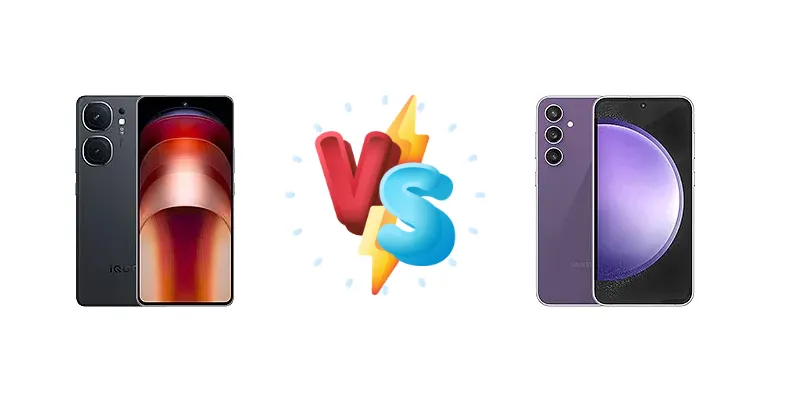
|
🏆 Quick Verdict
For users prioritizing raw performance and charging speed, the vivo iQOO Neo9 is the clear winner. Its Snapdragon 8 Gen 2 offers a significant advantage in demanding tasks and gaming. However, the Samsung Galaxy S23 FE provides a more polished software experience and a potentially more consistent camera performance, making it a strong contender for those valuing overall refinement.
| PHONES | ||
|---|---|---|
| Phone Names | vivo iQOO Neo9 | Samsung Galaxy S23 FE |
| Network | ||
|---|---|---|
| 2G bands | GSM 850 / 900 / 1800 / 1900 | GSM 850 / 900 / 1800 / 1900 |
| 3G bands | HSDPA 850 / 900 / 1700(AWS) / 1900 / 2100 | HSDPA 850 / 900 / 1700(AWS) / 1900 / 2100 |
| 4G bands | 1, 3, 4, 5, 7, 8, 18, 19, 26, 28, 34, 38, 39, 40, 41 | 1, 2, 3, 4, 5, 7, 8, 12, 13, 17, 20, 26, 28, 38, 40, 41, 66 - International |
| 5G bands | 1, 3, 5, 8, 28, 38, 40, 41, 77, 78 SA/NSA | 1, 2, 3, 5, 7, 8, 20, 28, 38, 40, 41, 66, 77, 78 SA/NSA/Sub6 - International |
| Speed | HSPA, LTE, 5G | HSPA, LTE, 5G |
| Technology | GSM / CDMA / HSPA / CDMA2000 / LTE / 5G | GSM / HSPA / LTE / 5G |
| Launch | ||
|---|---|---|
| Announced | 2023, December 27 | 2023, October 04 |
| Status | Available. Released 2023, December 30 | Available. Released 2023, October 05 |
| Body | ||
|---|---|---|
| Build | - | Glass front (Gorilla Glass 5), glass back (Gorilla Glass 5), aluminum frame |
| Dimensions | 163.5 x 75.7 x 8 mm or 8.3 mm | 158 x 76.5 x 8.2 mm (6.22 x 3.01 x 0.32 in) |
| SIM | Nano-SIM + Nano-SIM | · Nano-SIM· Nano-SIM + Nano-SIM· Nano-SIM + Nano-SIM + eSIM (max 2 at a time) |
| Weight | 190 g or 196 g (6.70 oz) | 209 g (7.37 oz) |
| Display | ||
|---|---|---|
| Protection | - | Corning Gorilla Glass 5 |
| Resolution | 1260 x 2800 pixels, 20:9 ratio (~453 ppi density) | 1080 x 2340 pixels, 19.5:9 ratio (~403 ppi density) |
| Size | 6.78 inches, 111.0 cm2 (~89.7% screen-to-body ratio) | 6.4 inches, 100.5 cm2 (~83.2% screen-to-body ratio) |
| Type | LTPO AMOLED, 1B colors, 144Hz, HDR10+, 1400 nits (HBM) | Dynamic AMOLED 2X, 120Hz, HDR10+, 1450 nits (peak) |
| Platform | ||
|---|---|---|
| CPU | Octa-core (1x3.2 GHz Cortex-X3 & 2x2.8 GHz Cortex-A715 & 2x2.8 GHz Cortex-A710 & 3x2.0 GHz Cortex-A510) | Octa-core (1x2.8 GHz Cortex-X2 & 3x2.50 GHz Cortex-A710 & 4x1.8 GHz Cortex-A510) - InternationalOcta-core (1x3.00 GHz Cortex-X2 & 3x2.50 GHz Cortex-A710 & 4x1.80 GHz Cortex-A510) - USA |
| Chipset | Qualcomm SM8550-AB Snapdragon 8 Gen 2 (4 nm) | Exynos 2200 (4 nm) - InternationalQualcomm SM8450 Snapdragon 8 Gen 1 (4 nm) - USA |
| GPU | Adreno 740 | Xclipse 920 - InternationalAdreno 730 - USA |
| OS | Android 14, OriginOS 4 | Android 13, up to 4 major Android upgrades, One UI 8 |
| Memory | ||
|---|---|---|
| Card slot | No | No |
| Internal | 256GB 12GB RAM, 256GB 16GB RAM, 512GB 16GB RAM, 1TB 16GB RAM | 128GB 8GB RAM, 256GB 8GB RAM |
| Main Camera | ||
|---|---|---|
| Dual | 50 MP, f/1.9, (wide), 1/1.49", PDAF, OIS 8 MP, f/2.2, 119˚ (ultrawide) | - |
| Features | LED flash, panorama, HDR | LED flash, HDR, panorama |
| Triple | - | 50 MP, f/1.8, 23mm (wide), 1/1.57", 1.0µm, dual pixel PDAF, OIS 8 MP, f/2.4, 76mm (telephoto), 1/4.5", 1.0µm, PDAF, OIS, 3x optical zoom 12 MP, f/2.2, 13mm, 123˚ (ultrawide), 1/3.0", 1.12µm |
| Video | 8K, 4K, 1080p, gyro-EIS | 8K@24fps, 4K@30/60fps, 1080p@30/60/120/240fps |
| Selfie camera | ||
|---|---|---|
| Single | 16 MP, f/2.5, (wide) | 10 MP, f/2.4, 25mm (wide), 1/3.0", 1.22µm |
| Video | 1080p@30fps | 4K@30/60fps, 1080p@30/60fps; gyro-EIS |
| Sound | ||
|---|---|---|
| 35mm jack | No | No |
| Loudspeaker | Yes, with stereo speakers (closed type) | Yes, with stereo speakers |
| Comms | ||
|---|---|---|
| Bluetooth | 5.3, A2DP, LE, aptX HD, aptX Adaptive, aptX Lossless | 5.3, A2DP, LE |
| Infrared port | Yes | - |
| NFC | Yes | Yes |
| Positioning | GPS, GALILEO, GLONASS, QZSS, BDS (B1I+B1c) | GPS, GLONASS, GALILEO, BDS |
| Radio | No | Unspecified |
| USB | USB Type-C 2.0, OTG | USB Type-C, OTG |
| WLAN | Wi-Fi 802.11 a/b/g/n/ac/6/7, dual-band, Wi-Fi Direct | Wi-Fi 802.11 a/b/g/n/ac/6e, dual-band, Wi-Fi Direct |
| Features | ||
|---|---|---|
| Sensors | Fingerprint (under display, optical), accelerometer, gyro, proximity, compass | Fingerprint (under display, optical), accelerometer, gyro, compass |
| Battery | ||
|---|---|---|
| Charging | 120W wired, 40% in 9 min Reverse wired | 25W wired, PD3.0, 50% in 30 min 15W wireless Reverse wireless |
| Type | 5160 mAh | Li-Ion 4500 mAh |
| Misc | ||
|---|---|---|
| Colors | Black, Blue, Red | Mint, Cream, Graphite, Purple, Indigo, Tangerine |
| Models | V2338A | SM-S711B, SM-S711B/DS, SM-S711U1, SM-S711U, SM-S711W, SM-S7110, SM-S711N |
| Price | About 290 EUR | $ 219.95 / C$ 327.90 / £ 248.99 / € 272.00 / ₹ 34,999 |
| SAR | - | 0.80 W/kg (head) 0.72 W/kg (body) |
| SAR EU | - | 0.76 W/kg (head) 1.04 W/kg (body) |
vivo iQOO Neo9
- Blazing-fast Snapdragon 8 Gen 2 performance
- Incredibly fast 120W wired charging
- Potentially better thermal management
- Battery capacity not specified
- Software experience may be less refined than Samsung’s One UI
Samsung Galaxy S23 FE
- Refined One UI software experience
- Solid 8:28h battery life
- Versatile camera system (likely)
- Slower 25W wired charging
- Exynos 2200/Snapdragon 8 Gen 1 chipset is less powerful than Snapdragon 8 Gen 2
Display Comparison
The Samsung Galaxy S23 FE boasts a peak brightness of 985 nits, providing excellent visibility outdoors. While the iQOO Neo9’s display specs aren’t provided, it’s likely to be slightly dimmer. Both utilize 4nm chipsets, which indirectly impacts display efficiency. The S23 FE’s panel is likely to benefit from Samsung’s DisplayMate calibration, offering superior color accuracy. The absence of LTPO technology in either device suggests a standard 120Hz refresh rate, potentially impacting battery life compared to adaptive refresh rate displays.
Camera Comparison
The context data lacks detailed camera specifications for both devices. However, given Samsung’s history, the S23 FE likely features a more versatile camera system with a focus on image processing and software features. The iQOO Neo9 may prioritize computational photography, but likely lacks the brand recognition and refinement of Samsung’s camera algorithms. Without sensor size or aperture information, it’s difficult to definitively assess image quality, but the S23 FE’s reputation suggests a more consistent and user-friendly camera experience. The 2MP macro camera on the S23 FE is likely a marketing feature with limited practical utility.
Performance
The iQOO Neo9’s Qualcomm Snapdragon 8 Gen 2 (4nm) is a substantial upgrade over the Exynos 2200 (4nm) or Snapdragon 8 Gen 1 found in the S23 FE. The Snapdragon 8 Gen 2’s Cortex-X3 prime core, clocked at 3.2 GHz, offers a significant performance boost over the S23 FE’s Cortex-X2. The iQOO Neo9’s more efficient 4nm process also translates to better thermal management, reducing the likelihood of throttling during sustained workloads. The S23 FE’s performance will vary depending on the region, with the Snapdragon 8 Gen 1 version offering slightly better performance than the Exynos 2200 variant. The iQOO Neo9’s LPDDR5x RAM further enhances its performance advantage.
Battery Life
The Samsung Galaxy S23 FE achieves an active use score of 8:28h, demonstrating solid battery life. The iQOO Neo9’s battery capacity is not specified, but its 120W wired charging is a game-changer, achieving 40% charge in just 9 minutes. This drastically reduces downtime compared to the S23 FE’s 25W charging, which takes 30 minutes to reach 50%. While the S23 FE offers 15W wireless and reverse wireless charging, the iQOO Neo9 only offers reverse wired charging, prioritizing speed over wireless convenience. The iQOO Neo9’s faster charging effectively mitigates any potential disadvantage from a smaller battery capacity.
Buying Guide
Buy the vivo iQOO Neo9 if you need uncompromising processing power for gaming, video editing, or other intensive applications, and if you value incredibly fast 120W charging. Buy the Samsung Galaxy S23 FE if you prefer a more established brand with a refined One UI experience, a versatile camera system, and longer battery life during typical daily use.