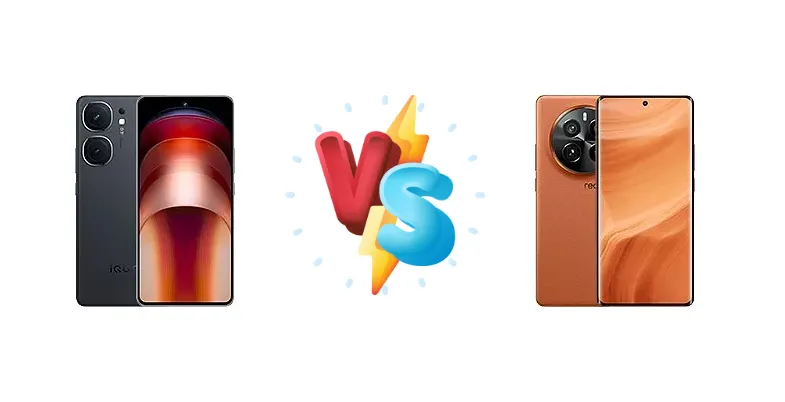
The vivo iQOO Neo9 and Realme GT5 Pro represent compelling options in the increasingly competitive upper-midrange and flagship smartphone space. The iQOO Neo9, leveraging the proven Snapdragon 8 Gen 2, aims for a balance of performance and affordability. The GT5 Pro, however, jumps to the latest Snapdragon 8 Gen 3, promising a significant leap in processing power, but at a potentially higher price point. This comparison dissects the key differences to determine which device delivers the best overall experience.
🏆 Quick Verdict
For most users, the Realme GT5 Pro emerges as the superior choice. While the iQOO Neo9 offers excellent value, the GT5 Pro’s Snapdragon 8 Gen 3 provides a noticeable performance advantage, coupled with a brighter display and longer battery life. The GT5 Pro justifies its price with future-proofed power.
| Network |
|---|
| 2G bands | GSM 850 / 900 / 1800 / 1900 | GSM 850 / 900 / 1800 / 1900 |
| 3G bands | HSDPA 850 / 900 / 1700(AWS) / 1900 / 2100 | HSDPA 850 / 900 / 2100 |
| 4G bands | 1, 3, 4, 5, 7, 8, 18, 19, 26, 28, 34, 38, 39, 40, 41 | 1, 3, 5, 7, 8, 28, 34, 38, 39, 40, 41 |
| 5G bands | 1, 3, 5, 8, 28, 38, 40, 41, 77, 78 SA/NSA | 1, 3, 5, 8, 28, 41, 77, 78 SA/NSA |
| Speed | HSPA, LTE, 5G | HSPA, LTE, 5G |
| Technology | GSM / CDMA / HSPA / CDMA2000 / LTE / 5G | GSM / CDMA / HSPA / CDMA2000 / LTE / 5G |
| Launch |
|---|
| Announced | 2023, December 27 | 2023, December 07 |
| Status | Available. Released 2023, December 30 | Available. Released 2023, December 14 |
| Body |
|---|
| Build | - | Glass front, glass back or silicone polymer back (eco leather), aluminum frame |
| Dimensions | 163.5 x 75.7 x 8 mm or 8.3 mm | 161.7 x 75.1 x 9.2 mm (6.37 x 2.96 x 0.36 in) |
| SIM | Nano-SIM + Nano-SIM | Nano-SIM + Nano-SIM |
| Weight | 190 g or 196 g (6.70 oz) | 218 g / 224 g (7.69 oz) |
| Display |
|---|
| Resolution | 1260 x 2800 pixels, 20:9 ratio (~453 ppi density) | 1264 x 2780 pixels (~450 ppi density) |
| Size | 6.78 inches, 111.0 cm2 (~89.7% screen-to-body ratio) | 6.78 inches, 111.7 cm2 (~92.0% screen-to-body ratio) |
| Type | LTPO AMOLED, 1B colors, 144Hz, HDR10+, 1400 nits (HBM) | LTPO AMOLED, 1B colors, 144Hz, HDR10+, Dolby Vision, 4500 nits (peak) |
| Platform |
|---|
| CPU | Octa-core (1x3.2 GHz Cortex-X3 & 2x2.8 GHz Cortex-A715 & 2x2.8 GHz Cortex-A710 & 3x2.0 GHz Cortex-A510) | Octa-core (1x3.3 GHz Cortex-X4 & 3x3.2 GHz Cortex-A720 & 2x3.0 GHz Cortex-A720 & 2x2.3 GHz Cortex-A520) |
| Chipset | Qualcomm SM8550-AB Snapdragon 8 Gen 2 (4 nm) | Qualcomm SM8650-AB Snapdragon 8 Gen 3 (4 nm) |
| GPU | Adreno 740 | Adreno 750 |
| OS | Android 14, OriginOS 4 | Android 14, upgradable to Android 15, Realme UI 6.0 |
| Memory |
|---|
| Card slot | No | No |
| Internal | 256GB 12GB RAM, 256GB 16GB RAM, 512GB 16GB RAM, 1TB 16GB RAM | 256GB 12GB RAM, 256GB 16GB RAM, 512GB 16GB RAM, 1TB 16GB RAM |
| Main Camera |
|---|
| Dual | 50 MP, f/1.9, (wide), 1/1.49", PDAF, OIS
8 MP, f/2.2, 119˚ (ultrawide) | - |
| Features | LED flash, panorama, HDR | Color spectrum sensor, Dual-LED dual-tone flash, HDR, panorama |
| Triple | - | 50 MP, f/1.7, 23mm (wide), 1/1.43", 1.12µm, dual pixel PDAF, OIS
50 MP, f/2.6, 65mm (periscope telephoto), 1/1.56", 1.0µm, multi-directional PDAF, OIS, 2.7x optical zoom
8 MP, f/2.2, 16mm, 112˚ (ultrawide), 1/4.0", 1.12µm |
| Video | 8K, 4K, 1080p, gyro-EIS | 8K@24fps, 4K@30/60fps, 1080p@30/60fps, gyro-EIS, Dolby Vision |
| Selfie camera |
|---|
| Features | - | HDR, panorama |
| Single | 16 MP, f/2.5, (wide) | 32 MP, f/2.5, 22mm (wide), 1/2.74" |
| Video | 1080p@30fps | 4K@30fps, 1080p@30fps, gyro-EIS |
| Sound |
|---|
| 35mm jack | No | No |
| Loudspeaker | Yes, with stereo speakers (closed type) | Yes, with stereo speakers (Dolby Atmos certified) |
| Comms |
|---|
| Bluetooth | 5.3, A2DP, LE, aptX HD, aptX Adaptive, aptX Lossless | 5.4, A2DP, LE, aptX HD |
| Infrared port | Yes | Yes |
| NFC | Yes | Yes, 360˚ |
| Positioning | GPS, GALILEO, GLONASS, QZSS, BDS (B1I+B1c) | GPS (L1+L5), GLONASS, BDS (B1I+B1c+B2a), GALILEO (E1+E5a), QZSS (L1+L5), NavIC |
| Radio | No | No |
| USB | USB Type-C 2.0, OTG | USB Type-C 3.2 |
| WLAN | Wi-Fi 802.11 a/b/g/n/ac/6/7, dual-band, Wi-Fi Direct | Wi-Fi 802.11 a/b/g/n/ac/6/7, tri-band, Wi-Fi Direct |
| Features |
|---|
| Sensors | Fingerprint (under display, optical), accelerometer, gyro, proximity, compass | Fingerprint (under display, optical), accelerometer, gyro, proximity, compass |
| Battery |
|---|
| Charging | 120W wired, 40% in 9 min
Reverse wired | 100W wired, 50% in 12 min
50W wireless |
| Type | 5160 mAh | Li-Ion 5400 mAh |
| Misc |
|---|
| Colors | Black, Blue, Red | Black, Silver, Orange |
| Models | V2338A | RMX3888 |
| Price | About 290 EUR | About 430 EUR |
vivo iQOO Neo9
- Faster wired charging (120W)
- Potentially lower price point
- Proven Snapdragon 8 Gen 2 performance
- Likely lower peak display brightness
- No wireless charging
- Older chipset compared to the GT5 Pro
Realme GT5 Pro
- Significantly more powerful Snapdragon 8 Gen 3
- Brighter display (1660 nits)
- Wireless charging (50W)
- Longer battery life (14:16h active use)
- Slower wired charging (100W)
- Potentially higher price
- Snapdragon 8 Gen 3 may require robust cooling
Display Comparison
The Realme GT5 Pro boasts a significantly brighter display, reaching a measured peak of 1660 nits, making it far more usable in direct sunlight compared to the iQOO Neo9 (brightness data unavailable, but likely lower). While both utilize 4nm chipsets, the GT5 Pro’s display technology likely benefits from improved power efficiency, contributing to its longer battery life. The iQOO Neo9’s display specs are not provided, so a direct comparison of panel type (AMOLED, LTPO) and resolution is impossible, but the GT5 Pro’s brightness advantage is a clear win for outdoor users.
Camera Comparison
The provided data lacks specific camera details for both phones, making a detailed comparison challenging. However, the Realme GT5 Pro’s positioning suggests a more advanced camera system. Given Realme’s recent focus on camera technology, it’s reasonable to assume the GT5 Pro features a larger main sensor and more sophisticated image processing algorithms. The iQOO Neo9 likely offers a competent camera experience, but the GT5 Pro is expected to excel in low-light photography and video recording. Without sensor size or aperture information, a definitive judgment is impossible, but the GT5 Pro’s brand trajectory points towards a more robust camera setup.
Performance
The core difference lies in the chipsets: the iQOO Neo9 features the Snapdragon 8 Gen 2 (4nm) with its Cortex-X3 prime core clocked at 3.2 GHz, while the Realme GT5 Pro utilizes the newer Snapdragon 8 Gen 3 (4nm) with a Cortex-X4 prime core at 3.3 GHz. The Gen 3 also features upgraded Cortex-A720 performance cores (3x3.2 GHz) versus the Gen 2’s A715/A710 mix (2x2.8 GHz). This architectural shift translates to a tangible performance boost for the GT5 Pro in CPU-intensive tasks and gaming. The GT5 Pro’s CPU configuration, with more cores at higher clock speeds, will deliver superior multi-threaded performance. Thermal management will be crucial; the Gen 3’s increased power demands require effective cooling to prevent throttling, a factor not detailed in the provided data.
Battery Life
The Realme GT5 Pro demonstrates superior battery performance with an active use score of 14:16h, indicating better power efficiency despite the more powerful chipset. The iQOO Neo9’s battery capacity is not specified, but its 120W wired charging is faster than the GT5 Pro’s 100W wired charging (40% in 9 minutes vs. 50% in 12 minutes). However, the GT5 Pro compensates with the addition of 50W wireless charging, a feature absent on the iQOO Neo9. The GT5 Pro’s longer battery life and wireless charging capability provide greater convenience and flexibility.
Buying Guide
Buy the vivo iQOO Neo9 if you prioritize value and already appreciate the performance of the Snapdragon 8 Gen 2. It’s ideal for users who enjoy mobile gaming but aren’t demanding the absolute highest frame rates or settings. Buy the Realme GT5 Pro if you demand the best possible performance, need a brighter display for outdoor visibility, and value the convenience of wireless charging. This phone is geared towards power users and mobile gamers who want a device that will remain competitive for years to come.
Frequently Asked Questions
❓ Will the Snapdragon 8 Gen 3 in the Realme GT5 Pro overheat during extended gaming sessions?
The Snapdragon 8 Gen 3 is a powerful chip, and heat management is crucial. While the provided data doesn't detail the GT5 Pro's cooling system, Realme typically employs vapor chamber cooling and other thermal solutions in their flagship devices. Monitoring temperatures during gameplay and adjusting graphics settings will be key to preventing throttling.
❓ How much faster is the Snapdragon 8 Gen 3 in the Realme GT5 Pro compared to the Snapdragon 8 Gen 2 in the iQOO Neo9 in real-world use?
The Snapdragon 8 Gen 3 offers approximately a 20-30% performance increase over the 8 Gen 2 in CPU and GPU benchmarks. In real-world use, this translates to faster app loading times, smoother multitasking, and higher frame rates in demanding games. The difference will be most noticeable in graphically intensive applications and when performing complex tasks.
❓ Does the 100W charging on the Realme GT5 Pro feel significantly slower than the 120W charging on the iQOO Neo9?
While the iQOO Neo9 charges faster initially (40% in 9 minutes), the difference in overall charge time isn't massive. The GT5 Pro reaches 50% in 12 minutes. The convenience of 50W wireless charging on the GT5 Pro also offsets the slightly slower wired charging speed for many users.