
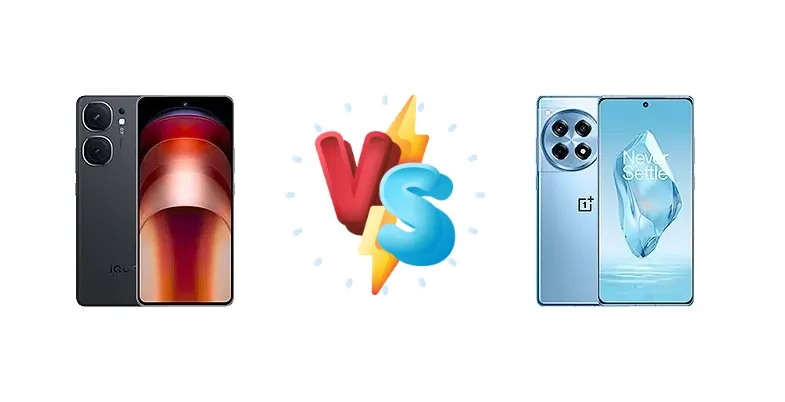
iQOO Neo9 vs OnePlus 12R: A Deep Dive into Performance and Value
| Phones Images | |||||
|---|---|---|---|---|---|
|
🏆 Quick Verdict
For users prioritizing the absolute fastest charging and a potentially more aggressive performance profile, the iQOO Neo9 is the winner. However, the OnePlus 12R counters with a demonstrably longer battery life in active use, making it the better choice for those who value endurance over peak charging speed.
| PHONES | ||
|---|---|---|
| Phone Names | vivo iQOO Neo9 | OnePlus 12R |
| Network | ||
|---|---|---|
| 2G bands | GSM 850 / 900 / 1800 / 1900 | GSM 850 / 900 / 1800 / 1900 |
| 3G bands | HSDPA 850 / 900 / 1700(AWS) / 1900 / 2100 | HSDPA 850 / 900 / 1700(AWS) / 1900 / 2100 |
| 4G bands | 1, 3, 4, 5, 7, 8, 18, 19, 26, 28, 34, 38, 39, 40, 41 | 1, 2, 3, 4, 5, 7, 8, 12, 17, 18, 19, 20, 26, 28, 32, 38, 39, 40, 41, 66 |
| 5G bands | 1, 3, 5, 8, 28, 38, 40, 41, 77, 78 SA/NSA | 1, 2, 3, 5, 7, 8, 12, 20, 28, 38, 40, 41, 66, 77, 78 SA/NSA |
| Speed | HSPA, LTE, 5G | HSPA, LTE, 5G |
| Technology | GSM / CDMA / HSPA / CDMA2000 / LTE / 5G | GSM / CDMA / HSPA / LTE / 5G |
| Launch | ||
|---|---|---|
| Announced | 2023, December 27 | 2024, January 23 |
| Status | Available. Released 2023, December 30 | Available. Released 2024, February 06 |
| Body | ||
|---|---|---|
| Build | - | Glass front (Gorilla Glass Victus 2), aluminum frame, glass back |
| Dimensions | 163.5 x 75.7 x 8 mm or 8.3 mm | 163.3 x 75.3 x 8.8 mm (6.43 x 2.96 x 0.35 in) |
| SIM | Nano-SIM + Nano-SIM | · Nano-SIM + Nano-SIM + eSIM (max 2 at a time)· Nano-SIM + Nano-SIM |
| Weight | 190 g or 196 g (6.70 oz) | 207 g (7.30 oz) |
| Display | ||
|---|---|---|
| Protection | - | Corning Gorilla Glass Victus 2 |
| Resolution | 1260 x 2800 pixels, 20:9 ratio (~453 ppi density) | 1264 x 2780 pixels (~450 ppi density) |
| Size | 6.78 inches, 111.0 cm2 (~89.7% screen-to-body ratio) | 6.78 inches, 111.7 cm2 (~90.9% screen-to-body ratio) |
| Type | LTPO AMOLED, 1B colors, 144Hz, HDR10+, 1400 nits (HBM) | LTPO4 AMOLED, 1B colors, 120Hz, HDR10+, Dolby Vision, 1600 nits (HBM), 4500 nits (peak) |
| Platform | ||
|---|---|---|
| CPU | Octa-core (1x3.2 GHz Cortex-X3 & 2x2.8 GHz Cortex-A715 & 2x2.8 GHz Cortex-A710 & 3x2.0 GHz Cortex-A510) | Octa-core (1x3.2 GHz Cortex-X3 & 2x2.8 GHz Cortex-A715 & 2x2.8 GHz Cortex-A710 & 3x2.0 GHz Cortex-A510) |
| Chipset | Qualcomm SM8550-AB Snapdragon 8 Gen 2 (4 nm) | Qualcomm SM8550-AB Snapdragon 8 Gen 2 (4 nm) |
| GPU | Adreno 740 | Adreno 740 |
| OS | Android 14, OriginOS 4 | Android 14, up to 3 major Android upgrades, OxygenOS 15 |
| Memory | ||
|---|---|---|
| Card slot | No | No |
| Internal | 256GB 12GB RAM, 256GB 16GB RAM, 512GB 16GB RAM, 1TB 16GB RAM | 128GB 8GB RAM, 256GB 8GB RAM, 256GB 12GB RAM, 256GB 16GB RAM |
| Main Camera | ||
|---|---|---|
| Dual | 50 MP, f/1.9, (wide), 1/1.49", PDAF, OIS 8 MP, f/2.2, 119˚ (ultrawide) | - |
| Features | LED flash, panorama, HDR | Laser AF, color spectrum sensor, LED flash, HDR, panorama |
| Triple | - | 50 MP, f/1.8, 24mm (wide), 1/1.56", 1.0µm, multi-directional PDAF, OIS 8 MP, f/2.2, 16mm, 112˚ (ultrawide), 1/4.0", 1.12µm 2 MP (macro) |
| Video | 8K, 4K, 1080p, gyro-EIS | 4K@30/60fps, 1080p@30/60/120/240fps, gyro-EIS, OIS |
| Selfie camera | ||
|---|---|---|
| Features | - | HDR, panorama |
| Single | 16 MP, f/2.5, (wide) | 16 MP, f/2.4, 26mm (wide), 1/3", 1.0µm |
| Video | 1080p@30fps | 1080p@30fps, gyro-EIS |
| Sound | ||
|---|---|---|
| 35mm jack | No | No |
| Loudspeaker | Yes, with stereo speakers (closed type) | Yes, with stereo speakers |
| Comms | ||
|---|---|---|
| Bluetooth | 5.3, A2DP, LE, aptX HD, aptX Adaptive, aptX Lossless | 5.3, A2DP, LE, aptX HD |
| Infrared port | Yes | Yes |
| NFC | Yes | Yes |
| Positioning | GPS, GALILEO, GLONASS, QZSS, BDS (B1I+B1c) | GPS, GALILEO, GLONASS, BDS, QZSS |
| Radio | No | No |
| USB | USB Type-C 2.0, OTG | USB Type-C 2.0 |
| WLAN | Wi-Fi 802.11 a/b/g/n/ac/6/7, dual-band, Wi-Fi Direct | Wi-Fi 802.11 a/b/g/n/ac/6/7, dual-band |
| Features | ||
|---|---|---|
| Sensors | Fingerprint (under display, optical), accelerometer, gyro, proximity, compass | Fingerprint (under display, optical), accelerometer, gyro, proximity, compass |
| Battery | ||
|---|---|---|
| Charging | 120W wired, 40% in 9 min Reverse wired | 100W wired, 100% in 26 min |
| Type | 5160 mAh | Li-Ion 5500 mAh |
| Misc | ||
|---|---|---|
| Colors | Black, Blue, Red | Iron Gray, Cool Blue, Electric Violet, Sunset Dune |
| Models | V2338A | CPH2609, CPH2585, CPH2611 |
| Price | About 290 EUR | € 410.84 / $ 399.95 / £ 649.00 |
| SAR | - | 1.19 W/kg (head) 0.82 W/kg (body) |
vivo iQOO Neo9
- Ultra-fast 120W charging for minimal downtime
- Powered by the Snapdragon 8 Gen 2 for flagship performance
- Potentially more aggressive performance tuning
- Battery life data is unavailable, potentially shorter than the OnePlus 12R
- Thermal management is unknown, potential for throttling
OnePlus 12R
- Excellent battery life with 14:32h of active use
- Bright 1181 nit display for good outdoor visibility
- Fast 100W charging provides a good balance of speed and convenience
- Charging speed is slower than the iQOO Neo9
- May lack the iQOO Neo9's aggressive performance profile
Display Comparison
While both phones likely utilize AMOLED panels (data not provided), the OnePlus 12R boasts a measured peak brightness of 1181 nits. This suggests a superior outdoor visibility experience compared to the iQOO Neo9, where brightness data is absent. The absence of LTPO information for either device implies both may not dynamically adjust refresh rates for optimal power saving, though this is speculative. Bezels and color accuracy are unknown, but given the price point, we expect similar performance in these areas.
Camera Comparison
Camera details are sparse. Without sensor size, aperture, or OIS information, a direct comparison is difficult. We can assume both phones will feature multi-camera systems, but the quality will heavily depend on image processing algorithms and sensor capabilities. The absence of details suggests neither phone is positioned as a camera-centric flagship. Any 2MP macro lenses included would likely offer limited practical benefit.
Performance
Both the iQOO Neo9 and OnePlus 12R are powered by the Qualcomm SM8550-AB Snapdragon 8 Gen 2 (4 nm) chipset, featuring the same Octa-core CPU configuration (1x3.2 GHz Cortex-X3, 2x2.8 GHz Cortex-A715, 2x2.8 GHz Cortex-A710, and 3x2.0 GHz Cortex-A510). This means raw processing power will be nearly identical. However, thermal management – a critical factor for sustained performance – is unknown for the iQOO Neo9. The 4nm process node of the Snapdragon 8 Gen 2 inherently offers better thermal efficiency than older nodes, but the iQOO Neo9’s aggressive charging and potential for higher sustained clock speeds could lead to more throttling under heavy load. RAM specifications are missing, but LPDDR5x is expected on both.
Battery Life
The OnePlus 12R shines with an active use score of 14:32h, indicating excellent battery endurance. The iQOO Neo9, while featuring incredibly fast 120W wired charging (40% in 9 minutes), lacks a comparable battery life figure. The OnePlus 12R’s 100W charging (100% in 26 minutes) is still very fast, but the iQOO Neo9’s speed is significantly higher. This trade-off is central to the decision: prioritize speed with the iQOO Neo9, or longevity with the OnePlus 12R.
Buying Guide
Buy the vivo iQOO Neo9 if you need blazing-fast 120W charging and are comfortable with potentially more frequent charging cycles. This phone is ideal for power users and gamers who demand immediate top-ups. Buy the OnePlus 12R if you prefer all-day battery life and a more balanced approach to performance and efficiency. It’s the better option for everyday users who prioritize longevity and don’t want to be tethered to a charger.