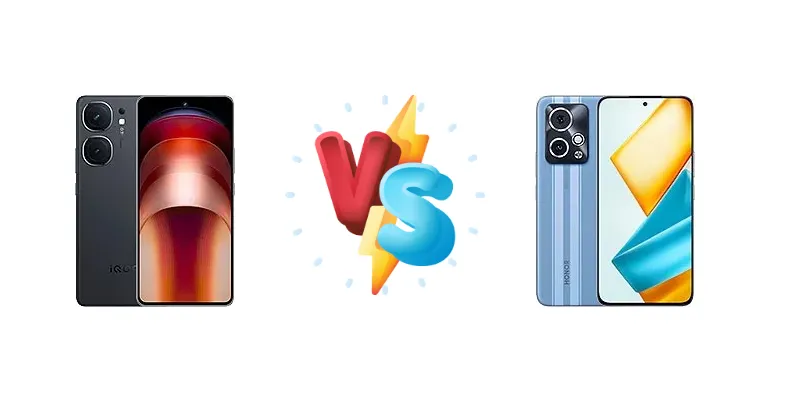
The iQOO Neo9 and Honor 90 GT represent a fascinating intersection in the Android market: both are aggressively priced devices built around Qualcomm’s flagship Snapdragon 8 Gen 2 chipset. This comparison isn’t about raw power – they’re nearly identical in that regard – but about how each manufacturer leverages that power, particularly in areas like charging speed, thermal management, and overall user experience. We’ll dissect the nuances to help you choose the right device.
🏆 Quick Verdict
For the average user prioritizing the fastest possible charging and potentially slightly better sustained performance, the iQOO Neo9 emerges as the winner. Its 120W charging significantly reduces downtime, and while both phones share the same chipset, iQOO’s thermal solutions may offer a slight edge in prolonged gaming sessions. However, the Honor 90 GT remains a compelling option, especially if its design or software appeals more.
| Network |
|---|
| 2G bands | GSM 850 / 900 / 1800 / 1900 | GSM 850 / 900 / 1800 / 1900 |
| 3G bands | HSDPA 850 / 900 / 1700(AWS) / 1900 / 2100 | HSDPA 800 / 850 / 900 / 1700(AWS) / 1900 / 2100 |
| 4G bands | 1, 3, 4, 5, 7, 8, 18, 19, 26, 28, 34, 38, 39, 40, 41 | LTE |
| 5G bands | 1, 3, 5, 8, 28, 38, 40, 41, 77, 78 SA/NSA | SA/NSA |
| Speed | HSPA, LTE, 5G | HSPA, LTE, 5G |
| Technology | GSM / CDMA / HSPA / CDMA2000 / LTE / 5G | GSM / CDMA / HSPA / CDMA2000 / LTE / 5G |
| Launch |
|---|
| Announced | 2023, December 27 | 2023, December 21 |
| Status | Available. Released 2023, December 30 | Available. Released 2023, December 21 |
| Body |
|---|
| Dimensions | 163.5 x 75.7 x 8 mm or 8.3 mm | 161 x 74.2 x 7.9 mm (6.34 x 2.92 x 0.31 in) |
| SIM | Nano-SIM + Nano-SIM | Nano-SIM + Nano-SIM |
| Weight | 190 g or 196 g (6.70 oz) | 185 g (6.53 oz) |
| Display |
|---|
| Resolution | 1260 x 2800 pixels, 20:9 ratio (~453 ppi density) | 1200 x 2664 pixels (~436 ppi density) |
| Size | 6.78 inches, 111.0 cm2 (~89.7% screen-to-body ratio) | 6.7 inches, 108.5 cm2 (~90.8% screen-to-body ratio) |
| Type | LTPO AMOLED, 1B colors, 144Hz, HDR10+, 1400 nits (HBM) | AMOLED, 1B colors, 120Hz, HDR, 2600 nits (peak) |
| Platform |
|---|
| CPU | Octa-core (1x3.2 GHz Cortex-X3 & 2x2.8 GHz Cortex-A715 & 2x2.8 GHz Cortex-A710 & 3x2.0 GHz Cortex-A510) | Octa-core (1x3.2 GHz Cortex-X3 & 2x2.8 GHz Cortex-A715 & 2x2.8 GHz Cortex-A710 & 3x2.0 GHz Cortex-A510) |
| Chipset | Qualcomm SM8550-AB Snapdragon 8 Gen 2 (4 nm) | Qualcomm SM8550-AB Snapdragon 8 Gen 2 (4 nm) |
| GPU | Adreno 740 | Adreno 740 |
| OS | Android 14, OriginOS 4 | Android 13, MagicOS 7.2 |
| Memory |
|---|
| Card slot | No | No |
| Internal | 256GB 12GB RAM, 256GB 16GB RAM, 512GB 16GB RAM, 1TB 16GB RAM | 256GB 12GB RAM, 256GB 16GB RAM, 512GB 16GB RAM, 1TB 24GB RAM |
| Main Camera |
|---|
| Dual | 50 MP, f/1.9, (wide), 1/1.49", PDAF, OIS
8 MP, f/2.2, 119˚ (ultrawide) | 50 MP, f/2, (wide), 1/1.56", 1.0µm, PDAF, OIS
12 MP, f/2.2, 112˚ (ultrawide), AF |
| Features | LED flash, panorama, HDR | LED flash, HDR, panorama |
| Video | 8K, 4K, 1080p, gyro-EIS | 4K@30fps, 1080p@30/60fps, gyro-EIS, OIS |
| Selfie camera |
|---|
| Features | - | HDR |
| Single | 16 MP, f/2.5, (wide) | 16 MP, f/2.4 |
| Video | 1080p@30fps | 1080p@30fps, gyro-EIS |
| Sound |
|---|
| 35mm jack | No | No |
| Loudspeaker | Yes, with stereo speakers (closed type) | Yes, with stereo speakers |
| Comms |
|---|
| Bluetooth | 5.3, A2DP, LE, aptX HD, aptX Adaptive, aptX Lossless | 5.3, A2DP, LE, aptX HD |
| Infrared port | Yes | Yes |
| NFC | Yes | Yes |
| Positioning | GPS, GALILEO, GLONASS, QZSS, BDS (B1I+B1c) | GPS, GALILEO, GLONASS, BDS (B1I+B1c) |
| Radio | No | No |
| USB | USB Type-C 2.0, OTG | USB Type-C 2.0, OTG |
| WLAN | Wi-Fi 802.11 a/b/g/n/ac/6/7, dual-band, Wi-Fi Direct | Wi-Fi 802.11 a/b/g/n/ac/6, dual-band, Wi-Fi Direct |
| Features |
|---|
| Sensors | Fingerprint (under display, optical), accelerometer, gyro, proximity, compass | Fingerprint (under display, optical), accelerometer, gyro, compass, ultrasound proximity |
| Battery |
|---|
| Charging | 120W wired, 40% in 9 min
Reverse wired | 100W wired, 3-100% in 32 min
5W reverse wired |
| Type | 5160 mAh | Li-Po 5000 mAh |
| Misc |
|---|
| Colors | Black, Blue, Red | Black, Blue, Gold |
| Models | V2338A | MAG-AN00 |
| Price | About 290 EUR | About 330 EUR |
vivo iQOO Neo9
- Significantly faster 120W charging
- Potentially better sustained performance due to aggressive cooling
- Streamlined, performance-focused software (typical of iQOO)
- Design may be less refined than the Honor 90 GT
- Software experience may be less feature-rich than Honor's MagicOS
Honor 90 GT
- Potentially more polished software experience (Honor MagicOS)
- Aesthetically pleasing design (based on Honor's brand reputation)
- 5W reverse wireless charging
- Slower 100W charging
- Potentially more thermal throttling under sustained load
- May prioritize aesthetics over raw performance
Display Comparison
Both devices are expected to feature high-refresh-rate AMOLED displays, though specific details like peak brightness and color accuracy are not provided. The absence of LTPO information suggests both may not dynamically adjust refresh rates for optimal power efficiency. Bezels are likely similar given the competitive market segment. The display experience will likely hinge on software calibration and color profile preferences, areas where Honor historically excels.
Camera Comparison
Without detailed camera specifications, a direct comparison is difficult. Both phones will likely feature multi-camera systems, but the quality will depend on sensor size, lens apertures, and image processing algorithms. The absence of information suggests neither phone is aiming for top-tier camera performance, focusing instead on value. We can expect a primary sensor, an ultrawide, and potentially a macro lens (though the usefulness of 2MP macro lenses is questionable). Image processing style will likely differentiate the two, with Honor potentially leaning towards more vibrant, saturated colors.
Performance
The core of both phones is the Qualcomm SM8550-AB Snapdragon 8 Gen 2 (4nm). This means identical CPU configurations: 1x3.2 GHz Cortex-X3, 2x2.8 GHz Cortex-A715, 2x2.8 GHz Cortex-A710, and 3x2.0 GHz Cortex-A510. Performance will be virtually indistinguishable in short bursts. However, sustained performance is where differences may emerge. The 4nm process node is efficient, but thermal management is crucial. iQOO’s Neo line often prioritizes aggressive cooling, potentially allowing the Snapdragon 8 Gen 2 to maintain peak clocks for longer periods. RAM type (likely LPDDR5X) is also expected to be similar, minimizing memory-related bottlenecks.
Battery Life
The iQOO Neo9 boasts 120W wired charging, capable of adding 40% charge in just 9 minutes. The Honor 90 GT offers 100W wired charging, taking 32 minutes for a full 0-100% charge. This is a significant difference in charging speed. While the Honor 90 GT offers 5W reverse wired charging, the iQOO Neo9 also supports reverse wired charging, though the wattage isn't specified. The actual battery capacity isn't provided, but the faster charging of the iQOO Neo9 mitigates the impact of a potentially smaller battery, offering less downtime.
Buying Guide
Buy the vivo iQOO Neo9 if you need the absolute fastest charging speeds available, frequently engage in extended gaming sessions, and prioritize a streamlined, performance-focused experience. Buy the Honor 90 GT if you prefer a potentially more refined software experience (based on Honor’s brand history), appreciate a different aesthetic, and don’t mind a slightly slower charging speed in exchange for potential software features or design preferences.
Frequently Asked Questions
❓ Will the iQOO Neo9's 120W charging degrade the battery faster than the Honor 90 GT's 100W charging?
While faster charging generates more heat, modern smartphones employ sophisticated battery management systems to mitigate degradation. The iQOO Neo9's charging circuitry is designed to protect the battery, and the difference in degradation, if any, is likely to be minimal over the typical lifespan of the device. The convenience of faster charging often outweighs the theoretical risk of slightly accelerated degradation.
❓ Does either phone support high frame rate gaming (90fps or 120fps) in demanding titles like PUBG Mobile or Genshin Impact?
Both phones, powered by the Snapdragon 8 Gen 2, are capable of running demanding games at high frame rates. However, achieving consistently high frame rates will depend on the game's optimization and the phone's thermal management. The iQOO Neo9's potentially superior cooling system may allow it to maintain higher frame rates for longer periods during extended gaming sessions.
❓ How does Honor's MagicOS compare to iQOO's UI in terms of bloatware and customization options?
Honor's MagicOS has historically been praised for its clean interface and relatively minimal bloatware, offering a user experience closer to stock Android. iQOO's UI, while functional, often includes more pre-installed apps and a more customized aesthetic. The preference here is subjective, but users seeking a cleaner experience may prefer MagicOS.