
iQOO Neo9 Pro vs ZTE nubia Z60 Ultra: A Head-to-Head Performance and Battery Showdown
| Phones Images | |||||
|---|---|---|---|---|---|
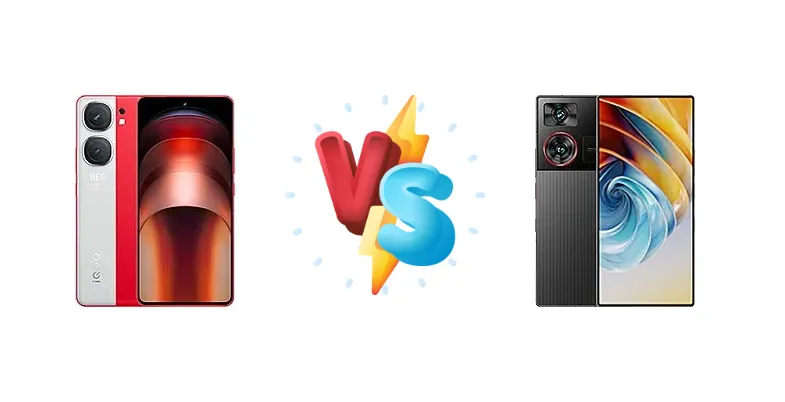
|
🏆 Quick Verdict
For the average user prioritizing sustained performance and battery longevity, the ZTE nubia Z60 Ultra emerges as the stronger contender. Its Snapdragon 8 Gen 3, coupled with a remarkable 14:04-hour active use battery score, provides a more consistent experience than the iQOO Neo9 Pro’s potentially throttling Dimensity 9300, despite the latter’s faster 120W charging.
| PHONES | ||
|---|---|---|
| Phone Names | vivo iQOO Neo9 Pro (China) | ZTE nubia Z60 Ultra Leading |
| Network | ||
|---|---|---|
| 2G bands | GSM 850 / 900 / 1800 / 1900 | GSM 850 / 900 / 1800 / 1900 |
| 3G bands | HSDPA 850 / 900 / 1700(AWS) / 1900 / 2100 | HSDPA 850 / 900 / 1700(AWS) / 1900 / 2100 |
| 4G bands | 1, 3, 4, 5, 7, 8, 19, 28, 34, 38, 39, 40, 41 | 1, 2, 3, 4, 5, 7, 8, 12, 17, 18, 19, 20, 26, 28, 34, 38, 39, 40, 41, 66 - International |
| 5G bands | 1, 3, 5, 8, 28, 38, 40, 41, 77, 78 SA/NSA | 1, 2, 3, 5, 7, 8, 28, 38, 40, 41, 66, 77, 78 SA/NSA - International |
| Speed | HSPA, LTE, 5G | HSPA, LTE, 5G |
| Technology | GSM / CDMA / HSPA / CDMA2000 / LTE / 5G | GSM / CDMA / HSPA / CDMA2000 / LTE / 5G |
| Launch | ||
|---|---|---|
| Announced | 2023, December 27 | 2024, July 23 |
| Status | Available. Released 2023, December 30 | Available. Released 2024, August 12 |
| Body | ||
|---|---|---|
| Build | - | Glass front, aluminum frame, glass back |
| Dimensions | 163.5 x 75.7 x 8 mm or 8.3 mm | 164 x 76.4 x 8.8 mm (6.46 x 3.01 x 0.35 in) |
| SIM | Nano-SIM + Nano-SIM | Nano-SIM + Nano-SIM |
| Weight | 190 g or 196 g (6.70 oz) | 246 g (8.68 oz) |
| Display | ||
|---|---|---|
| Resolution | 1260 x 2800 pixels, 20:9 ratio (~453 ppi density) | 1116 x 2480 pixels, 20:9 ratio (~400 ppi density) |
| Size | 6.78 inches, 111.0 cm2 (~89.7% screen-to-body ratio) | 6.8 inches, 111.6 cm2 (~89.1% screen-to-body ratio) |
| Type | LTPO AMOLED, 1B colors, 144Hz, HDR10+, 1400 nits (HBM) | AMOLED, 1B colors, 120Hz, HDR10, 1500 nits (peak) |
| Platform | ||
|---|---|---|
| CPU | Octa-core (1x3.25 GHz Cortex-X4 & 3x2.85 GHz Cortex-X4 & 4x2.0 GHz Cortex-A720) | Octa-core (1x3.4 GHz Cortex-X4 & 3x3.2 GHz Cortex-A720 & 2x3.0 GHz Cortex-A720 & 2x2.3 GHz Cortex-A520) |
| Chipset | Mediatek Dimensity 9300 (4 nm) | Qualcomm SM8650-AC Snapdragon 8 Gen 3 (4 nm) |
| GPU | Immortalis-G720 MC12 | Adreno 750 (1 GHz) |
| OS | Android 14, OriginOS 4 | Android 14, MyOS 14 (International), MyOS 14.5 (China) |
| Memory | ||
|---|---|---|
| Card slot | No | No |
| Internal | 256GB 12GB RAM, 512GB 12GB RAM, 512GB 16GB RAM, 1TB 16GB RAM | 256GB 8GB RAM, 256GB 12GB RAM, 512GB 16GB RAM, 1TB 16GB RAM, 1TB 24GB RAM |
| Main Camera | ||
|---|---|---|
| Dual | 50 MP, f/1.9, (wide), 1/1.49", PDAF, OIS 50 MP, f/2.0, 119˚ (ultrawide), 1/2.76", 0.64µm, AF | - |
| Features | LED flash, panorama, HDR | Laser AF, color spectrum sensor, Ring-LED, dual-tone flash, panorama, HDR |
| Triple | - | 50 MP, f/1.6, 35mm (standard), 1/1.56", 1.0µm, PDAF, OIS 64 MP, f/3.3, 85mm (periscope telephoto), 1/2.0", PDAF, OIS, 3.3x optical zoom (vs. 26mm cam) 50 MP, f/1.8, 18mm, 100˚ (ultrawide), 1/1.55", 1.0µm, PDAF, OIS |
| Video | 8K, 4K, 1080p, gyro-EIS | 8K@30fps, 4K@30/60/120fps, 1080p@30/60fps, gyro-EIS, HDR10, 10‑bit video |
| Selfie camera | ||
|---|---|---|
| Features | - | HDR |
| Single | 16 MP, f/2.5, (wide) | 12 MP, under display |
| Video | 1080p@30fps | 1080p@30fps |
| Sound | ||
|---|---|---|
| 35mm jack | No | No |
| Loudspeaker | Yes, with stereo speakers (closed type) | Yes, with stereo speakers |
| Comms | ||
|---|---|---|
| Bluetooth | 5.4, A2DP, LE, aptX HD, aptX Adaptive | 5.4, A2DP, LE, aptX HD, aptX Adaptive, aptX Lossless |
| Infrared port | Yes | Yes |
| NFC | Yes | Yes (market/region dependent) |
| Positioning | GPS (L1+L5), GLONASS, BDS (B1I+B1c+B2a+B2b), GALILEO (E1+E5a+E5b), QZSS (L1+L5), NavIC (L5) | GPS (L1+L2+L5), GLONASS (G1+G5), BDS (B1I+B1C+B2a+B2b), GALILEO (E1+E5a), QZSS (L1+L5) |
| Radio | No | No |
| USB | USB Type-C 2.0, OTG | USB Type-C 3.1, OTG |
| WLAN | Wi-Fi 802.11 a/b/g/n/ac/6/7, dual-band | Wi-Fi 802.11 a/b/g/n/ac/6e/7, dual-band, Wi-Fi Direct |
| Features | ||
|---|---|---|
| Sensors | Fingerprint (under display, optical), accelerometer, gyro, proximity, compass | Fingerprint (under display, optical), accelerometer, gyro, proximity, compass |
| Battery | ||
|---|---|---|
| Charging | 120W wired, 40% in 9 min Reverse wired | 80W wired, PD3.0, QC4 |
| Type | 5160 mAh | Li-Po 6000 mAh |
| Misc | ||
|---|---|---|
| Colors | Black, Blue, Red | Black, Silver |
| Models | V2339A | - |
| Price | About 380 EUR | About 730 EUR |
vivo iQOO Neo9 Pro (China)
- Faster 120W wired charging
- Potentially higher peak CPU performance
- MediaTek Dimensity 9300 offers cutting-edge features
- Potential for thermal throttling under sustained load
- Likely shorter battery life compared to the nubia
- Dimensity 9300 may not be as optimized as Snapdragon
ZTE nubia Z60 Ultra Leading
- Superior battery life (14:04h active use)
- More efficient Snapdragon 8 Gen 3 chipset
- Better sustained performance due to thermal management
- Slower 80W wired charging
- Potentially lower peak CPU performance
- May lack some of the newest MediaTek features
Display Comparison
Display specifications are absent from the provided data, but given the flagship positioning, both devices likely feature high-refresh-rate AMOLED panels. However, the nubia Z60 Ultra’s focus on multimedia consumption, suggested by its battery life, hints at a potentially brighter panel for better outdoor visibility. The iQOO Neo9 Pro, geared towards gaming, may prioritize a lower response time for smoother visuals. Without specific data, it’s difficult to definitively declare a winner, but the nubia’s battery performance suggests a display optimized for extended viewing.
Camera Comparison
Camera details are missing, but both brands have a history of incorporating capable camera systems in their flagships. The absence of sensor size information makes a direct comparison impossible. However, the nubia Z60 Ultra’s emphasis on overall user experience suggests a more refined image processing pipeline, potentially prioritizing natural colors and dynamic range. The iQOO Neo9 Pro, often targeting a younger audience, might lean towards more vibrant, social media-friendly image profiles. Without further data, it’s reasonable to assume both phones offer competitive camera performance, but the nubia’s overall focus on user experience could translate to a more polished camera experience.
Performance
The core difference lies in the chipsets. The nubia Z60 Ultra’s Snapdragon 8 Gen 3 (4nm) boasts a 3.4 GHz Cortex-X4 prime core, slightly exceeding the iQOO Neo9 Pro’s Dimensity 9300’s 3.25 GHz Cortex-X4. While the Dimensity 9300 features three X4 cores versus the Snapdragon’s one, the Snapdragon’s architecture and thermal efficiency are generally superior. The Dimensity 9300, while powerful, is known to generate more heat under sustained load, potentially leading to throttling. The Snapdragon 8 Gen 3’s more efficient 4nm process mitigates this risk, ensuring more consistent performance during extended gaming sessions. The nubia also benefits from a more balanced core configuration, with two mid-cores clocked at 3.0 GHz, providing sustained performance.
Battery Life
The nubia Z60 Ultra’s 14:04-hour active use score is a significant advantage. This demonstrates superior battery optimization and efficiency. While the iQOO Neo9 Pro’s 120W wired charging is faster than the nubia’s 80W, the difference in charging speed is less impactful than the substantial difference in battery life. The iQOO Neo9 Pro can reach 40% charge in 9 minutes, but the nubia Z60 Ultra’s longer runtime reduces the need for frequent top-ups. The Snapdragon 8 Gen 3’s efficiency directly contributes to the nubia’s impressive battery performance.
Buying Guide
Buy the vivo iQOO Neo9 Pro (China) if you absolutely need the fastest possible CPU performance for short bursts, and 120W charging is a priority. You’re willing to trade some sustained performance and battery life for peak speed. Buy the ZTE nubia Z60 Ultra Leading if you prioritize all-day battery life, consistent gaming performance, and a more refined thermal profile. It’s the better choice for power users and mobile gamers who demand reliability.