
iQOO Neo9 Pro vs Redmi K70 Pro: A Deep Dive into China's Flagship Face-Off
| Phones Images | |||||
|---|---|---|---|---|---|
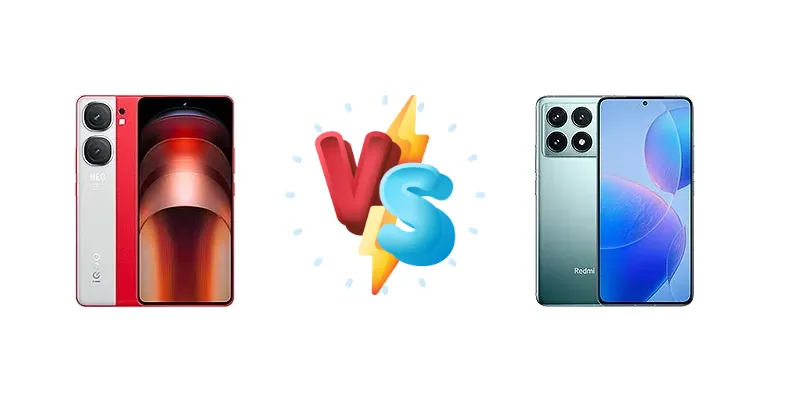
|
🏆 Quick Verdict
For the average user prioritizing raw processing power and sustained performance, the Xiaomi Redmi K70 Pro edges out the iQOO Neo9 Pro thanks to the Snapdragon 8 Gen 3's superior thermal management and slightly more refined CPU architecture. However, the iQOO Neo9 Pro offers a compelling alternative with its equally impressive chipset and blazing-fast 120W charging.
| PHONES | ||
|---|---|---|
| Phone Names | vivo iQOO Neo9 Pro (China) | Xiaomi Redmi K70 Pro |
| Network | ||
|---|---|---|
| 2G bands | GSM 850 / 900 / 1800 / 1900 | GSM 850 / 900 / 1800 / 1900 |
| 3G bands | HSDPA 850 / 900 / 1700(AWS) / 1900 / 2100 | HSDPA 800 / 850 / 900 / 1700(AWS) / 2100 |
| 4G bands | 1, 3, 4, 5, 7, 8, 19, 28, 34, 38, 39, 40, 41 | 1, 3, 4, 5, 8, 18, 19, 26, 28, 34, 38, 39, 40, 41, 42, 48, 66 |
| 5G bands | 1, 3, 5, 8, 28, 38, 40, 41, 77, 78 SA/NSA | 1, 3, 5, 8, 28, 38, 41, 48, 66, 77, 78 SA/NSA |
| Speed | HSPA, LTE, 5G | HSPA, LTE, 5G |
| Technology | GSM / CDMA / HSPA / CDMA2000 / LTE / 5G | GSM / CDMA / HSPA / CDMA2000 / LTE / 5G |
| Launch | ||
|---|---|---|
| Announced | 2023, December 27 | 2023, November 29 |
| Status | Available. Released 2023, December 30 | Available. Released 2023, November 29 |
| Body | ||
|---|---|---|
| Dimensions | 163.5 x 75.7 x 8 mm or 8.3 mm | 160.9 x 75 x 8.2 mm (6.33 x 2.95 x 0.32 in) |
| SIM | Nano-SIM + Nano-SIM | Nano-SIM + Nano-SIM |
| Weight | 190 g or 196 g (6.70 oz) | 209 g (7.37 oz) |
| Display | ||
|---|---|---|
| Resolution | 1260 x 2800 pixels, 20:9 ratio (~453 ppi density) | 1440 x 3200 pixels, 20:9 ratio (~526 ppi density) |
| Size | 6.78 inches, 111.0 cm2 (~89.7% screen-to-body ratio) | 6.67 inches, 107.4 cm2 (~89.0% screen-to-body ratio) |
| Type | LTPO AMOLED, 1B colors, 144Hz, HDR10+, 1400 nits (HBM) | OLED, 68B colors, 120Hz, Dolby Vision, HDR10+, 4000 nits (peak) |
| Platform | ||
|---|---|---|
| CPU | Octa-core (1x3.25 GHz Cortex-X4 & 3x2.85 GHz Cortex-X4 & 4x2.0 GHz Cortex-A720) | Octa-core (1x3.3 GHz Cortex-X4 & 3x3.2 GHz Cortex-A720 & 2x3.0 GHz Cortex-A720 & 2x2.3 GHz Cortex-A520) |
| Chipset | Mediatek Dimensity 9300 (4 nm) | Qualcomm SM8650-AB Snapdragon 8 Gen 3 (4 nm) |
| GPU | Immortalis-G720 MC12 | Adreno 750 |
| OS | Android 14, OriginOS 4 | Android 14, HyperOS |
| Memory | ||
|---|---|---|
| Card slot | No | No |
| Internal | 256GB 12GB RAM, 512GB 12GB RAM, 512GB 16GB RAM, 1TB 16GB RAM | 256GB 12GB RAM, 256GB 16GB RAM, 512GB 12GB RAM, 512GB 16GB RAM, 1TB 24GB RAM |
| Main Camera | ||
|---|---|---|
| Dual | 50 MP, f/1.9, (wide), 1/1.49", PDAF, OIS 50 MP, f/2.0, 119˚ (ultrawide), 1/2.76", 0.64µm, AF | - |
| Features | LED flash, panorama, HDR | Color spectrum sensor, LED flash, HDR, panorama |
| Triple | - | 50 MP, f/1.6, (wide), 1/1.55", 1.0µm, PDAF, OIS 50 MP, (telephoto), PDAF, 2x optical zoom 12 MP, (ultrawide) |
| Video | 8K, 4K, 1080p, gyro-EIS | 8K@24fps, 4K@24/30/60fps, 1080p@30/60/120/240/960fps, 720p@1920fps, gyro-EIS |
| Selfie camera | ||
|---|---|---|
| Features | - | HDR |
| Single | 16 MP, f/2.5, (wide) | 16 MP, (wide) |
| Video | 1080p@30fps | 1080p@30/60fps, gyro-EIS |
| Sound | ||
|---|---|---|
| 35mm jack | No | No |
| Loudspeaker | Yes, with stereo speakers (closed type) | Yes, with stereo speakers |
| Comms | ||
|---|---|---|
| Bluetooth | 5.4, A2DP, LE, aptX HD, aptX Adaptive | 5.4, A2DP, LE, aptX HD, aptX Adaptive, aptX Lossless |
| Infrared port | Yes | Yes |
| NFC | Yes | Yes |
| Positioning | GPS (L1+L5), GLONASS, BDS (B1I+B1c+B2a+B2b), GALILEO (E1+E5a+E5b), QZSS (L1+L5), NavIC (L5) | GPS (L1+L5), GLONASS (G1), BDS (B1I+B1c+B2a), GALILEO (E1+E5a), QZSS (L1+L5), NavIC (L5) |
| Radio | No | No |
| USB | USB Type-C 2.0, OTG | USB Type-C, OTG |
| WLAN | Wi-Fi 802.11 a/b/g/n/ac/6/7, dual-band | Wi-Fi 802.11 a/b/g/n/ac/6e/7, dual-band, Wi-Fi Direct |
| Features | ||
|---|---|---|
| Sensors | Fingerprint (under display, optical), accelerometer, gyro, proximity, compass | Fingerprint (under display, optical), accelerometer, proximity, gyro, compass |
| Battery | ||
|---|---|---|
| Charging | 120W wired, 40% in 9 min Reverse wired | 120W wired, PD3.0, QC3+, 100% in 18 min |
| Type | 5160 mAh | Li-Po 5000 mAh |
| Misc | ||
|---|---|---|
| Colors | Black, Blue, Red | Black, Silver, Blue/Green, Lamborgini Green, Lamborgini Yellow |
| Models | V2339A | 23117RK66C |
| Price | About 380 EUR | About 430 EUR |
vivo iQOO Neo9 Pro (China)
- Blazing-fast 120W charging (40% in 9 mins)
- Powerful Mediatek Dimensity 9300 chipset
- Reverse wired charging capability
- China-specific software ecosystem
- Potential thermal throttling under sustained load
Xiaomi Redmi K70 Pro
- Qualcomm Snapdragon 8 Gen 3 for superior efficiency
- Potentially better long-term software support
- Optimized image processing with Qualcomm ISP
- Slower full charge time (18 mins)
- May be slightly more expensive
Display Comparison
While both devices are expected to feature high-refresh-rate AMOLED displays, specific details like peak brightness and panel technology (LTPO) are currently unavailable. However, given Xiaomi’s history with high-end displays, the Redmi K70 Pro likely boasts a slightly more color-accurate panel. Bezels are expected to be minimal on both, focusing on maximizing screen real estate. The absence of detailed display specs necessitates a wait-and-see approach for a definitive assessment.
Camera Comparison
Without detailed camera specifications, a direct comparison is challenging. However, both brands typically prioritize strong main sensors. The Redmi K70 Pro is likely to leverage Qualcomm’s image signal processor (ISP) for enhanced image processing, potentially delivering more natural-looking photos. The iQOO Neo9 Pro will rely on Mediatek’s ISP, which has improved significantly in recent generations. The absence of information regarding sensor size, OIS, and lens apertures prevents a conclusive assessment, but we anticipate both phones will offer competitive camera performance in their respective price brackets. We can safely assume both will downplay or omit the usefulness of any 2MP macro lenses.
Performance
The core battleground lies in the chipsets. The Redmi K70 Pro’s Snapdragon 8 Gen 3 (4nm) features a 1x3.3 GHz Cortex-X4 prime core, while the iQOO Neo9 Pro utilizes the Mediatek Dimensity 9300 (4nm) with a slightly higher clocked 1x3.25 GHz Cortex-X4. The Snapdragon 8 Gen 3’s architecture, with its 3x3.2 GHz Cortex-A720 cores and 2x3.0 GHz Cortex-A720 cores, offers a more balanced approach compared to the iQOO’s 3x2.85 GHz Cortex-X4 configuration. This translates to potentially better multi-core performance and sustained speeds under heavy load. Both utilize LPDDR5x RAM, but the Snapdragon’s integrated AI engine provides an edge in tasks like image processing and on-device machine learning. The Dimensity 9300’s raw CPU power is impressive, but the Snapdragon 8 Gen 3’s thermal efficiency is a key advantage for prolonged gaming sessions.
Battery Life
Both devices feature 120W wired charging, but the iQOO Neo9 Pro claims a 40% charge in just 9 minutes, while the Redmi K70 Pro takes 18 minutes for a full charge. This suggests the iQOO’s charging implementation is more efficient. While battery capacity remains undisclosed, the Redmi K70 Pro’s charging speed, combined with Qualcomm’s power management optimizations, likely mitigates any capacity disadvantage. The inclusion of reverse wired charging on the iQOO Neo9 Pro adds a convenient feature for topping up accessories.
Buying Guide
Buy the vivo iQOO Neo9 Pro (China) if you prioritize extremely fast charging – reaching 40% in just 9 minutes – and are comfortable with the China-specific software ecosystem. Buy the Xiaomi Redmi K70 Pro if you prefer a more globally-optimized experience, potentially better long-term software support, and a chipset known for its efficiency and gaming prowess.