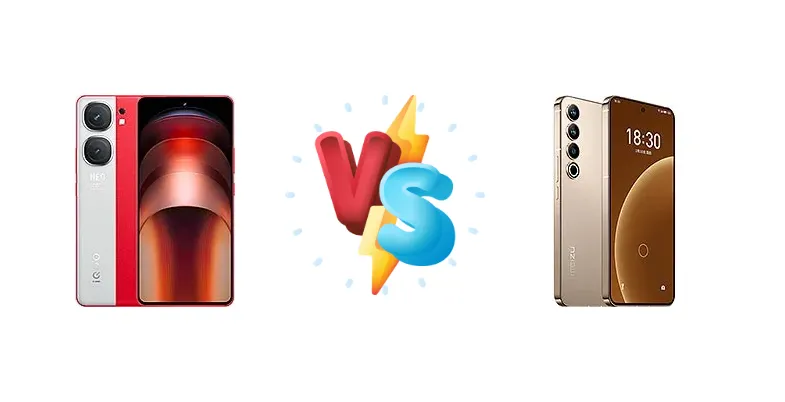
The iQOO Neo9 Pro and Meizu 20 Pro represent compelling options in the competitive flagship smartphone market, particularly for users seeking top-tier performance without the premium price tag of established brands. This comparison focuses on the core differences – the Mediatek Dimensity 9300 powering the iQOO Neo9 Pro versus the Qualcomm Snapdragon 8 Gen 2 in the Meizu 20 Pro – and how those translate into real-world user experience.
🏆 Quick Verdict
For the average user prioritizing raw processing power and incredibly fast charging, the iQOO Neo9 Pro emerges as the winner. Its Dimensity 9300 chipset delivers a performance edge, and the 120W charging significantly reduces downtime. However, the Meizu 20 Pro offers a more refined software experience and wireless charging.
| Network |
|---|
| 2G bands | GSM 850 / 900 / 1800 / 1900 | GSM 850 / 900 / 1800 / 1900 |
| 3G bands | HSDPA 850 / 900 / 1700(AWS) / 1900 / 2100 | HSDPA 850 / 900 / 1900 / 2100 |
| 4G bands | 1, 3, 4, 5, 7, 8, 19, 28, 34, 38, 39, 40, 41 | 1, 2, 3, 4, 5, 7, 8, 12, 28, 34, 38, 39, 40, 41 |
| 5G bands | 1, 3, 5, 8, 28, 38, 40, 41, 77, 78 SA/NSA | 1, 3, 5, 8, 28, 38, 41, 77, 78, 79 SA/NSA |
| Speed | HSPA, LTE, 5G | HSPA, LTE, 5G |
| Technology | GSM / CDMA / HSPA / CDMA2000 / LTE / 5G | GSM / HSPA / LTE / 5G |
| Launch |
|---|
| Announced | 2023, December 27 | 2023, March 30 |
| Status | Available. Released 2023, December 30 | Available. Released 2023, June 20 |
| Body |
|---|
| Dimensions | 163.5 x 75.7 x 8 mm or 8.3 mm | 164.2 x 76.4 x 7.8 mm (6.46 x 3.01 x 0.31 in) |
| SIM | Nano-SIM + Nano-SIM | Nano-SIM + Nano-SIM |
| Weight | 190 g or 196 g (6.70 oz) | 209 g (7.37 oz) |
| | - | IP54 |
| Display |
|---|
| Resolution | 1260 x 2800 pixels, 20:9 ratio (~453 ppi density) | 1440 x 3200 pixels, 20:9 ratio (~515 ppi density) |
| Size | 6.78 inches, 111.0 cm2 (~89.7% screen-to-body ratio) | 6.81 inches, 112.0 cm2 (~89.3% screen-to-body ratio) |
| Type | LTPO AMOLED, 1B colors, 144Hz, HDR10+, 1400 nits (HBM) | LTPO OLED, 120Hz, HDR10+, 500 nits (typ), 1800 nits (peak) |
| Platform |
|---|
| CPU | Octa-core (1x3.25 GHz Cortex-X4 & 3x2.85 GHz Cortex-X4 & 4x2.0 GHz Cortex-A720) | Octa-core (1x3.2 GHz Cortex-X3 & 2x2.8 GHz Cortex-A715 & 2x2.8 GHz Cortex-A710 & 3x2.0 GHz Cortex-A510) |
| Chipset | Mediatek Dimensity 9300 (4 nm) | Qualcomm SM8550-AB Snapdragon 8 Gen 2 (4 nm) |
| GPU | Immortalis-G720 MC12 | Adreno 740 |
| OS | Android 14, OriginOS 4 | Android 13, Flyme 10 |
| Memory |
|---|
| Card slot | No | No |
| Internal | 256GB 12GB RAM, 512GB 12GB RAM, 512GB 16GB RAM, 1TB 16GB RAM | 128GB 12GB RAM, 256GB 12GB RAM, 512GB 12GB RAM |
| | - | UFS 4.0 - 512GB |
| Main Camera |
|---|
| Dual | 50 MP, f/1.9, (wide), 1/1.49", PDAF, OIS
50 MP, f/2.0, 119˚ (ultrawide), 1/2.76", 0.64µm, AF | - |
| Features | LED flash, panorama, HDR | Ring-LED flash, panorama, HDR |
| Triple | - | 50 MP, f/1.9, (wide), PDAF, OIS
50 MP f/1.9, (telephoto), PDAF, 2x optical zoom
50 MP, f/2.2, 129˚ (ultrawide) |
| Video | 8K, 4K, 1080p, gyro-EIS | 8K, 4K, 1080p; gyro-EIS |
| Selfie camera |
|---|
| Features | - | HDR |
| Single | 16 MP, f/2.5, (wide) | 32 MP, f/2.5, (wide) |
| Video | 1080p@30fps | Yes |
| Sound |
|---|
| 3.5mm jack | - | No |
| 35mm jack | No | No |
| Loudspeaker | Yes, with stereo speakers (closed type) | Yes, with stereo speakers |
| Comms |
|---|
| Bluetooth | 5.4, A2DP, LE, aptX HD, aptX Adaptive | 5.3, A2DP, LE |
| Infrared port | Yes | Yes |
| NFC | Yes | Yes |
| Positioning | GPS (L1+L5), GLONASS, BDS (B1I+B1c+B2a+B2b), GALILEO (E1+E5a+E5b), QZSS (L1+L5), NavIC (L5) | GPS (L1+L5), GLONASS, BDS (B1I+B1c+B2a), GALILEO, QZSS |
| Radio | No | No |
| USB | USB Type-C 2.0, OTG | USB Type-C |
| WLAN | Wi-Fi 802.11 a/b/g/n/ac/6/7, dual-band | Wi-Fi 802.11 а/b/g/n/ac/6e/7, tri-band |
| Features |
|---|
| Sensors | Fingerprint (under display, optical), accelerometer, gyro, proximity, compass | Fingerprint (under display, ultrasonic), accelerometer, gyro, proximity, compass |
| Battery |
|---|
| Charging | 120W wired, 40% in 9 min
Reverse wired | 80W wired, PD3 PPS, QC4+
50W wireless |
| Type | 5160 mAh | Li-Po 5000 mAh |
| Misc |
|---|
| Colors | Black, Blue, Red | Gray, Gold, Silver |
| Models | V2339A | - |
| Price | About 380 EUR | About 530 EUR |
vivo iQOO Neo9 Pro (China)
- Significantly faster 120W wired charging
- Potentially superior CPU performance with Dimensity 9300
- Likely more aggressive pricing for comparable specs
- No wireless charging support
- Software experience may be less refined than Meizu
Meizu 20 Pro
- 50W wireless charging for added convenience
- Snapdragon 8 Gen 2 offers excellent all-around performance
- Potentially more polished software experience
- Slower 80W wired charging
- CPU performance likely trails the Dimensity 9300
Display Comparison
While both devices likely feature high-quality AMOLED panels (specific details are missing), the focus here is on performance. The absence of display specs necessitates a focus on the chipsets driving the UI. A smoother experience is expected on the iQOO Neo9 Pro due to the Dimensity 9300's superior CPU, potentially translating to faster app loading and more responsive animations. Bezels and color accuracy are unknown, but both brands typically deliver competitive displays in this segment.
Camera Comparison
Without detailed camera specifications, a direct comparison is limited. However, both phones likely feature multi-camera systems. The absence of sensor size information makes it difficult to assess image quality. The Meizu 20 Pro, given Meizu’s history, may prioritize color science and image processing for a more natural look, while iQOO often leans towards vibrant, social media-friendly images. The presence of OIS on the main sensor of either device would be a significant advantage for low-light photography and video stabilization.
Performance
The core battleground is the chipset. The iQOO Neo9 Pro’s Mediatek Dimensity 9300, built on a 4nm process, boasts a unique CPU configuration with a 1x3.25 GHz Cortex-X4 prime core, three 2.85 GHz Cortex-X4 performance cores, and four 2.0 GHz Cortex-A720 efficiency cores. This contrasts with the Meizu 20 Pro’s Snapdragon 8 Gen 2 (also 4nm) featuring a 1x3.2 GHz Cortex-X3, two 2.8 GHz Cortex-A715, two 2.8 GHz Cortex-A710, and three 2.0 GHz Cortex-A510 cores. The Dimensity 9300’s newer architecture and higher clock speeds suggest a performance advantage in CPU-intensive tasks. Both utilize LPDDR5x RAM, but thermal management will be crucial; the Dimensity 9300’s potential for higher peak performance could lead to more heat generation, requiring robust cooling solutions.
Battery Life
The iQOO Neo9 Pro’s 120W wired charging is a standout feature, capable of adding 40% charge in just 9 minutes. This is significantly faster than the Meizu 20 Pro’s 80W wired charging (supporting PD3 PPS and QC4+). The Meizu 20 Pro compensates with 50W wireless charging, a feature absent on the iQOO Neo9 Pro. While battery capacity isn’t specified, the faster charging of the iQOO Neo9 Pro mitigates the impact of a potentially smaller battery, offering quicker top-ups and reduced range anxiety.
Buying Guide
Buy the vivo iQOO Neo9 Pro (China) if you need uncompromising CPU performance for demanding tasks like gaming and video editing, and if minimizing charging time is a top priority. Buy the Meizu 20 Pro if you prefer a more polished software experience, value wireless charging convenience, and prioritize a balanced feature set over absolute peak performance.
Frequently Asked Questions
❓ Will the Dimensity 9300 in the iQOO Neo9 Pro overheat during extended gaming sessions?
The Dimensity 9300 is a powerful chip, and sustained peak performance can generate heat. iQOO typically employs robust cooling systems in their gaming-focused devices, but real-world thermal performance will depend on the specific implementation and game settings. Monitoring temperatures during gameplay is recommended.
❓ Does the Meizu 20 Pro support global ROMs and Google services?
Meizu phones historically have had limited global ROM support and potential compatibility issues with Google services. Users should verify the availability of a stable global ROM and Google Play Store access before purchasing, as it may require manual flashing or workarounds.
❓ How does the 80W charging on the Meizu 20 Pro compare to typical fast charging standards?
The Meizu 20 Pro's 80W charging, supporting PD3 PPS and QC4+, is still considered very fast, capable of fully charging a typical smartphone battery in around 30-45 minutes. While slower than the iQOO Neo9 Pro's 120W, it's significantly faster than standard 25W or 33W charging solutions.