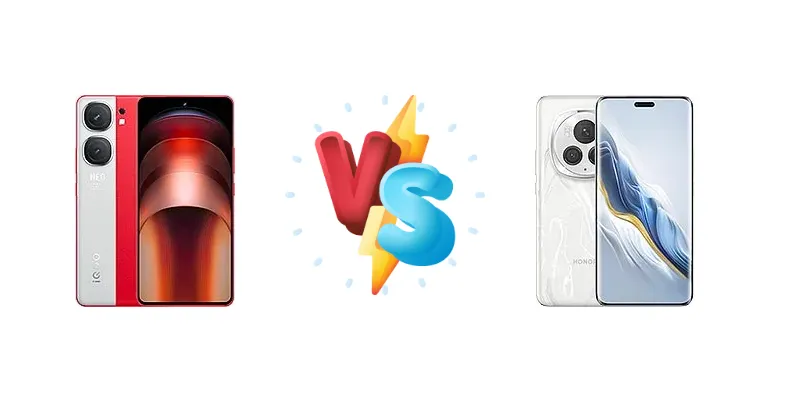
The Honor Magic6 Pro and vivo iQOO Neo9 Pro represent distinct approaches to the high-end smartphone market. The Magic6 Pro aims for a complete flagship experience with a focus on display and battery, while the iQOO Neo9 Pro prioritizes raw processing power and blazing-fast charging, positioning itself as a performance-focused alternative. This comparison dissects their key differences to help you choose the right device.
🏆 Quick Verdict
For the average user prioritizing all-around excellence, the Honor Magic6 Pro emerges as the winner. Its superior battery life, brighter display, and more balanced feature set outweigh the iQOO Neo9 Pro’s raw CPU performance advantage. However, gamers and power users will find the iQOO Neo9 Pro’s Dimensity 9300 a compelling choice.
| Network |
|---|
| 2G bands | GSM 850 / 900 / 1800 / 1900 | GSM 850 / 900 / 1800 / 1900 |
| 3G bands | HSDPA 850 / 900 / 1700(AWS) / 1900 / 2100 | HSDPA 800 / 850 / 900 / 1700(AWS) / 1900 / 2100 |
| 4G bands | 1, 3, 4, 5, 7, 8, 19, 28, 34, 38, 39, 40, 41 | LTE |
| 5G bands | 1, 3, 5, 8, 28, 38, 40, 41, 77, 78 SA/NSA | SA/NSA |
| Speed | HSPA, LTE, 5G | HSPA, LTE, 5G |
| Technology | GSM / CDMA / HSPA / CDMA2000 / LTE / 5G | GSM / CDMA / HSPA / CDMA2000 / LTE / 5G |
| Launch |
|---|
| Announced | 2023, December 27 | 2024, January 11 |
| Status | Available. Released 2023, December 30 | Available. Released 2024, January 18 |
| Body |
|---|
| Build | - | Glass front (NanoCrystal Shield), glass back or silicone polymer back (eco leather) |
| Dimensions | 163.5 x 75.7 x 8 mm or 8.3 mm | 162.5 x 75.8 x 8.9 mm (6.40 x 2.98 x 0.35 in) |
| SIM | Nano-SIM + Nano-SIM | · Nano-SIM + eSIM· Nano-SIM + Nano-SIM |
| Weight | 190 g or 196 g (6.70 oz) | 225 g or 229 g (7.94 oz) |
| Display |
|---|
| Protection | - | NanoCrystal Shield |
| Resolution | 1260 x 2800 pixels, 20:9 ratio (~453 ppi density) | 1280 x 2800 pixels, 19.5:9 ratio (~453 ppi density) |
| Size | 6.78 inches, 111.0 cm2 (~89.7% screen-to-body ratio) | 6.8 inches, 112.8 cm2 (~91.6% screen-to-body ratio) |
| Type | LTPO AMOLED, 1B colors, 144Hz, HDR10+, 1400 nits (HBM) | LTPO OLED, 1B colors, 120Hz, Dolby Vision, HDR, 1600 nits (HBM), 5000 nits (peak) |
| Platform |
|---|
| CPU | Octa-core (1x3.25 GHz Cortex-X4 & 3x2.85 GHz Cortex-X4 & 4x2.0 GHz Cortex-A720) | Octa-core (1x3.3 GHz Cortex-X4 & 3x3.2 GHz Cortex-A720 & 2x3.0 GHz Cortex-A720 & 2x2.3 GHz Cortex-A520) |
| Chipset | Mediatek Dimensity 9300 (4 nm) | Qualcomm SM8650-AB Snapdragon 8 Gen 3 (4 nm) |
| GPU | Immortalis-G720 MC12 | Adreno 750 |
| OS | Android 14, OriginOS 4 | Android 14, up to 4 major Android upgrades, MagicOS 8 |
| Memory |
|---|
| Card slot | No | No |
| Internal | 256GB 12GB RAM, 512GB 12GB RAM, 512GB 16GB RAM, 1TB 16GB RAM | 256GB 12GB RAM, 256GB 16GB RAM, 512GB 12GB RAM, 512GB 16GB RAM, 1TB 16GB RAM |
| Main Camera |
|---|
| Dual | 50 MP, f/1.9, (wide), 1/1.49", PDAF, OIS
50 MP, f/2.0, 119˚ (ultrawide), 1/2.76", 0.64µm, AF | - |
| Features | LED flash, panorama, HDR | Laser AF, color spectrum sensor, LED flash, HDR, panorama |
| Triple | - | 50 MP, f/1.4-2.0, 23mm (wide), 1/1.3", 1.2µm, PDAF, OIS
180 MP, f/2.6, (periscope telephoto), 1/1.49", 0.56µm, PDAF, OIS, 2.5x optical zoom
50 MP, f/2.0, 13mm, 122˚ (ultrawide), 1/2.88", 0.61µm, AF |
| Video | 8K, 4K, 1080p, gyro-EIS | 4K@24/30/60fps, 1080p@30/60/120/240fps, gyro-EIS, OIS, HDR, 10-bit video |
| Selfie camera |
|---|
| Single | 16 MP, f/2.5, (wide) | 50 MP, f/2.0, 22mm (wide), 1/2.93", 0.6µm, AF
TOF 3D, (depth/biometrics sensor) |
| Video | 1080p@30fps | 4K@30fps, 1080p@30/60fps, gyro-EIS |
| Sound |
|---|
| 35mm jack | No | No |
| Loudspeaker | Yes, with stereo speakers (closed type) | Yes, with stereo speakers |
| Comms |
|---|
| Bluetooth | 5.4, A2DP, LE, aptX HD, aptX Adaptive | 5.3, A2DP, LE, aptX HD |
| Infrared port | Yes | Yes |
| NFC | Yes | Yes |
| Positioning | GPS (L1+L5), GLONASS, BDS (B1I+B1c+B2a+B2b), GALILEO (E1+E5a+E5b), QZSS (L1+L5), NavIC (L5) | GPS (L1+L5), GLONASS, BDS (B1I+B1c+B2a), GALILEO (E1+E5a) |
| Radio | No | No |
| USB | USB Type-C 2.0, OTG | USB Type-C 3.2, DisplayPort 1.2, OTG |
| WLAN | Wi-Fi 802.11 a/b/g/n/ac/6/7, dual-band | Wi-Fi 802.11 a/b/g/n/ac/6/7, dual-band, Wi-Fi Direct |
| Features |
|---|
| Sensors | Fingerprint (under display, optical), accelerometer, gyro, proximity, compass | Fingerprint (under display, optical), Face ID, accelerometer, gyro, proximity, compass |
| Battery |
|---|
| Charging | 120W wired, 40% in 9 min
Reverse wired | 80W wired
66W wireless
Reverse wireless
5W reverse wired |
| Type | 5160 mAh | Si/C Li-Ion 5600 mAh |
| Misc |
|---|
| Colors | Black, Blue, Red | Black, Green, Blue, Purple, White |
| Models | V2339A | BVL-AN16, BVL-N49 |
| Price | About 380 EUR | € 455.54 / $ 899.00 / £ 598.99 |
vivo iQOO Neo9 Pro (China)
- Blazing-fast 120W wired charging
- Potentially superior multi-core CPU performance with Dimensity 9300
- Aggressive pricing (likely, given iQOO's brand positioning)
- Battery life likely inferior to the Magic6 Pro
- Display specifications are unknown, potentially lacking brightness and advanced features
Honor Magic6 Pro
- Exceptional battery life (14:06h active use)
- Extremely bright 1578 nit display
- Wireless charging support (66W)
- Slower wired charging (80W) compared to iQOO Neo9 Pro
- Potentially less raw CPU power for demanding tasks
Display Comparison
The Honor Magic6 Pro boasts a significantly brighter display, reaching a measured 1578 nits, making it ideal for outdoor visibility. While the iQOO Neo9 Pro’s display specs are not provided, the Magic6 Pro’s panel likely utilizes LTPO technology for adaptive refresh rates, contributing to power efficiency. The Magic6 Pro’s brightness advantage is crucial for HDR content consumption and usability in direct sunlight, while the iQOO Neo9 Pro’s display quality remains unknown without further specifications.
Camera Comparison
Without detailed camera specifications for either device, a direct comparison is limited. However, given Honor’s history, the Magic6 Pro likely prioritizes image processing and computational photography, potentially offering more refined image quality in various conditions. The iQOO Neo9 Pro, being a gaming-focused device, may lean towards a more vibrant and contrasty image profile. The absence of information regarding sensor sizes and OIS makes a definitive assessment impossible, but the Magic6 Pro’s brand reputation suggests a more comprehensive camera system.
Performance
Both devices utilize a 4nm process, but the core architecture differs significantly. The Honor Magic6 Pro’s Snapdragon 8 Gen 3 features a 1x3.3 GHz Cortex-X4 prime core, while the iQOO Neo9 Pro’s Dimensity 9300 has a 1x3.25 GHz Cortex-X4. The Dimensity 9300 uniquely employs *three* Cortex-X4 performance cores, potentially offering a multi-core performance edge, but the Snapdragon 8 Gen 3’s more efficient architecture and optimized GPU could translate to better sustained performance and thermal management. The iQOO Neo9 Pro’s CPU configuration (1+3+4) suggests a focus on sustained high performance, while the Magic6 Pro’s (1+3+2+2) aims for a balance between power and efficiency.
Battery Life
The Honor Magic6 Pro demonstrates a clear advantage in battery life, achieving an active use score of 14:06h. This is significantly impacted by the Snapdragon 8 Gen 3’s efficiency. The iQOO Neo9 Pro compensates with incredibly fast 120W wired charging (40% in 9 minutes), a feature the Magic6 Pro’s 80W wired and 66W wireless charging cannot match. The iQOO Neo9 Pro’s charging speed is ideal for users who frequently need to top up quickly, while the Magic6 Pro prioritizes longevity between charges and offers the convenience of wireless charging.
Buying Guide
Buy the vivo iQOO Neo9 Pro (China) if you demand the absolute fastest CPU performance for gaming and demanding applications, and 120W charging is a must-have. Buy the Honor Magic6 Pro if you prioritize exceptional battery life, a stunningly bright and color-accurate display, and a more refined, all-around flagship experience with wireless charging capabilities.
Frequently Asked Questions
❓ Does the Dimensity 9300 in the iQOO Neo9 Pro overheat during prolonged gaming sessions?
While the Dimensity 9300 is a powerful chip, its thermal performance depends heavily on the iQOO Neo9 Pro’s cooling system. The three Cortex-X4 cores could generate significant heat under sustained load. Without detailed thermal testing data, it’s difficult to say definitively, but the Snapdragon 8 Gen 3 in the Magic6 Pro is generally known for its improved thermal efficiency.
❓ How does the 66W wireless charging on the Honor Magic6 Pro compare to the 80W wired charging in real-world usage?
While 66W wireless charging is fast, it will still be slower than the Honor Magic6 Pro’s 80W wired charging. The iQOO Neo9 Pro’s 120W wired charging is significantly faster than both. Wireless charging offers convenience, but wired charging remains the quickest way to replenish the battery.
❓ Is the reverse wireless charging on the Honor Magic6 Pro useful for charging accessories like earbuds?
The 5W reverse wireless charging on the Honor Magic6 Pro is primarily intended for small accessories like earbuds or smartwatches. It's not designed to quickly charge larger devices like another phone, but it provides a convenient way to top up smaller gadgets on the go.